Blog

  • What Happens When Your UM or UIM Claim Is Denied: Arbitration Under Your Illinois Policy

    What Happens When Your UM or UIM Claim Is Denied: Arbitration Under Your Illinois Policy

    A denied uninsured motorist claim in Illinois does not necessarily end your pursuit of compensation, in most cases, it is the beginning of a formal process that ends in binding arbitration. When an insurer rejects or disputes a UM or UIM claim, Illinois policyholders have a specific legal path forward that is very different from suing the at-fault driver directly. Understanding what arbitration means for your uninsured motorist claim denied in Illinois, how the arbitration process works under your policy and state law, and how long the road ahead might be can help you prepare and protect your rights.

    This article provides general legal information; consult a licensed Illinois attorney for advice specific to your situation.

    First-Party Arbitration: You vs. Your Own Insurer

    First-Party Arbitration: You vs. Your Own Insurer

    The most important distinction in a UM or UIM dispute is who you are actually fighting. When you pursue a UM or UIM claim, you are making a first-party claim, a claim against your own insurance policy, not a lawsuit against the driver who hit you. The at-fault driver is either uninsured, underinsured, or unidentified (hit-and-run), so your own carrier steps in to pay up to your policy limits for damages you cannot recover from that driver. Your insurer, however, may dispute whether you were actually hurt, whether the other driver was truly at fault, or how much your claim is worth. When those disputes cannot be resolved through negotiation, the mechanism for resolving them is arbitration, not a lawsuit against the other driver.

    Under 215 ILCS 5/143a, Illinois law requires that auto insurance policies include UM coverage and that policies contain arbitration provisions as a mechanism for resolving coverage disputes. The Uniform Arbitration Act, 710 ILCS 5, then governs how that arbitration proceeding is conducted, including how arbitrators are selected, how hearings are held, and how awards are enforced.

    What Triggers Arbitration

    Arbitration typically becomes necessary when your insurer denies your claim outright, disputes the amount it owes, or the parties simply cannot reach agreement after extended negotiation. A denial letter from your carrier, or a settlement offer that is far below your documented damages, is usually the signal that arbitration will be required to resolve the dispute. Your policy will contain language specifying when and how you may demand arbitration, and those deadlines matter. Missing a demand deadline in a UM or UIM context can forfeit your right to proceed.

    For policyholders dealing with the aftermath of a crash involving an uninsured or underinsured driver, our overview of uninsured and underinsured motorist claims explains how these policies work and what to expect when filing a claim with your own carrier.

    The Arbitration Timeline: Demand Through Award

    The Arbitration Timeline: Demand Through Award

    Once arbitration is demanded, the process moves through several distinct phases. First, the parties exchange a formal demand letter that puts the insurer on notice that you are invoking your policy’s arbitration provision and seeking a binding resolution. This demand should specify the nature of the dispute and the damages claimed.

    Next comes arbitrator selection. Typical Illinois UM/UIM policy language provides for a panel of three arbitrators: you select one, your insurer selects one, and those two arbitrators select a neutral third. If the party-appointed arbitrators cannot agree on a neutral, the policy may allow either party to petition a court to appoint the neutral, a process governed by 710 ILCS 5. Some policies allow for a single agreed-upon arbitrator, which can simplify and accelerate the process. As a practical matter, each side typically bears the cost of the arbitrator it selects, with the cost of the neutral third arbitrator shared equally, though the exact fee-allocation language varies by policy and is worth confirming before the process begins.

    Once the panel is seated, the parties exchange evidence, medical records, bills, expert reports, accident reconstruction findings, and any relevant documentation about the at-fault driver’s insurance status. Both sides may submit written briefs or present witnesses at a hearing. The hearing itself is less formal than a courtroom trial but follows structured rules: each side presents evidence, witnesses may be examined and cross-examined, and the arbitrators ask questions. For smaller claims, Illinois law itself streamlines this process: 215 ILCS 5/143a specifically allows medical bills, medical records, property-repair bills or estimates, and earnings-loss reports to be admitted without live foundation testimony in UM arbitrations seeking damages up to the statutory minimum limits, provided the offering party gives the other side at least 60 days’ written notice, a real time-and-cost savings that most claimants never hear about. Depending on the complexity of the claim and the schedules of the arbitrators, the time from demand to hearing can range from several months to more than a year.

    At the conclusion of the hearing, the arbitrators deliberate and issue a written award. In a three-arbitrator panel, a majority decision controls. Under 710 ILCS 5, the award is binding and can be confirmed as a court judgment, making it enforceable in the same way as any court order.

    What Arbitrators Decide, and What They Don’t

    UM arbitration typically covers two core questions: whether the other driver was legally liable for your injuries, and how much your injuries are worth in damages. The arbitrators do not decide whether you have UM coverage, that is a coverage question resolved separately under the policy and, if disputed, in court. They also do not set a number higher than your policy limits; the award is capped at whatever UM or UIM limit you purchased.

    In UIM cases, the analysis is slightly more complex. A UIM claim typically requires showing that the at-fault driver’s liability policy limits have been exhausted (or nearly so), and then demonstrating that your total damages exceed those limits such that your UIM coverage is triggered. Your insurer may dispute either the exhaustion requirement or the damage calculation. Arbitrators weigh the same categories of evidence as a jury would, medical records, lost wage documentation, expert testimony, photographs, but in a more condensed proceeding.


    A Realistic Example

    Hypothetical, for illustration only: A Chicago claimant is hit by an uninsured driver and suffers a broken wrist requiring surgery, with total damages around $85,000. Her own UIM coverage is $100,000, well within range, but her carrier disputes both the severity of the injury and whether all the treatment was reasonably necessary, offering $35,000. After negotiations stall, she demands arbitration. Her attorney selects an arbitrator with relevant injury-valuation experience, the insurer selects its own, and the two agree on a neutral. Because the claim exceeds the statutory minimum threshold, live medical testimony is used rather than the streamlined records-only procedure, and her orthopedic surgeon testifies about the injury’s permanency. The panel awards $78,000, well above the insurer’s pre-arbitration offer and confirmed as a binding award under 710 ILCS 5, closing the case without a courtroom trial.

    Grounds for Challenging or Vacating an Award

    Arbitration awards under the Uniform Arbitration Act, 710 ILCS 5, are difficult to overturn. Illinois courts will vacate an award only in limited circumstances: fraud, corruption, or misconduct by an arbitrator; evident partiality of a neutral arbitrator; an arbitrator exceeding their authority; or refusal to postpone a hearing when sufficient cause existed. A party that simply disagrees with the outcome cannot appeal the merits to a court. This finality is a feature, not a flaw, it is what makes arbitration a viable alternative to prolonged litigation, but it also underscores the importance of presenting your strongest case at the hearing itself.

    Frequently Asked Questions

    Can I bring an attorney to the arbitration hearing?

    Yes, and given that the outcome is binding with very limited appeal rights, having counsel prepare the evidence presentation and select an arbitrator with relevant experience is one of the highest-value steps a claimant can take before the hearing, not an optional extra.

    Do I have to arbitrate, or can I just sue my own insurer instead?

    Most Illinois UM/UIM policies require binding arbitration as the exclusive remedy for disputing the amount owed once coverage itself is not contested. A genuine coverage dispute, whether the policy applies at all, can sometimes be litigated in court rather than arbitrated, which is a separate question from the damages dispute arbitration is built to resolve.

    How much does UM/UIM arbitration typically cost compared to a lawsuit?

    Generally less, since arbitration avoids extended court discovery, motion practice, and trial scheduling delays, and resolves faster on average than full civil litigation. The main direct costs are the arbitrators’ fees, split as described above, plus the usual costs of gathering medical records and expert opinions that any claim requires regardless of forum.

    What if my insurer refuses to participate in arbitration at all?

    A refusal to arbitrate when the policy requires it is itself something a court can compel under the Uniform Arbitration Act, and an insurer that stonewalls the process risks the kind of scrutiny that supports a separate claim-handling complaint under Illinois’s unfair claims practices statute.

    Talk to a Chicago Attorney, Free Consultation

    If your UM or UIM claim has been denied or disputed and you are facing the prospect of arbitration, the attorneys at Phillips Law Offices are here to help. Call (312) 346-4262 or contact us online for a free, no-obligation consultation.

    When the at-fault driver has no coverage or not enough, your own policy is the route to recovery. See our guide to uninsured and underinsured motorist claims.

    Related guides on uninsured and underinsured motorist claims

    Talk to a Chicago uninsured motorist lawyer. Phillips Law Offices offers a free case review, and there is no fee unless we recover for you. Call (312) 346-4262 or request a free case review.

    This article is general information about Illinois law, not legal advice, and reading it does not create an attorney-client relationship. Illinois law changes; confirm anything you intend to rely on with a licensed Illinois attorney.


  • How Prejudgment Interest Pressures Insurers to Settle Car Accident Cases Faster

    How Prejudgment Interest Pressures Insurers to Settle Car Accident Cases Faster

    When a car accident claim drags on for months while an insurance company stalls, delays, and low-balls, Illinois law provides a powerful incentive for carriers to resolve cases sooner rather than later. Prejudgment interest on car accident cases in Illinois, governed by 735 ILCS 5/2-1303(c), begins accruing from the date the action is filed, at a rate of 6% per year, for a maximum of five years. That means every week an insurer refuses to make a fair offer, the potential judgment against it keeps growing. For injury victims, understanding how this statute shapes settlement negotiations can be the difference between waiting years for fair compensation and resolving a claim much faster.

    This article provides general legal information; consult a licensed Illinois attorney for advice specific to your situation.

    Why the Filing Date Is the Critical Moment

    Why the Filing Date Is the Critical Moment

    Before the prejudgment interest statute was enacted through P.A. 102-0006, effective 1 July 2021, insurance companies had little reason to rush settlement talks. A carrier could drag out negotiations, force a plaintiff to file suit, take years to litigate, and lose nothing for the delay, a judgment entered three years after an accident still reflected roughly what the case was worth the day after the crash. The clock has since changed.

    Under the current law, once a plaintiff files their complaint, prejudgment interest begins accruing at 6% annually on the eventual judgment amount. If the jury returns a verdict of $400,000 two years after the complaint was filed, the carrier owes not only that $400,000 but also an additional $48,000 in prejudgment interest. In a serious injury case with high damages, the interest alone can reach tens of thousands of dollars, all of which could have been avoided with an earlier, reasonable settlement offer.

    Three limits matter before you count on it. Interest accrues for no longer than five years, however long the litigation runs. It is calculated only on compensatory damages, punitive damages, sanctions, statutory attorney’s fees and statutory costs are excluded. And the statute does not apply to the State, a unit of local government, a school district, a community college district or any other governmental entity, so a claim against the City of Chicago or the CTA carries no prejudgment interest at all.

    Whether the Statute Survives Constitutional Challenge

    Insurance defense counsel have repeatedly challenged the prejudgment interest statute since it took effect, arguing it violates a defendant’s right to a jury trial and due-process protections. Illinois appellate courts have so far rejected those challenges: the First District held the statute constitutional in Cotton v. Coccaro, 2023 IL App (1st) 220788, and the Fourth District reached the same conclusion in First Midwest Bank v. Rossi, 2023 IL App (4th) 220643, finding no violation of either the right to a jury trial or due process. As of this writing, the Illinois Supreme Court has not issued its own definitive ruling resolving every open question about the statute, including some procedural challenges to exactly how it was enacted, so the law remains in active use while that larger legal landscape continues to develop. For claimants, the practical takeaway is the same either way: the statute is currently being applied and enforced by trial courts across Illinois, including Cook County, and defense counsel should be expected to raise, and so far lose, these challenges rather than treating them as a reason interest will not actually apply.

    The Settlement-Offer Offset: How Carriers Try to Use the Law Against You

    The Settlement-Offer Offset: How Carriers Try to Use the Law Against You

    The statute includes an offset provision, and it works more precisely than it is usually described. A defendant who makes a written settlement offer within 12 months of the filing of the action gets the benefit of it if the plaintiff does not accept within 90 days. From that point, interest accrues only on the amount by which the eventual judgment exceeds the highest timely offer, not on the whole judgment. If the judgment comes in at or below that highest offer, no prejudgment interest is added at all. The mechanism is designed to stop a plaintiff from sitting on a genuinely fair offer purely to accumulate interest.

    In practice, this means insurance adjusters may use formal written offers as a litigation tactic, making an offer that appears close to a fair number in hopes of cutting off interest exposure. Whether an offer is genuinely reasonable depends on the full facts of the case, medical bills, lost wages, future care needs, and pain and suffering. A number that looks large in isolation may still undervalue a serious injury claim. This is one reason the offer-offset mechanism makes it critical to have an attorney evaluate any written settlement offer before responding, and to diary the 90-day clock the moment the offer lands.


    A Realistic Example

    Hypothetical, for illustration only: A Chicago plaintiff files suit eight months after a serious rear-end crash, after pre-suit negotiations stall well below the medical bills alone. Nine months into litigation, the defense sends a written offer of $150,000. The plaintiff does not accept within 90 days, believing the case is worth substantially more given ongoing treatment and a likely future surgery. Two years later, the jury returns a verdict of $310,000. Because the defense’s $150,000 offer was made within 12 months of filing and was not accepted within 90 days, prejudgment interest under the offset rule accrues only on the $160,000 difference between the verdict and the offer, not on the full $310,000. The plaintiff still nets a meaningfully larger recovery than the rejected offer plus interest on the shortfall, but the example shows why a written offer, however inadequate it may seem, needs a documented, reasoned response rather than silent rejection, since it starts a clock that directly affects the final number.

    How Prejudgment Interest Changes Carrier Behavior

    Before this statute, delay was effectively free for insurers. Adjusters could run out the clock, hoping injured claimants would accept low offers out of financial desperation or exhaustion. The 6% accrual rate changes that calculus in meaningful ways. A carrier that estimates a case is worth $300,000 knows that waiting 18 months to settle costs it an extra $27,000 in interest, on top of mounting defense attorney fees. For larger cases, the combined pressure of accruing interest and ongoing litigation costs makes early, fair settlement significantly more attractive.

    Adjusters and defense counsel are now acutely aware of the running interest tally. This awareness can accelerate movement on cases that previously would have lingered in the litigation queue. Cases where liability is clear and damages are well-documented tend to see the most pronounced effect, since the carrier has the least to gain by prolonging the dispute.

    The Connection Between Prejudgment Interest and Insurance Claim Strategy

    Prejudgment interest is most relevant once litigation has begun, but its effects ripple backward into pre-suit negotiations. A carrier that knows a plaintiff’s attorney will file promptly if settlement talks fail has reason to negotiate more seriously before suit is even filed. Conversely, plaintiffs who signal they are reluctant to file, or attorneys who delay filing, remove one of the statute’s most potent pressures. Timely filing, backed by thorough documentation of damages, positions an injury victim to use the interest clock as genuine leverage.

    For a broader overview of how Illinois law regulates what insurers can and cannot do during the claims process, our resource on insurance claims after a car accident covers the key obligations carriers have under Illinois law from the moment a claim is reported.

    What This Means for Your Case Timeline

    If you have been injured in a Chicago-area car accident and your claim is being delayed or undervalued, the timing of when your attorney files suit carries real financial consequences. Every month that passes after filing adds to the interest that a defendant will ultimately owe if the case goes to verdict or is settled after suit is pending. Equally, if you receive a formal written settlement offer, responding to it with full awareness of the offset rule is essential, accepting a below-value offer forfeits not just interest but also the full compensation you may be owed.

    Illinois’s prejudgment interest law is relatively new, and its effects on real-world settlement negotiations are still developing through case law. Working with an attorney who actively tracks these developments, and who understands how to use the filing date and interest clock as strategic tools, matters more than it did before this statute took effect.

    Frequently Asked Questions

    Does prejudgment interest apply if my case settles before trial?

    Prejudgment interest is calculated against a judgment, so a voluntary pre-trial settlement does not automatically include it unless the parties negotiate it as part of the settlement figure. In practice, the accruing interest exposure is exactly what pushes many defendants toward a settlement number that implicitly accounts for it, even though the settlement itself does not formally itemize an interest line.

    What if the defendant makes multiple written offers over time?

    The offset applies to the highest timely written offer made within 12 months of filing, not the first or the most recent one. A defendant cannot reset the clock with a series of low offers; only a qualifying offer that meets the statute’s timing and form requirements counts toward the offset.

    Does prejudgment interest apply to my UM/UIM claim against my own insurer?

    UM/UIM claims are frequently resolved through arbitration under the policy rather than a court judgment, and whether prejudgment interest applies can depend on whether the claim proceeds as a lawsuit versus a contractual arbitration. This is a case-specific question worth raising directly with your attorney given how the statute is written around court judgments specifically.

    Why doesn’t prejudgment interest apply to claims against the city or a government agency?

    The statute contains an explicit governmental-entity exemption, consistent with the broader pattern in Illinois tort law of treating claims against government bodies differently (shorter notice deadlines, different immunity rules) than claims between private parties. This is worth knowing early if your crash involved a CTA bus, a city vehicle, or another government-owned vehicle, since it changes the settlement-pressure calculus discussed throughout this guide.

    Talk to a Chicago Attorney, Free Consultation

    If you or a family member has been injured in a car accident and an insurance company is stalling your claim, the attorneys at Phillips Law Offices are here to help. Call (312) 346-4262 or contact us online for a free, no-obligation consultation.

    Related guides on lawsuits and court process

    Talk to a Chicago car accident lawyer. Phillips Law Offices offers a free case review, and there is no fee unless we recover for you. Call (312) 346-4262 or request a free case review.

    This article is general information about Illinois law, not legal advice, and reading it does not create an attorney-client relationship. Illinois law changes; confirm anything you intend to rely on with a licensed Illinois attorney.

  • Underinsured Motorist Setoffs in Illinois: Why Your UIM Limit Is Not What You Collect

    Underinsured Motorist Setoffs in Illinois: Why Your UIM Limit Is Not What You Collect

    Understanding the underinsured motorist setoff in Illinois is one of the most important, and most misunderstood, aspects of any UIM claim. Many policyholders assume that their UIM coverage limit is the amount they can actually collect. In practice, it is not. Illinois law requires that the at-fault driver’s liability payment be subtracted from the UIM limit before you receive anything from your own insurer. The result is often far less than the policy number on the declarations page suggests.

    This article provides general legal information; consult with a licensed Illinois attorney for advice specific to your situation.

    What Is an Underinsured Motorist Setoff in Illinois?

    What Is an Underinsured Motorist Setoff in Illinois?

    Illinois UIM coverage is governed by 215 ILCS 5/143a-2. Under that statute, underinsured motorist coverage is designed to compensate you when the at-fault driver’s liability limits are insufficient to cover your actual damages. The statute’s own language caps a UIM settlement at the amount by which your UIM limit exceeds the at-fault driver’s bodily-injury liability limit, which is the setoff rule written directly into the statute, not just an insurer-friendly interpretation of it. The standard Illinois auto policy operates on this “difference in limits” or “setoff” basis rather than a “stacking” basis. This means your insurer calculates its maximum payment by subtracting what the at-fault driver’s insurer paid from your own UIM limit, not by simply adding the two amounts together.

    Illinois courts interpreting 215 ILCS 5/143a-2 have consistently upheld this setoff structure. The practical effect is that your UIM coverage only activates meaningfully when your damages exceed the at-fault driver’s policy limits, and even then, the net amount your UIM insurer pays is reduced by whatever the at-fault insurer already paid.

    A Worked Hypothetical: How the Underinsured Motorist Setoff Illinois Calculation Works

    A Worked Hypothetical: How the Underinsured Motorist Setoff Illinois Calculation Works

    The following example uses hypothetical numbers for illustration only. These figures do not represent any specific case outcome or guarantee of recovery.

    Hypothetical facts:

    • Your total verifiable damages (medical bills, lost wages, pain and suffering): $120,000
    • At-fault driver’s bodily injury liability limit (per person): $25,000 (the Illinois minimum under 625 ILCS 5/7-203)
    • Amount paid by the at-fault driver’s insurer: $25,000
    • Your own UIM policy limit (per person): $100,000

    Step 1, Does the other driver qualify as “underinsured”?
    Yes. The at-fault driver’s per-person limit ($25,000) is less than your UIM limit ($100,000). The at-fault driver is underinsured by definition under 215 ILCS 5/143a-2.

    Step 2, Apply the setoff.
    Maximum your UIM insurer can pay = UIM limit minus the at-fault driver’s payment
    $100,000 (UIM limit) − $25,000 (at-fault payment) = $75,000 maximum UIM payment

    Step 3, Total recovery.
    $25,000 (at-fault insurer) + $75,000 (UIM insurer, net of setoff) = $100,000 total

    The gap. Even though your damages are $120,000 and you hold a $100,000 UIM policy, your total insurance recovery is capped at $100,000, a $20,000 shortfall. The UIM policy did not add $100,000 on top of the liability payment; it defined the ceiling of combined recovery.

    Multi-Vehicle Policies: Can You Stack UIM Coverage in Illinois?

    A separate, and separately confusing, question is whether a policyholder who insures multiple vehicles on one policy can add together the UIM limits on each car to reach a higher total. Illinois allows insurers to write enforceable anti-stacking provisions under 215 ILCS 5/143a, and courts have upheld them when the policy language is clear, so most standard Illinois policies with more than one insured vehicle do not let you combine per-vehicle UIM limits into a single larger pool. That said, anti-stacking clauses that are ambiguous, buried in dense policy language, or that conflict with the statute’s underlying purpose have been struck down in litigation, which means the actual policy language matters and is worth having an attorney review rather than assuming stacking is or is not available based on a general rule of thumb.

    Why the Minimum Limits Matter for UIM Claims

    Illinois still sets the mandatory minimum bodily injury liability limits at $25,000 per person and $50,000 per accident, with $20,000 for property damage, commonly written as 25/50/20. Uninsured motorist coverage is separately required at $25,000 per person and $50,000 per accident. Those figures are confirmed by the Illinois Department of Insurance.

    The low floor is exactly why setoff bites so hard. When the at-fault driver carries the minimum, only $25,000 comes off the top, and everything above that has to come from your own UIM coverage, reduced by that same $25,000. If you bought UIM years ago and have not looked at the declarations page since, it is worth checking whether the limit still matches what a serious injury actually costs.

    For additional background on handling insurance coverage after a crash, see our uninsured and underinsured driver claims overview.


    Common Misconceptions About UIM Coverage in Illinois

    Several myths persist about how UIM coverage works. The most common is that a $100,000 UIM policy means you receive $100,000 from your insurer in addition to whatever the at-fault driver pays. As the example above shows, that is not how Illinois policies are structured under 215 ILCS 5/143a-2. Other misconceptions include:

    • Myth: UIM always pays the difference between your damages and what you received. Fact: UIM pays the difference between the at-fault driver’s limits and your UIM limit, not the difference between your actual damages and the payment received. If your damages exceed your UIM limit, you still face a shortfall.
    • Myth: You must litigate the at-fault driver before filing a UIM claim. Fact: You generally must exhaust the at-fault driver’s liability limits first and obtain your insurer’s consent before settling with the at-fault insurer, but a full trial is not required.
    • Myth: Umbrella policies are subject to UIM setoff rules the same way primary policies are. Fact: Umbrella policy mechanics vary significantly by carrier and policy language. An attorney should review the specific policy terms.
    • Myth: Multiple cars on one policy automatically means multiple UIM payouts. Fact: Most Illinois policies include an enforceable anti-stacking clause limiting UIM coverage to the vehicle involved in the crash, though the exact language controls and should be reviewed individually.

    What to Do If You Think You Have a UIM Claim

    If you believe your damages may exceed the at-fault driver’s liability coverage, notify your own insurer promptly. Illinois policies typically require timely notice of a potential UIM claim, and missing a notice deadline can jeopardize your rights. Do not settle with the at-fault driver’s insurer without first obtaining your own insurer’s written consent, settling without consent can trigger a policy exclusion that eliminates your UIM recovery entirely.

    Because the underinsured motorist setoff in Illinois operates in ways that are counterintuitive to most people, having an attorney review your declarations page, the at-fault driver’s policy disclosure, and your damages before you settle any portion of the claim can protect substantial sums of money that might otherwise be left on the table.

    Frequently Asked Questions

    Why would I even carry UIM coverage if the setoff reduces what I collect?

    Because without it, you have no recovery at all beyond the at-fault driver’s minimum policy, which for a serious injury is rarely enough. UIM does not make you whole beyond your own limit, but it substantially raises the ceiling compared to relying on the at-fault driver’s coverage alone, and Illinois requires insurers to offer it precisely because minimum liability limits are so low.

    What happens if I accidentally settle with the at-fault insurer without my UIM carrier’s consent?

    This is one of the most damaging, and most preventable, mistakes in a UIM claim. Most Illinois UIM policies include a consent-to-settle clause, and settling with the at-fault carrier first, without written permission from your own UIM insurer, can void your UIM claim entirely under the policy’s own terms. Always coordinate the timing and sequence of any settlement with your attorney before signing anything.

    Does the setoff apply to a wrongful-death UIM claim the same way?

    Yes, the same difference-in-limits structure under 215 ILCS 5/143a-2 applies whether the underlying claim is for injury or wrongful death; the at-fault driver’s liability payment is still subtracted from the UIM limit before the estate collects anything additional.

    Can I increase my UIM limits after a crash has already happened?

    No. UIM coverage is determined by the policy in force at the time of the crash. This is exactly why reviewing and, if needed, raising UIM limits is something to do proactively, before any crash, rather than something that can be fixed retroactively once a claim is underway.

    Talk to a Chicago Attorney, Free Consultation

    If you or a family member has been harmed, the attorneys at Phillips Law Offices are ready to help. Call (312) 346-4262 or contact us online for a free, no-obligation consultation. We handle cases throughout the Chicago metropolitan area.

    When the at-fault driver has no coverage or not enough, your own policy is the route to recovery. See our guide to uninsured and underinsured motorist claims.

    Related guides on uninsured and underinsured motorist claims

    Talk to a Chicago uninsured motorist lawyer. Phillips Law Offices offers a free case review, and there is no fee unless we recover for you. Call (312) 346-4262 or request a free case review.

    This article is general information about Illinois law, not legal advice, and reading it does not create an attorney-client relationship. Illinois law changes; confirm anything you intend to rely on with a licensed Illinois attorney.

  • How to Find Out the Other Driver’s Insurance Policy Limits in Illinois

    How to Find Out the Other Driver’s Insurance Policy Limits in Illinois

    After a car accident in Illinois, one of the most pressing questions is how to find out the other driver’s policy limits, and whether that coverage is enough to compensate you for your injuries. The answer is not always obvious, but Illinois law gives injured claimants a concrete legal mechanism to obtain this information when it matters most.

    This article provides general legal information; consult with a licensed Illinois attorney for advice specific to your situation.

    How to Find Out the Other Driver’s Policy Limits in Illinois: The Statutory Right

    How to Find Out the Other Driver's Policy Limits in Illinois: The Statutory Right

    Illinois has a specific statute addressing this exact question. Under 215 ILCS 5/143.24b, an insurer must disclose the limits of any liability policy to a person who has made a claim for bodily injury, provided that the request is made by certified letter and includes a brief description of the injury along with a statement of medical bills incurred to date and copies of supporting medical records. The insurer then has 30 days from receipt of the certified letter to disclose the coverage amount, not the shorter window sometimes cited elsewhere; getting this deadline right matters because it is the date you can escalate a non-response, not just a rough guideline. This applies to the at-fault driver’s own insurer, the company that issued the policy covering the vehicle that struck you.

    This is a legally enforceable right. If the insurer fails to respond within 30 days, or provides false information, it may face consequences under the Illinois Insurance Code. Knowing how to find out the other driver’s policy limits in Illinois through this process is an important early step in evaluating your claim.

    How to Send the Certified Letter Request

    How to Send the Certified Letter Request

    The process under 215 ILCS 5/143.24b is straightforward, but the letter must meet certain basic requirements:

    • Address the letter to the insurer (not the at-fault driver personally) using the insurer’s official claims address
    • Identify the date, location, and parties involved in the crash
    • State that you are a claimant asserting a bodily injury claim, with a brief description of the injury
    • Include a statement of medical bills incurred to date, with supporting records, since the statute requires this to trigger the disclosure duty
    • Specifically request disclosure of all applicable liability policy limits under 215 ILCS 5/143.24b
    • Send the letter via certified mail, return receipt requested, and keep the green card when it comes back

    Once you have the insurer’s identity, which you can typically get from the police crash report or from the at-fault driver directly at the scene, you can direct your certified letter to the correct company. Illinois law requires a driver involved in a crash to provide their name, address, and vehicle registration information to the other parties at the scene under 625 ILCS 5/11-403; in practice, most drivers also exchange insurance-card information at the same time, which gives you the insurer’s name even before the police report is available.

    Illinois Minimum Liability Limits: What to Expect

    Illinois sets low mandatory minimums, and they have not changed. Under 625 ILCS 5/7-203, and as confirmed by the Illinois Department of Insurance, the required minimums are:

    • $25,000 per person for bodily injury
    • $50,000 per occurrence for bodily injury (when more than one person is injured)
    • $20,000 for property damage

    These are the floor, not the ceiling. Many drivers carry higher limits, and some carry additional coverage through umbrella policies. However, the mandatory disclosure mechanism under 143.24b applies to the primary liability policy, not to an umbrella. Understanding the distinction is important when evaluating total available coverage. For a broader look at insurance issues in accident claims, visit our insurance claims guidance hub.

    The Umbrella Policy Exception

    A critical limitation of 215 ILCS 5/143.24b is that it applies only to the primary liability policy, not to umbrella or excess policies the at-fault driver may hold. Illinois courts have interpreted the statute narrowly in this regard. Even if you know or suspect the at-fault driver has an umbrella policy, the insurer is not required to disclose those limits in response to a certified letter under 143.24b.

    This does not mean umbrella coverage is entirely inaccessible. In litigation, discovery rules allow parties to obtain insurance information under Illinois Supreme Court Rule 213 and the Illinois Code of Civil Procedure. An attorney can also sometimes identify umbrella coverage through other means during pre-litigation negotiations, such as the driver’s own deposition testimony once suit is filed, homeowner’s-policy cross-references, or a driver’s occupation and asset profile suggesting an umbrella policy likely exists. The point is that the 143.24b mechanism has limits, and claimants should not assume they have seen the full picture based solely on the primary policy disclosure.


    A Realistic Example

    Hypothetical, for illustration only: A Chicago claimant is struck by a driver who was clearly at fault, and the resulting injuries include a fractured ankle requiring surgery. Medical bills alone exceed $40,000 before any wage loss or pain-and-suffering value is added. The claimant’s attorney sends a certified letter under 215 ILCS 5/143.24b, including the required description of the injury and medical bills to date, and 30 days later the insurer discloses the at-fault driver’s policy limit: the Illinois minimum, $25,000 per person. Because that limit is already exhausted by medical bills alone, the attorney immediately turns to the claimant’s own underinsured-motorist (UIM) coverage to make up the gap, rather than spending months negotiating against a policy that could never fully cover the claim in the first place. Knowing the limit early, within the first month or two rather than after a year of negotiation, changed the entire strategy of the case.

    What Happens If the At-Fault Driver’s Policy Limits Are Not Enough

    If the other driver’s liability limits are insufficient to cover your losses, Illinois law provides an additional layer of protection through your own uninsured and underinsured motorist (UIM) coverage, governed in part by 215 ILCS 5/143a-2. UIM coverage can bridge the gap between the at-fault driver’s policy limits and the actual value of your damages, though the mechanics of how that calculation works are more complex than many claimants expect, since most UIM policies apply a setoff for what the at-fault driver’s carrier already paid rather than simply stacking on top of it. An attorney can help you evaluate all available sources of recovery.

    Frequently Asked Questions

    What if the insurer ignores my certified letter entirely?

    A failure to respond within the 30-day window is itself something an attorney can raise with the insurer’s claims supervisor, and repeated non-responsiveness can be reported to the Illinois Department of Insurance as a potential violation of the insurer’s statutory obligations. Keep the certified-mail receipt as proof of when the 30-day clock started.

    Can I send the 143.24b letter myself, without a lawyer?

    Yes, nothing in the statute requires the letter to come from an attorney. That said, the letter has to include the specific elements the statute requires (injury description, medical bills to date, supporting records) to trigger the disclosure duty, and an incomplete letter gives the insurer a technical basis to delay or decline. Many claimants have an attorney send it to make sure it is done correctly the first time.

    Does requesting policy limits early hurt my negotiating position?

    No. Knowing the actual ceiling of available coverage as early as possible is what lets you and your attorney build an accurate strategy, whether that means pursuing UIM coverage sooner, adjusting settlement expectations, or identifying additional defendants. Negotiating without knowing the limits risks spending months pursuing a number the policy could never pay.

    Does the 30-day disclosure rule apply to my own insurer too?

    215 ILCS 5/143.24b is written to apply to disclosure requests made to an insurer by a claimant, which most commonly means the at-fault driver’s carrier. Your own carrier’s obligations around your own policy’s UM/UIM limits are governed by your policy terms and general Illinois claims-handling law rather than this specific statute, though your own insurer already knows its own limits and typically does not need a formal certified-letter process to confirm them to you.

    Talk to a Chicago Attorney, Free Consultation

    If you or a family member has been harmed, the attorneys at Phillips Law Offices are ready to help. Call (312) 346-4262 or contact us online for a free, no-obligation consultation. We handle cases throughout the Chicago metropolitan area.

    When the at-fault driver has no coverage or not enough, your own policy is the route to recovery. See our guide to uninsured and underinsured motorist claims.

    Related guides on uninsured and underinsured motorist claims

    Talk to a Chicago uninsured motorist lawyer. Phillips Law Offices offers a free case review, and there is no fee unless we recover for you. Call (312) 346-4262 or request a free case review.

    This article is general information about Illinois law, not legal advice, and reading it does not create an attorney-client relationship. Illinois law changes; confirm anything you intend to rely on with a licensed Illinois attorney.
  • Dealing With Country Financial After a Chicago Car Crash

    Dealing With Country Financial After a Chicago Car Crash

    Filing a country financial car accident claim after a Chicago crash can feel overwhelming. Country Financial operates as an insurance provider in Illinois, and like all insurers, it is subject to state laws governing how claims must be handled. Understanding those rules puts you in a stronger position when you begin the claims process.

    This article provides general legal information; consult with a licensed Illinois attorney for advice specific to your situation.

    Who COUNTRY Financial Is, and Why That Matters for Your Claim

    COUNTRY Financial (the group brand for COUNTRY Mutual Insurance Company and affiliated companies) is headquartered in Bloomington, Illinois and has written auto insurance in the state since 1925. It is a domestic Illinois insurer, which means it is directly regulated by the Illinois Department of Insurance (IDOI) and subject to periodic market-conduct examinations, the kind of regulatory review that checks whether an insurer’s actual claim-handling practices match what state law requires. Being Illinois-based does not make the company inherently easier or harder to deal with than an out-of-state carrier, but it does mean IDOI oversight and any published market-conduct findings are a real, checkable source of information rather than just a company’s own marketing about how it treats claimants.

    What Illinois Law Requires of Insurance Companies After a Car Accident

    What Illinois Law Requires of Insurance Companies After a Car Accident

    Illinois sets clear standards for how insurers must treat claimants. Under 215 ILCS 5/154.6, the Illinois Insurance Code identifies eighteen specific acts that constitute an improper claims practice when committed without just cause. The most relevant for a car accident claimant include failing to acknowledge a claim within a reasonable time, failing to adopt reasonable standards for investigating claims, refusing to pay a claim without conducting a reasonable investigation, failing to affirm or deny coverage within a reasonable time after proof of loss has been submitted, and two provisions worth knowing by name: the statute separately prohibits an insurer from compelling claimants to file suit by offering substantially less than what courts ultimately award in similar cases, and it prohibits an insurer from setting arbitrary caps or limits on paint, materials, or labor when estimating vehicle repairs, a specific, recurring complaint in property-damage disputes.

    In addition, 50 Ill. Adm. Code Part 919, the Illinois Department of Insurance’s Unfair Claims Practices regulations, provides further procedural requirements. Insurers must respond to communications within specific timeframes, must not misrepresent policy terms to claimants, and must provide a reasonable explanation when a claim is denied or a settlement offer differs from the amount demanded.

    Common Patterns in Country Financial Car Accident Claim Handling

    Common Patterns in Country Financial Car Accident Claim Handling

    After a crash, claimants dealing with any auto insurer, including Country Financial, often report similar experiences. Adjusters may reach out quickly with a recorded statement request before the full scope of injuries is known. Early settlement offers may be made before medical treatment is complete. Certain expenses, such as future medical care or non-economic damages like pain and suffering, may be minimized or disputed. None of these practices is inherently unlawful, but each can significantly affect the total value of a country financial car accident claim if the claimant is not prepared.

    It is worth knowing that you are not required to give a recorded statement to the other driver’s insurer, even when requested. You are also not required to accept a first settlement offer, and you have the right to dispute a denial or low offer through formal channels.

    Reading COUNTRY Financial’s Complaint Record in Context

    The National Association of Insurance Commissioners (NAIC) publishes a complaint index for licensed insurers, a ratio comparing an insurer’s complaint volume, relative to its market share, against the industry average of 1.0. COUNTRY Financial has generally scored below 1.0 on this index, including for private-passenger auto complaints specifically, which means it receives fewer formal complaints per dollar of premium than a typical carrier. That is a genuinely useful data point when deciding how aggressively to push back on a claim, but it is not a guarantee about any individual case: a below-average complaint index describes the company’s overall book of business, not what happens with your specific adjuster on your specific file, and it says nothing about whether a particular settlement offer reflects the true value of your injuries.


    A Realistic Example

    Hypothetical, for illustration only: A Chicago driver’s vehicle is declared a total loss after a COUNTRY-insured driver runs a stop sign in the South Loop. COUNTRY’s property-damage adjuster sends a repair-cost estimate that caps paint-and-materials pricing well below what every body shop the claimant contacts actually charges locally. Under 215 ILCS 5/154.6, an arbitrary cap on paint, materials, or labor that does not reflect actual local costs is itself listed as an improper claims practice, not just a negotiating position. The claimant’s attorney gathers three independent local shop estimates, cites the specific statutory provision in a written demand, and the valuation is corrected without needing to escalate to a formal IDOI complaint. The lesson: knowing which specific tactic maps to which specific statutory prohibition turns a vague sense that “this number feels low” into a concrete, citable objection.

    How to Document Your Claim Effectively

    Strong documentation is the foundation of any successful claim. After a crash in Chicago, you should:

    • Obtain the official Chicago Police Department crash report (CPD Form 11-10-101)
    • Photograph the scene, vehicle damage, and any visible injuries
    • Keep a detailed log of all medical appointments, medications, and out-of-pocket expenses
    • Save every letter, email, or voicemail from the insurer
    • Request that all communications be made in writing
    • Get at least two independent repair estimates before accepting a property-damage valuation

    Contemporaneous records make it far harder for an insurer to dispute the nature or extent of your injuries at a later stage. If you have questions about navigating the broader process, our insurance claims guidance covers many of the issues Chicago accident victims encounter.

    Filing a Complaint With the Illinois Department of Insurance

    If you believe a Country Financial adjuster has violated the claims-handling requirements set out in 215 ILCS 5/154.6 or 50 Ill. Adm. Code Part 919, you have the right to file a complaint with the Illinois Department of Insurance (IDI). The IDI maintains an online complaint portal at insurance.illinois.gov. The Department can investigate whether the insurer followed required procedures, though it does not adjudicate the dollar value of your claim or award damages on your behalf.

    An IDI complaint can still be a useful tool. It creates a formal record, may prompt the insurer to re-examine the claim handling, and can inform any subsequent litigation or arbitration. Keep copies of everything you submit to the Department.

    When an Attorney Can Help With Your Country Financial Claim

    Many claimants find that retaining an attorney changes the dynamic of their country financial car accident claim negotiations. An attorney can review the policy, evaluate whether the insurer has met its statutory obligations under 215 ILCS 5/154.6, and correspond with the adjuster directly. If the claim cannot be resolved through negotiation, an attorney can file suit in Cook County Circuit Court or seek arbitration, depending on the policy terms.

    Legal representation is particularly valuable when injuries are serious, when liability is disputed, or when the insurer has delayed or denied the claim without a clear explanation. Personal injury attorneys typically handle these cases on a contingency fee basis, meaning there is no upfront cost to the client.

    Frequently Asked Questions

    Is my own insurer, COUNTRY Financial, held to the same standards as the at-fault driver’s insurer?

    Yes, 215 ILCS 5/154.6 applies to how an insurer handles any claim, first-party or third-party. The practical difference is that a first-party dispute (your own UM/UIM or MedPay claim against COUNTRY) can potentially support a separate bad-faith claim under 215 ILCS 5/155 if the conduct is vexatious and unreasonable, while a third-party dispute (COUNTRY defending its insured against your claim) cannot.

    Does a low NAIC complaint index mean I shouldn’t push back on a low offer?

    No. The index reflects company-wide complaint volume relative to market share, not whether any individual offer is fair. A carrier with a good overall complaint record can still make a lowball opening offer on any specific claim; the index is background context, not a reason to accept less than the claim is actually worth.

    What should I do if COUNTRY caps my repair estimate below what every local shop quotes?

    Gather at least two or three independent estimates from Chicago-area body shops and put the discrepancy in writing, citing 215 ILCS 5/154.6’s specific prohibition on arbitrary caps on paint, materials, or labor. This converts a vague dispute into a concrete statutory citation the adjuster’s supervisor has to address directly.

    How long do I have to bring a claim against a COUNTRY-insured driver?

    Two years from the date of the crash for a standard personal-injury claim under Illinois’s general statute of limitations, though this can be shorter for claims against a government entity and longer in limited circumstances involving minors. Do not wait until close to the deadline to get counsel involved, since evidence and witness memory degrade well before the legal deadline arrives.

    Talk to a Chicago Attorney, Free Consultation

    If you or a family member has been harmed, the attorneys at Phillips Law Offices are ready to help. Call (312) 346-4262 or contact us online for a free, no-obligation consultation. We handle cases throughout the Chicago metropolitan area.

    Related guides on dealing with the insurance company

    Talk to a Chicago car accident lawyer. Phillips Law Offices offers a free case review, and there is no fee unless we recover for you. Call (312) 346-4262 or request a free case review.

    This article is general information about Illinois law, not legal advice, and reading it does not create an attorney-client relationship. Illinois law changes; confirm anything you intend to rely on with a licensed Illinois attorney.
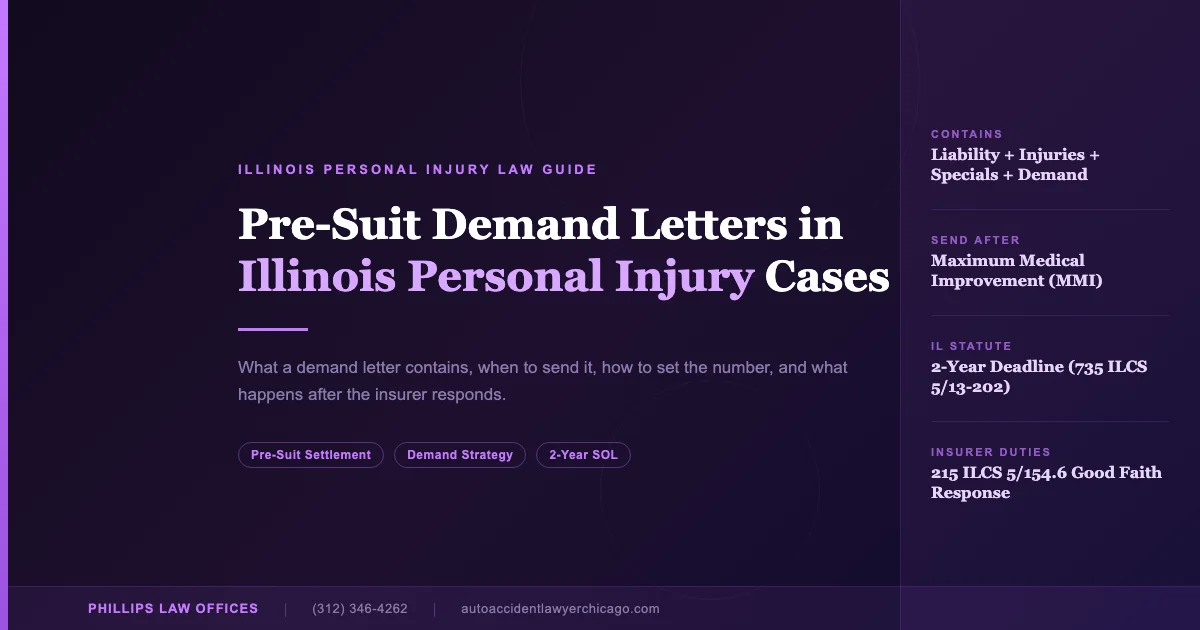
  • Pre-Suit Demand Letters in Illinois Personal Injury Cases โ€” What They Are and How They Work

    Pre-Suit Demand Letters in Illinois Personal Injury Cases โ€” What They Are and How They Work

    Short answer: A demand letter is a written settlement demand sent to the at-fault party’s insurance company that sets out liability, your injuries, medical bills, lost wages, and a specific dollar amount you are willing to accept to resolve the case. Most Illinois personal injury cases begin here — before any lawsuit is filed — and most settle during or shortly after this phase.

    I describe the demand letter to clients as the opening move in a negotiation, not a final offer. It is the first time you put a number on paper and hand it to the insurer. Everything that follows — their response, the counter, the back-and-forth, and ultimately the settlement or the lawsuit — flows from how well that letter is built. A poorly drafted demand letter signals to the adjuster that the claimant does not understand their own case. A well-drafted one signals the opposite: that this claim is documented, legally grounded, and ready to go to court if necessary.

    What a Demand Letter Contains

    A demand letter in an Illinois personal injury case is a structured document, not a complaint letter. It serves a legal and strategic function, and every section is there for a reason. Missing a section or underbuilding it gives the insurer a reason to lowball or deny.

    ComponentWhat It DoesSupporting Exhibits
    Liability SectionEstablishes that the defendant caused the crash and is legally responsiblePolice report, witness statements, photos, traffic citations
    Injury SummaryDescribes each injury, how it was diagnosed, and its impact on daily functionER records, specialist notes, MRI/CT reports
    Medical SpecialsItemizes every medical bill related to the crashItemized billing statements from all providers
    Lost WagesDocuments income lost due to the injury and recoveryPay stubs, employer letter, tax records
    Pain and SufferingArticulates non-economic harm in human termsJournal entries, photos, family/friend accounts
    Future DamagesProjects ongoing care costs and future lost income if injuries are permanentPhysician opinion letters, vocational assessments
    Total DemandStates the specific dollar amount demanded to settle the claimSummary calculation referencing all above

    The demand letter is sent with a complete exhibits package. An adjuster reading a bare demand letter with no supporting documentation will offer less and delay more. The documentation is not a courtesy — it is the case.

    When to Send the Demand Letter

    The timing of a demand letter is one of the most important strategic decisions in any Illinois personal injury case. Send it too early and you leave money on the table. Send it too late and you create problems.

    Too early means you have not reached maximum medical improvement (MMI) — the point at which your treating physicians believe your condition has stabilized. If you send a demand before MMI and settle the case, you release all future claims. If your injury turns out to require surgery or has long-term consequences, you have permanently closed your claim at a fraction of its actual value.

    Too late means you are cutting into the time needed for negotiation, filing suit if necessary, and still resolving the case before Illinois’s two-year statute of limitations under 735 ILCS 5/13-202. Most experienced Illinois personal injury attorneys send demands at least six to nine months before the limitations deadline to preserve room for negotiations and litigation if needed.

    The right time is after MMI, once all medical records and bills have been gathered, all lost wage documentation has been collected, and your attorney has a complete picture of your damages. This is typically several months after your last active treatment, but it varies by case.

    Setting the Demand Amount — High vs. Realistic

    The demand number is not a ceiling — it is the opening of a negotiation. Setting it well requires understanding what the case is actually worth and what number creates useful leverage without making the insurer dismiss the demand outright as unreasonable.

    There are two schools of thought among Illinois plaintiffs’ attorneys. The first is to demand a figure that is significantly above expected settlement value — sometimes two to three times the realistic range — to create maximum room for negotiation. The second is to demand a figure that is high but defensible, grounded in comparable Illinois verdicts and settlements, to signal credibility and move the negotiation forward efficiently.

    The right approach depends on the strength of liability, the severity of injuries, the policy limits available, and the specific adjuster and carrier involved. An experienced Illinois personal injury attorney will know which approach fits your case. What you should never do is set the demand at or near what you actually need to recover — that leaves you with nowhere to negotiate.

    The demand number is not a ceiling — it opens a negotiation. Set it too low and it becomes a ceiling. You cannot walk the number back up once the insurer has a written figure in their file that is lower than what you need to recover. The demand must give you room to move down while still landing above your minimum acceptable outcome.

    What Happens After You Send the Demand

    Once the demand letter is sent, the insurance company has a period to respond. Illinois’s Unfair Claims Practices statute at 215 ILCS 5/154.6 requires insurers to acknowledge claims promptly, investigate in good faith, and not delay settlement offers unreasonably. The statute does not specify a hard deadline for responding to a pre-suit demand, but most carriers respond within 30 to 60 days in routine cases.

    When the insurer responds, one of four things happens:

    • They accept the demand. This is rare at full demand value but occasionally happens when liability is clear, injuries are severe, and the demand is reasonable relative to policy limits.
    • They make a counter-offer. This is the most common response. The counter is typically well below the demand and begins the negotiation. Multiple rounds of offers and counter-offers often follow.
    • They dispute liability or coverage. The insurer may push back on who was at fault, argue comparative negligence, or raise a coverage issue. These disputes often require additional investigation or — if not resolved — litigation.
    • They ignore or delay. Some carriers stall. This is a bad-faith risk under 215 ILCS 5/154.6 and it frequently accelerates the timeline to filing suit.

    Your attorney manages this entire phase — maintaining your settlement timeline, evaluating counter-offers, and making the call on when negotiation has run its course and it is time to file. For more on what the overall timeline looks like, see our guide on the Chicago car accident settlement timeline.

    Demand Letters vs. Filing Suit

    The demand letter is not the same as filing a lawsuit. It is a pre-suit communication. Filing suit means your attorney prepares and files a complaint in the appropriate Illinois circuit court, which triggers the formal litigation process — discovery, depositions, motions, and ultimately trial if no settlement is reached.

    Most Illinois personal injury cases settle without ever filing suit. The demand letter and negotiation phase resolves the majority of claims because litigation is expensive and uncertain for both sides. However, the credible threat of litigation is what gives the demand letter its power. An insurer that knows your attorney will file suit if necessary takes the demand more seriously than one dealing with an unrepresented claimant who has never mentioned court.

    When negotiations fail or the insurer’s offer is unreasonably low, filing suit is not a failure — it is the next step in the process. Many of the best Illinois personal injury settlements are reached after suit is filed, often during the discovery period or shortly before trial. To understand how the decision to file affects your claim, see our guide on when to hire a lawyer after a Chicago car accident.


    Frequently Asked Questions

    Can I write my own demand letter?

    You can, but it is rarely in your interest. A self-drafted demand letter signals to the insurer that you are unrepresented, which is valuable information for them. Unrepresented claimants typically recover significantly less than represented ones — not because the law is different, but because adjusters know exactly how to exploit inexperience. A letter that does not include the right legal framework, properly calculated damages, and a credible threat of litigation gives the insurer every reason to offer minimum value. If cost is the concern, remember that Illinois personal injury attorneys work on contingency — no recovery, no fee.

    How long does the insurance company have to respond?

    Illinois’s Unfair Claims Practices Act at 215 ILCS 5/154.6 requires insurers to acknowledge claims promptly and investigate without unreasonable delay, but it does not set a specific hard deadline for responding to a demand letter. In practice, most carriers respond within 30 to 60 days. If an insurer is not responding or is stalling beyond a reasonable period, that delay itself becomes a factor in your case — repeated, documented delays can support a bad-faith argument under 215 ILCS 5/155, which provides for attorney fees and penalties against the insurer.

    What if the insurer offers less than my demand?

    This is the normal outcome of sending a demand. A counter-offer below your demand is the beginning of negotiations, not the end. Your attorney will evaluate the counter, respond with a revised demand or counter, and continue the process until either an acceptable number is reached or it becomes clear that settlement is not achievable without litigation. Never accept the first offer without your attorney’s assessment of whether it represents fair compensation for your specific injuries and circumstances. For help evaluating whether an offer is reasonable, see our guide on how much your Chicago car accident case may be worth.

    Does sending a demand letter start the statute of limitations clock?

    No. The statute of limitations clock starts on the date of the accident, not when the demand letter is sent. Under 735 ILCS 5/13-202, you have two years from the date of the crash to file a lawsuit in Illinois. The demand letter and any negotiations that follow do not toll or extend that deadline. If negotiations drag on and the two-year mark approaches without a settlement, your attorney must file suit to preserve your rights, regardless of where discussions stand. This is why timing the demand well before the limitations deadline matters.

    What if the insurer ignores the demand letter?

    Ignoring a demand letter is a recognized bad-faith practice under Illinois law. Under 215 ILCS 5/154.6, insurers are prohibited from failing to acknowledge claims or failing to respond in a reasonable time. If an insurer does not respond to a demand letter, your attorney’s next step is typically to file suit. The lawsuit creates a legal obligation for the insurer to respond. In cases of egregious delay or bad-faith denial, 215 ILCS 5/155 allows courts to award attorney fees and penalties to the claimant on top of the underlying damages. Check our guide on dealing with insurance adjusters in Illinois for more on how insurers use delay tactics.

    Authoritative Sources

    Related Illinois Injury Guides

    If you have a personal injury claim in Illinois and are ready to begin the settlement process, the attorneys at Phillips Law Offices can evaluate your case, build your demand package, and handle negotiations from start to finish. Call us at (312) 346-4262 for a free consultation. There is no fee unless you recover.

    Related guides on lawsuits and court process

    Talk to a Chicago car accident lawyer. Phillips Law Offices offers a free case review, and there is no fee unless we recover for you. Call (312) 346-4262 or request a free case review.

    This article is general information about Illinois law, not legal advice, and reading it does not create an attorney-client relationship. Illinois law changes; confirm anything you intend to rely on with a licensed Illinois attorney.
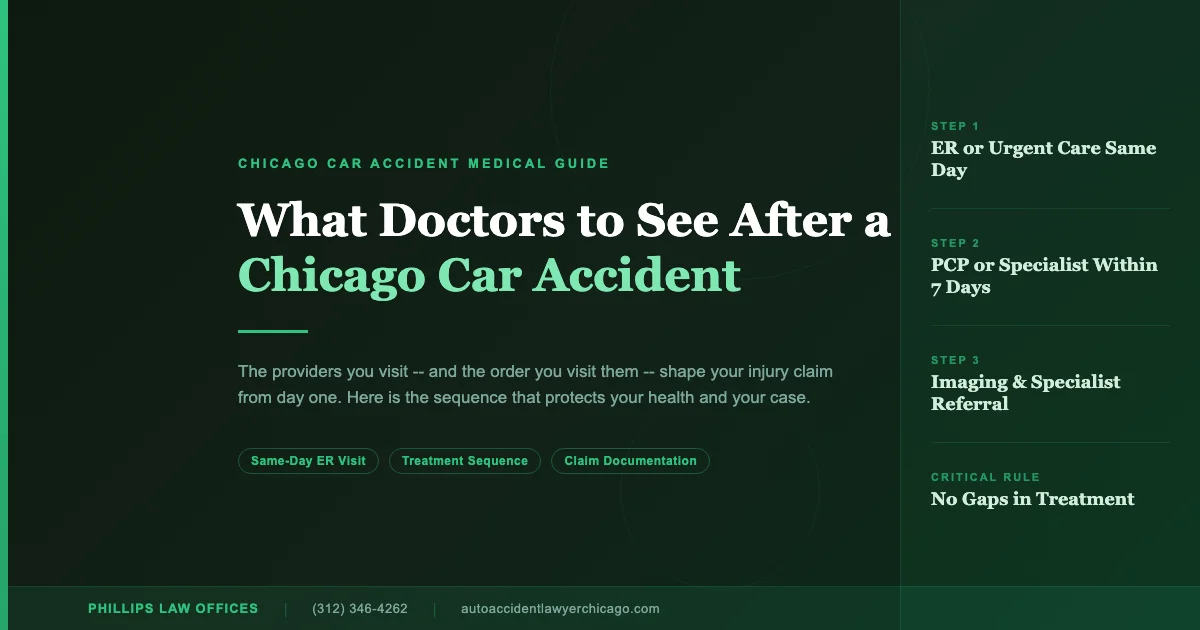
  • What Doctors to See After a Chicago Car Accident โ€” and Why the Order Matters

    What Doctors to See After a Chicago Car Accident โ€” and Why the Order Matters

    Short answer: See the ER or an urgent care the same day as your crash — even if you feel okay. Follow up with your primary care doctor or a specialist within five to seven days. Gaps in treatment are one of the first things insurance adjusters look for, and a delay of even ten days can reduce your settlement value more than the medical visit itself would have cost.

    After handling Chicago car accident cases for more than two decades, I can tell you that the single most common mistake injured people make is not the crash itself — it is what they do in the 72 hours after. They feel sore but functional. They tell themselves to wait and see. Two weeks later they start treating, and the insurer’s first response is: “If you were really hurt, why did you wait?” That gap is now part of your file forever. The sequence of medical care you receive is not just about your health — it is evidence. How you build it determines how much your case is worth.

    Why the Same-Day Visit Is Non-Negotiable

    Illinois insurers are trained to look for gaps between a crash and first medical contact. Under the state’s comparative fault framework at 735 ILCS 5/2-1116, insurers will argue that a claimant who delayed treatment either was not seriously hurt or failed to mitigate their damages. Both arguments reduce your recovery.

    A same-day ER or urgent care visit accomplishes several things at once:

    • It creates a contemporaneous record linking the crash to your injuries
    • It rules out serious conditions (internal bleeding, cervical fractures, traumatic brain injury) that may not cause obvious symptoms immediately
    • It begins the chain of documentation that your attorney will use to build your case
    • It removes the insurer’s most potent early argument against your claim

    Adrenaline is real. Many crash victims feel surprisingly okay at the scene and for hours afterward. Whiplash, concussion symptoms, disc injuries, and soft tissue damage frequently do not present fully until 24 to 48 hours after impact. A same-day visit captures you at your earliest post-crash state, before inflammation and delayed-onset symptoms begin.

    The Treatment Sequence That Supports Your Claim

    Not every doctor visit is equal in the eyes of an insurance adjuster or a jury. The sequence matters almost as much as the treatment itself. A claim that follows a logical, medically defensible progression carries far more weight than one where a claimant skipped directly from the crash to a chiropractor without any diagnostic imaging or primary care evaluation.

    ProviderTimingPurpose in Your Claim
    Emergency Room or Urgent CareSame day as crashDocuments mechanism of injury; rules out emergencies; anchors the timeline
    Primary Care PhysicianWithin 5 to 7 daysContinuing care record; referrals to specialists; ongoing symptom documentation
    Orthopedist or NeurologistWithin 2 to 3 weeks, as directedDiagnostic imaging (MRI, CT); confirms structural injuries that support damages
    Physical Therapist or ChiropractorAfter diagnostic workupFunctional recovery; treatment records show ongoing impact of injuries
    Pain Management SpecialistIf conservative care failsDocuments chronic or escalating pain; supports higher damage valuation

    The key principle is continuity. Each appointment should reference the prior one and connect back to the crash. Gaps in appointment records — even a month-long gap while waiting on a referral — will be flagged by the defense. Your attorney can help address this with written explanations, but it is far better not to create the gap at all.

    Which Specialists Matter and When to See Them

    Orthopedic surgeon. If you have neck or back pain, shoulder injuries, or extremity fractures, an orthopedic evaluation is typically the first specialist referral. They order MRIs and CTs that can confirm disc herniations, rotator cuff tears, and other structural damage that soft tissue claims are built on. Without imaging, an insurer can argue your pain is subjective and unsupported.

    Neurologist. Head trauma, loss of consciousness, persistent headaches, cognitive changes, or tingling and numbness in the extremities all warrant a neurological evaluation. Traumatic brain injuries and nerve damage are among the most undervalued injuries in car accident claims — and among the most consequential to your life. A neurologist’s documented findings are difficult for an insurer to minimize.

    Pain management specialist. If you are still in significant pain after several months of conservative treatment, a pain management referral signals to the insurer and any jury that your injuries are not minor and may be permanent or long-term. This specialist can also evaluate the need for injections, nerve blocks, or surgical consultation, each of which substantially affects your damages calculation.

    Mental health provider. Post-traumatic stress, anxiety about driving, and depression following a serious crash are real and compensable under Illinois law. A psychiatric or psychological evaluation creates the documentation needed to claim these non-economic damages. Many clients overlook this entirely, leaving recoverable damages on the table.

    Chiropractic and Physical Therapy — What Insurers Say

    Chiropractic care is one of the most common treatments for soft tissue injuries from car crashes. Illinois insurers are familiar with it and have formed views about it. Here is what you need to know.

    Chiropractors provide legitimate, well-documented treatment for whiplash and spinal soft tissue injuries. Their records are admissible evidence and their bills are compensable medical specials. However, insurers and defense attorneys will try to minimize chiropractic-only claims by arguing that the lack of diagnostic imaging means the injuries were not structural and were therefore minor.

    The solution is not to avoid chiropractic care — it is to combine it with medical doctor evaluation and imaging. A claim that includes ER records, an MRI ordered by an orthopedist showing a disc herniation, and then a course of chiropractic and physical therapy to treat that confirmed injury is a strong claim. Chiropractic records alone, without any medical doctor involvement or imaging, are an easier target for the defense.

    Physical therapy operates somewhat differently. PT is typically prescribed by a physician and follows a structured plan of care. Insurers generally view PT records as strong evidence of both injury and recovery effort. The key is that the therapy must be consistent with the documented injury — a patient who treats twice a week for four months for a “minor strain” will face questions about medical necessity.

    A 10-day gap between the crash and your first medical appointment will cost you more in settlement value than that appointment would have cost you in time and copay. Insurers document these gaps immediately and use them in every negotiation. The gap is never explainable enough — it is always better not to have one.

    Independent Medical Exams — The Defense’s Doctor

    At some point in a contested injury claim, the insurance company will request that you attend an Independent Medical Exam, commonly called an IME. Despite the name, there is nothing independent about it. The examining physician is hired and paid by the defense, and their report almost always finds one of three things: your injuries are minor, your injuries preexisted the crash, or your injuries have resolved and you need no further treatment.

    You should never attend an IME without first consulting your attorney. You are generally required to cooperate with a reasonable IME request under Illinois law, but the scope of what is reasonable, the timing, the location, and the conditions under which it occurs are all negotiable with legal representation. Your attorney can often have a representative present or obtain the physician’s prior opinions in similar cases.

    Your own treating physicians’ records carry far more weight than an IME report when there is a long, consistent treatment record that predates the defense exam. This is another reason why building a complete treatment record from day one is critical — it is the best counter to a one-day IME designed to minimize your claim. For a deeper look at how IMEs work in Illinois, see our guide on Independent Medical Exams in Illinois Auto Cases.


    Frequently Asked Questions

    Do I have to go to the ER if I feel fine?

    You do not legally have to, but skipping the ER is one of the most costly decisions crash victims make. Adrenaline masks pain in the immediate aftermath of a crash, and many serious injuries — whiplash, disc herniations, concussions — take 24 to 72 hours to become symptomatic. If you feel “okay” but later develop pain and have no same-day medical record, the insurer will argue your injuries came from something else, or that they are minor because you didn’t seek immediate care. Going to the ER the same day creates the record your claim depends on.

    Can I see a chiropractor instead of a medical doctor?

    You can, but you should not do it exclusively if you want to maximize your claim. Chiropractic care is compensable and legitimate, but claims that involve only chiropractic records and no medical doctor evaluation or diagnostic imaging are routinely minimized by insurers. The stronger approach is to start with the ER or your primary care physician, get a referral for imaging, and then pursue chiropractic or physical therapy as part of a medically supervised treatment plan.

    What happens at an independent medical exam?

    An IME is an examination requested by the insurance company and performed by a doctor of their choosing. The exam typically lasts 15 to 30 minutes. The physician will ask about your symptoms, review your prior records, and conduct a brief physical examination. They will then submit a written report to the insurer. These reports almost always minimize the claimant’s injuries or attribute them to preexisting conditions. Do not attend an IME without speaking to your attorney first.

    What if I cannot afford treatment?

    Affordability is a genuine concern, but it is not a barrier to care in most Illinois car accident cases. Medical providers who treat crash victims routinely work on medical liens — they provide treatment now and are repaid from your settlement proceeds at the end of the case. Your attorney can help arrange lien-based care with qualified physicians, specialists, and imaging centers. Illinois law also gives lienholding providers specific rights under the Health Care Services Lien Act (770 ILCS 23/). You can also use your own health insurance for treatment costs. For more on how this works, see our guide on Medical Liens in Chicago Auto Accident Cases.

    Will the at-fault driver’s insurance pay my medical bills as I go?

    Generally, no. The at-fault driver’s liability insurer does not pay your medical bills on an ongoing basis during your treatment. They pay once, at the end of the claim, as part of a lump-sum settlement or jury verdict. Illinois is a tort state, not a no-fault state, which means you are responsible for managing your care costs during the case. Options include your own health insurance, medical liens, and — if you have it — your own MedPay coverage. This is one more reason to have an attorney manage the process so nothing falls through the cracks.

    Authoritative Sources

    Related Illinois Injury Guides

    If you were injured in a Chicago car accident, the doctors you see and the sequence in which you see them will shape your claim from the first day to the last. At Phillips Law Offices, we have guided Chicago accident victims through this process for decades. Call us at (312) 346-4262 for a free consultation. There is no fee unless you recover.

    For an overview of how Illinois car accident claims work and how the firm handles them, see our Chicago car accident lawyer page.

    Related guides on injuries and medical treatment

    Talk to a Chicago car accident lawyer. Phillips Law Offices offers a free case review, and there is no fee unless we recover for you. Call (312) 346-4262 or request a free case review.

    This article is general information about Illinois law, not legal advice, and reading it does not create an attorney-client relationship. Illinois law changes; confirm anything you intend to rely on with a licensed Illinois attorney.

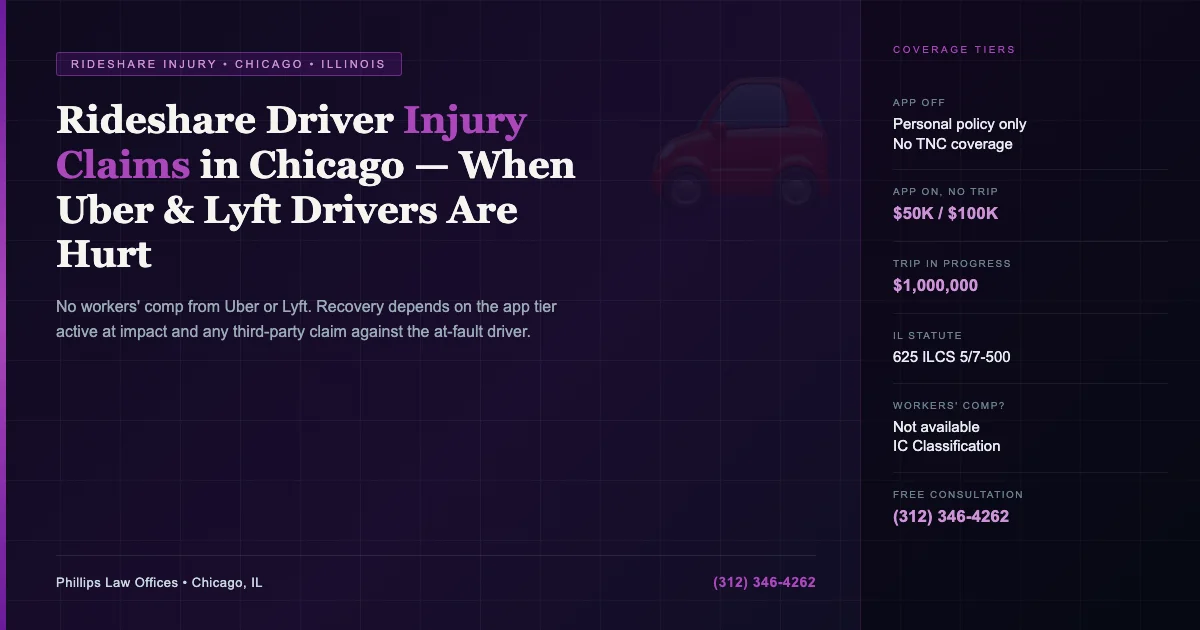
  • Rideshare Driver Injury Claims in Chicago โ€” When Uber and Lyft Drivers Are Hurt

    Rideshare Driver Injury Claims in Chicago โ€” When Uber and Lyft Drivers Are Hurt

    Short answer: Uber and Lyft classify their drivers as independent contractors, not employees, which means injured rideshare drivers have no access to workers’ compensation from the company. Recovery after an on-the-job crash comes from two sources: the TNC’s commercial insurance tiers (which vary depending on whether the app was on and whether a trip was active) and any third-party liability claim against the at-fault driver. Understanding which tier applies to your specific moment of injury is the key to knowing what you can recover.

    The independent contractor classification is one of the most consequential legal fictions in the gig economy. I hear it described as a gap by clients who were driving for Uber or Lyft when they were hurt, but in practice it is more accurate to describe it as a design feature. The structure that prevents drivers from accessing workers’ comp is not accidental. It is built into the business model. What it means for you, practically, is that your path to recovery runs through the commercial insurance tiers, your own coverage, and any fault-based claim against whoever caused the crash.

    Independent Contractor vs. Employee: Why It Matters

    In Illinois, employees injured on the job have access to workers’ compensation benefits regardless of fault. Medical bills, a portion of lost wages, and rehabilitation costs are all covered through the employer’s workers’ comp policy. That system does not apply to independent contractors.

    Uber and Lyft have consistently maintained in Illinois courts and regulatory proceedings that their drivers are independent contractors, not employees. While that classification is being challenged in various states, Illinois law as currently applied does not treat rideshare drivers as employees for workers’ compensation purposes. The consequence is that if you are hurt while driving for Uber or Lyft, you cannot file a workers’ comp claim against the company. You are left to pursue recovery through other channels.

    This is not a minor distinction. Workers’ compensation provides no-fault coverage. The commercial insurance tier system that applies to rideshare drivers is fault-based, meaning your recovery depends on proving who caused the accident and what their insurance covers at the exact moment of your injury.

    Uber and Lyft Insurance Coverage for Drivers

    Both Uber and Lyft maintain commercial auto insurance that covers drivers, but the coverage is structured in tiers based on the status of the app and whether a trip was in progress at the moment of the crash. The tiers are not equivalent, and the distinction between them can mean the difference between $50,000 and $1,000,000 in available coverage.

    App StatusUber Coverage (Driver)Lyft Coverage (Driver)
    App off (personal use)None, personal auto policy onlyNone, personal auto policy only
    App on, no trip accepted$50,000/person, $100,000/accident, $25,000 property; contingent comprehensive/collision$50,000/person, $100,000/accident, $25,000 property; contingent comprehensive/collision
    Trip accepted or in progress$1,000,000 third-party liability; uninsured/underinsured motorist; contingent comprehensive/collision ($1,000 deductible)$1,000,000 third-party liability; uninsured/underinsured motorist; contingent comprehensive/collision ($2,500 deductible)

    The tier you fall into is determined by a timestamp logged in the app at the exact moment of the crash. Uber and Lyft both have records of this. In disputed cases, that data becomes a central issue in the claim.

    When the App Is On vs. Off: Coverage Tiers Explained

    If your app was completely off at the time of the accident, you were using your vehicle as a private driver. Uber and Lyft owe you nothing. Your personal auto policy is the only coverage that applies, and standard personal auto policies often exclude commercial use. This means you may be driving without any effective coverage during personal time if your insurer knows you drive for a TNC and your policy has not been updated accordingly.

    If the app was on but you had not yet accepted a ride request, the intermediate tier applies. Uber and Lyft both provide $50,000 per person and $100,000 per accident in third-party liability coverage during this period. This is substantially higher than Illinois’s mandatory minimums but far below the full commercial policy that activates once a trip begins.

    Once you have accepted a trip request and are en route to pick up a passenger, or are actively transporting a passenger, the full $1,000,000 commercial policy is in effect. This is the tier that provides the most meaningful coverage for serious injuries.

    Third-Party Claims Against the At-Fault Driver

    The TNC insurance tiers described above cover claims against the TNC’s policy, but if another driver caused your accident, you also have a separate fault-based claim against that driver and their insurer. This is a third-party claim, and it operates independently of the TNC coverage.

    If the at-fault driver is underinsured, the TNC’s uninsured/underinsured motorist coverage (available during active trips) may provide additional recovery. Stacking these coverages requires careful coordination to avoid subrogation pitfalls and ensure you are not inadvertently waiving rights against one insurer while pursuing another.

    The third-party claim is often the most important source of recovery in driver injury cases. It requires proving the other driver’s negligence, documenting your injuries, and negotiating with their insurer or filing suit. This process is identical to any other Illinois car accident claim, with the added complexity of coordinating with TNC coverage.

    Attorney insight: The independent contractor classification that denies rideshare drivers workers’ comp benefits is being actively challenged in California, Massachusetts, and other states. In Illinois today, however, the classification stands, and injured rideshare drivers must work within the TNC commercial coverage tiers and fault-based third-party claims. The good news is that when a trip was in progress, the $1,000,000 commercial policy provides substantial room for recovery in serious injury cases. The challenge is coordinating those claims without inadvertently compromising your rights.

    Illinois Law on TNC Coverage

    Illinois regulates Transportation Network Companies under 625 ILCS 5/7-500 et seq., the Transportation Network Providers Act. This statute establishes the insurance requirements that Uber, Lyft, and other TNCs operating in Illinois must meet. The law mandates the tiered coverage structure described above and requires TNCs to maintain primary liability coverage when a driver is logged into the app.

    The Illinois Insurance Code at 215 ILCS 5/ also applies to how commercial insurers are required to process and respond to claims under these commercial policies. Knowing both the TNC-specific statute and the general insurance code provisions helps identify when an insurer is acting in bad faith or improperly delaying your claim.

    Illinois also requires that TNC commercial coverage be primary, meaning it applies before any personal auto policy the driver carries. This matters because some personal auto insurers have tried to disclaim coverage based on commercial use exclusions, then argued that their policy should apply anyway when it benefits the insurer. The statute resolves this by establishing the priority of coverage clearly.

    Steps After Being Injured as a Rideshare Driver

    The steps you take immediately after being hurt while driving for Uber or Lyft affect your ability to recover. Here is what matters most in the immediate aftermath and in the days that follow.

    • Document the app status at the time of the crash. Take a screenshot if possible, or note the trip details before the session closes. The app status at the exact moment of impact determines which coverage tier applies.
    • Report the accident through the Uber or Lyft app as required by their driver agreements. Failure to report through the proper channel can complicate the claim process later.
    • Get medical attention immediately, even if injuries seem minor. Rideshare driving involves repetitive use of your vehicle and physical vulnerability in traffic. Soft tissue injuries and whiplash can become serious over days.
    • Document the scene. Photograph the vehicles, the intersection, any road conditions, and the other driver’s information and insurance card.
    • Notify your personal auto insurer, but do not make a recorded statement to any insurance company before consulting an attorney.
    • Preserve all records related to your driving activity, including trip logs, earnings records, and any communications from Uber or Lyft related to the accident.

    Frequently Asked Questions

    Does Uber or Lyft provide workers’ compensation for drivers?

    No. Uber and Lyft classify their drivers as independent contractors rather than employees. In Illinois, workers’ compensation benefits are available only to employees. Because rideshare drivers are not treated as employees under current Illinois law, they have no access to workers’ compensation through Uber or Lyft. Recovery after a crash must come from the TNC’s commercial insurance tiers and any third-party claim against the at-fault driver.

    What if I was injured and the app was off at the time?

    If the Uber or Lyft app was completely off when the accident occurred, you were using your vehicle as a private driver and neither TNC owes you any coverage. Your personal auto policy is your only source of coverage for that accident. Be aware that many standard personal auto policies contain commercial use exclusions, so if you regularly drive for a TNC, you should verify that your personal policy covers you during non-app time.

    Can I sue Uber or Lyft directly for my injuries?

    Direct negligence claims against Uber or Lyft as corporations are difficult but not impossible. Because they maintain the independent contractor classification, they are generally not vicariously liable for driver negligence under respondeat superior. However, claims based on the company’s own negligence, such as failure to screen drivers, failure to maintain adequate insurance, or knowing placement of an unfit driver, may be viable in specific circumstances. An attorney can assess whether a direct claim against the TNC is appropriate based on the facts of your case.

    What coverage applies between trips when the app is on?

    When you are logged into the Uber or Lyft app but have not yet accepted a ride request, the intermediate coverage tier applies. Both TNCs provide $50,000 per person and $100,000 per accident in third-party liability coverage, plus $25,000 for property damage, during this “app on, no trip” period. This is substantially more than Illinois’s statutory minimums but significantly less than the $1,000,000 commercial policy that activates when a trip is accepted or in progress.

    Do I need my own commercial auto policy as a rideshare driver?

    Many insurance professionals recommend that rideshare drivers carry a rideshare endorsement on their personal auto policy or purchase a standalone commercial policy. Standard personal auto policies often exclude commercial use, which creates a gap in coverage during the intermediate tier period or when the app is off. A rideshare endorsement fills that gap at relatively low additional cost. Some insurers also offer policies specifically designed for TNC drivers that coordinate with the Uber or Lyft commercial coverage tiers.

    Authoritative Sources

    • 625 ILCS 5/7-500 et seq., Illinois Transportation Network Providers Act (TNC insurance requirements and driver coverage obligations)
    • 215 ILCS 5/, Illinois Insurance Code (insurer obligations and commercial policy requirements)

    Related Illinois Injury Guides

    If you were injured while driving for Uber or Lyft in Chicago, the Phillips Law Offices team can help you understand which coverage tiers apply, coordinate claims across multiple insurers, and build a full picture of your available recovery. Call us at (312) 346-4262 for a free consultation.

    Which policy pays in a rideshare crash depends on what the app was doing. See our Chicago rideshare accident lawyer page.

    Related guides on rideshare and for-hire vehicle claims

    Talk to a Chicago rideshare accident lawyer. Phillips Law Offices offers a free case review, and there is no fee unless we recover for you. Call (312) 346-4262 or request a free case review.

    This article is general information about Illinois law, not legal advice, and reading it does not create an attorney-client relationship. Illinois law changes; confirm anything you intend to rely on with a licensed Illinois attorney.

  • Allstate Commercial and Business Auto Claims After a Chicago Car Crash

    Allstate Commercial and Business Auto Claims After a Chicago Car Crash

    Short answer: Commercial and business auto policies issued by Allstate carry higher liability limits than personal auto policies, but they also come with more aggressive corporate defense teams, multiple potential defendants (the driver, the employer, and often the vehicle owner), and claims processes designed to protect business assets rather than compensate injured people. If you were hit by an Allstate-insured commercial vehicle in Chicago, the rules are different, and so is the strategy you need.

    I want to be upfront about something. When I talk to clients who have been hit by a commercial vehicle, delivery van, or company car, there is often genuine surprise when they discover that the claim works nothing like a typical car accident case. The driver may be insured under a business policy they know little about. The employer may be a named insured. And Allstate’s commercial claims unit will often respond faster and more aggressively than the personal auto claims side ever would. That is not paranoia. That is how commercial claims work, and understanding it gives you a real advantage.

    Commercial Auto vs. Personal Auto: Key Differences

    Most people assume that all auto insurance works the same way. You file a claim, the adjuster evaluates it, and you receive a settlement. Commercial auto policies share some of that surface structure, but the underlying economics and legal dynamics are sharply different.

    FactorPersonal Auto ClaimCommercial Auto Claim
    Typical policy limits$25,000โ€“$100,000 per person$500,000โ€“$1,000,000+ (often CSL)
    Potential defendantsAt-fault driverDriver, employer, vehicle owner, lessor
    Defense resourcesStandard adjuster and counselCorporate legal team, retained defense firms
    Time to resolveWeeks to monthsOften 12โ€“24+ months for contested cases

    Commercial policies are purchased by businesses to protect their financial interests in the event an employee causes a crash while operating a company vehicle. When Allstate underwrites a commercial policy, the business owner is the named insured. That means the business, not just the driver, is the policyholder, and Allstate’s obligation runs to that business first.

    Who Is Liable: Driver, Employer, and Vehicle Owner

    One of the most important differences in commercial crash cases is that liability can extend well beyond the person behind the wheel. Under Illinois law, there are three distinct theories that may apply depending on the facts of your case.

    First, the driver remains personally liable for their own negligence, just as in any accident. If the driver ran a red light or was distracted, that is direct negligence. Second, the employer may be liable under respondeat superior, which imposes liability on a business for the negligent acts of its employees committed within the scope of their employment. Third, the vehicle owner may be independently liable under Illinois’s owner liability statute, 625 ILCS 5/7-317, which creates liability when a vehicle is operated with the owner’s permission.

    In a typical commercial vehicle case, all three theories apply simultaneously. That means you may be pursuing claims against the driver individually, the business entity, and potentially a vehicle leasing company, all within a single lawsuit.

    Allstate’s Commercial Claims Process

    Allstate handles commercial claims through a separate business insurance division that operates differently from the personal auto claims side. When a commercial claim is reported, a dedicated commercial claims adjuster is assigned. That adjuster is trained to evaluate claims with business liability exposure in mind, not to make the process easy for injured parties.

    Expect Allstate’s commercial team to request a recorded statement early. They may also investigate the driver’s employment status, whether the driver was acting within the scope of their job at the time of the crash, and whether any maintenance issues with the vehicle contributed to the accident. These are not procedural formalities. They are information-gathering steps designed to build a defense.

    Before you give any recorded statement to Allstate’s commercial claims unit, speak with an attorney. The information you provide will be used to frame the defense narrative, and commercial cases often involve early investigation by surveillance or accident reconstruction professionals.

    Attorney insight: Commercial claims are not just bigger personal auto claims. They involve corporate defense teams with institutional knowledge of how to minimize exposure on high-limit policies. Surveillance often begins within days of the accident. Your social media, daily routine, and medical appointments may all be monitored. A different strategy is required from day one, and that starts with not volunteering information before you understand the full scope of who is on the other side.

    Higher Policy Limits and What That Means for Your Claim

    The existence of higher policy limits is genuinely good news if your injuries are serious. Commercial auto policies often carry combined single limits of $500,000, $1,000,000, or even higher for large fleets. If a driver with a standard Illinois minimum policy hit you, your recovery might be limited by that $25,000 per-person floor even in catastrophic cases. Commercial policies remove that ceiling in most serious injury scenarios.

    But higher limits also mean higher stakes for the insurer and the business. A $1,000,000 claim gets very different treatment than a $25,000 claim. Allstate’s commercial side will invest significantly more in defense, investigation, and delay when the potential payout is substantial. This is why commercial cases frequently take longer to resolve and why the litigation phase matters more.

    Medical documentation, treatment continuity, expert witnesses, and detailed damages calculations all become more important when the policy limits create room for a full recovery. A skilled Illinois injury attorney can help you build the kind of case that holds up against a corporate defense team with significant resources.

    Respondeat Superior and Negligent Entrustment in Illinois

    Respondeat superior is a Latin phrase that means “let the master answer.” Under this common law doctrine, an employer is vicariously liable for the torts of an employee committed within the scope of employment. In Illinois, courts have consistently applied this doctrine to commercial vehicle accidents where the driver was performing job duties at the time of the crash.

    The key questions are: Was the driver an employee (not an independent contractor)? Was the driver acting within the scope of their employment at the time? If the driver was making a delivery, transporting equipment, or performing any task assigned by the employer, respondeat superior almost certainly applies.

    Negligent entrustment is a separate but related theory. Under this doctrine, the vehicle owner can be independently liable if they entrusted a vehicle to a driver they knew, or should have known, was unfit to drive. This might apply if the driver had a history of violations, a suspended license, or prior accidents that the employer knew about but ignored. Negligent entrustment claims require evidence of the employer’s actual or constructive knowledge of the driver’s unfitness.

    Both theories are authorized under Illinois law and can be pleaded simultaneously. The Illinois Insurance Code at 215 ILCS 5/ governs how commercial insurers like Allstate must respond to claims, and 625 ILCS 5/7-317 creates the statutory basis for owner liability in vehicle accident cases.


    Frequently Asked Questions

    What is the difference between an Allstate personal and commercial auto policy?

    A personal auto policy covers an individual’s private use of a vehicle. A commercial auto policy is purchased by a business to cover vehicles used in business operations. Commercial policies typically carry significantly higher liability limits, list the business as the named insured, and are subject to different underwriting and claims handling procedures. When a crash involves a commercial vehicle, the insurer’s obligations, the available coverage, and the potential defendants are all different from a standard personal auto claim.

    Can I sue both the driver and the employer after a commercial vehicle crash?

    Yes. Illinois law permits claims against the driver individually for their own negligence and against the employer under respondeat superior if the driver was acting within the scope of their employment at the time of the crash. You can name both as defendants in a lawsuit and pursue recovery from both. The vehicle owner may also be named as a defendant under Illinois’s owner liability statute. An attorney can help you identify all responsible parties before filing.

    What is respondeat superior?

    Respondeat superior is a common law legal doctrine that holds employers vicariously liable for the negligent acts of their employees committed within the scope of employment. In a commercial vehicle accident context, if the driver was performing job duties at the time of the crash, the employer can be held liable for the driver’s negligence even if the employer did nothing wrong independently. This doctrine is well established under Illinois law and regularly applied in commercial vehicle injury cases.

    Do commercial auto policies have higher limits than personal auto policies?

    Generally, yes. Illinois law requires minimum personal auto liability coverage of $25,000 per person and $50,000 per accident. Commercial auto policies often carry combined single limits of $500,000 to $1,000,000 or more, particularly for fleets, delivery operations, and larger businesses. The higher limits can make a significant difference in serious injury cases where medical expenses, lost wages, and other damages exceed what a personal auto policy would cover.

    How long do commercial auto claims take to settle?

    Commercial claims typically take longer to resolve than personal auto claims. Cases involving significant injuries and high policy limits may take 12 to 24 months or more, particularly if litigation is required. The insurer and employer have financial incentives to delay and minimize, and corporate defense teams are often experienced at extending the process. Completing your medical treatment before settling, understanding the full scope of your damages, and having experienced legal representation all affect how efficiently a case moves toward resolution.

    Authoritative Sources

    • 215 ILCS 5/, Illinois Insurance Code (governing insurer obligations and commercial auto coverage requirements)
    • 625 ILCS 5/7-317, Illinois Vehicle Code (owner liability for permissive use of a vehicle)
    • Respondeat superior doctrine, Illinois common law as applied in commercial vehicle negligence cases

    Related Illinois Injury Guides

    If you were injured by an Allstate-insured commercial or business vehicle in Chicago, the Phillips Law Offices team can evaluate your claim, identify all responsible parties, and build a strategy designed for the commercial claims environment. Call us at (312) 346-4262 for a free consultation.

    Related guides on dealing with the insurance company

    Talk to a Chicago car accident lawyer. Phillips Law Offices offers a free case review, and there is no fee unless we recover for you. Call (312) 346-4262 or request a free case review.

    This article is general information about Illinois law, not legal advice, and reading it does not create an attorney-client relationship. Illinois law changes; confirm anything you intend to rely on with a licensed Illinois attorney.
  • Construction Site Vehicle Crashes in Chicago โ€” Liability and Injury Claims

    Construction Site Vehicle Crashes in Chicago โ€” Liability and Injury Claims

    Short answer: Construction site vehicle crashes in Chicago can involve multiple responsible parties, the general contractor, a subcontractor, the equipment owner, the vehicle operator, or the property owner. If you were injured by a construction vehicle on a public road or a worksite, you may have claims against more than one defendant and may be entitled to compensation beyond what workers’ compensation alone provides. Illinois law allows injured construction workers and bystanders to pursue third-party personal injury claims in addition to, or instead of, workers’ comp benefits. Getting an attorney involved early is critical because evidence disappears fast on active job sites.

    Multi-Party Liability in Chicago Construction Vehicle Cases

    At Phillips Law Offices, I handle construction site vehicle crash cases throughout Chicago and Cook County. These cases are among the most legally complex injury matters I work on, not because the facts are obscure, but because the web of contracts, insurance policies, and overlapping liability rules requires careful navigation from day one. A dump truck that backs into a worker may be owned by a subcontractor, operated by a temp agency employee, insured through a commercial fleet policy, and working under a general contractor’s site safety plan, all simultaneously. Every one of those layers is a potential source of compensation, and every one of those parties will have lawyers protecting their interests the moment an injury is reported. You need someone protecting yours.

    Types of Construction Vehicle Accidents in Chicago

    Construction vehicle crashes in the Chicago area fall into several distinct categories, each with its own liability dynamics:

    • Dump trucks and cement mixers on public roads. Heavy vehicles entering and exiting job sites pose risks to passing drivers and cyclists. If a construction truck failed to yield, lacked proper signage, or was overloaded, the trucking company and the general contractor responsible for site traffic management may both be liable.
    • Forklifts and warehouse vehicles inside worksites. Forklift accidents are among the most common construction site injuries in Illinois. OSHA’s powered industrial truck standards at 29 CFR 1926.602 govern forklift operation on construction sites. Violations of those standards establish negligence.
    • Cranes and aerial lifts. Crane swing strikes, boom collapses, and aerial lift tip-overs cause catastrophic injuries. Equipment maintenance records, load certifications, and operator training documentation are critical evidence in these cases.
    • Excavators and bulldozers near pedestrians. Heavy earthmoving equipment operates in areas that may be inadequately cordoned from bystanders or from workers in adjacent areas. Poor site organization and inadequate spotting procedures are common contributing factors.
    • Delivery and supply vehicles on active job sites. Vendors delivering lumber, rebar, or equipment often enter sites without formal safety orientation. When a delivery driver’s vehicle injures a worker, the delivery company may carry independent commercial auto liability.
    • Roadway construction vehicle strikes. Workers in Illinois highway construction zones are protected by enhanced penalties under Illinois Vehicle Code provisions, but crashes still happen. Both the contracting company and the striking driver may be liable.

    Who Is Liable, Multiple Possible Defendants

    Illinois law allows injured parties to pursue every defendant whose negligence contributed to the crash. Here is how liability typically breaks down in construction vehicle cases:

    Defendant TypeBasis for LiabilityCommon Evidence
    General ContractorOverall site safety responsibility, OSHA compliance, subcontractor supervisionSite safety plan, OSHA citations, daily logs
    SubcontractorDirect operator of vehicle, employer of negligent driver, equipment maintenanceEmployment records, maintenance logs, training certificates
    Equipment Owner (Rental Company)Negligent entrustment if rented to unqualified operator; defective equipment if not maintainedRental agreements, inspection records, service history
    Equipment ManufacturerProduct liability if defective design or manufacturing caused or contributed to the crashRecall records, engineering specifications, incident reports
    Property OwnerPremises liability for unsafe site conditions, failure to require contractor compliance with safety standardsSite lease agreements, property owner safety requirements, prior incident history
    Staffing AgencyVicariously liable if the negligent operator was placed by the agencyStaffing contracts, operator qualifications on file with agency

    Illinois construction workers often assume that workers’ compensation is their only option after a job site vehicle crash. That is rarely true. If any party other than your direct employer caused or contributed to your injury, a subcontractor, an equipment owner, a neighboring contractor, you can file a third-party personal injury lawsuit on top of your workers’ comp claim. Dual recovery is not just possible; in serious injury cases it is often the only way to get full compensation for what you have actually lost.

    Illinois Workers’ Compensation vs. Third-Party Claims

    If you were injured as a construction worker, you may have two separate legal remedies running simultaneously:

    • Workers’ compensation (820 ILCS 305/). Your employer’s workers’ comp covers medical bills and two-thirds of your average weekly wage while you are off work, regardless of fault. Workers’ comp does not cover pain and suffering. You cannot sue your direct employer for negligence, workers’ comp is the exclusive remedy against them.
    • Third-party personal injury lawsuit. If a party other than your direct employer caused your injury, a subcontractor’s driver, an equipment manufacturer, the site owner, you can file a civil lawsuit seeking full compensation including pain and suffering, full lost wages, and future earning capacity. Workers’ comp has a lien on any third-party recovery, but even after satisfying that lien, injured workers typically net significantly more through a combined recovery than through workers’ comp alone.

    If you were a bystander or a driver on a public road struck by a construction vehicle, workers’ compensation does not apply to you at all. Your remedy is a direct personal injury claim against the vehicle operator, the construction company, and any other responsible party.

    OSHA and Illinois Safety Regulations That Establish Negligence

    Violations of OSHA standards and Illinois safety regulations are powerful evidence of negligence in construction vehicle crash cases. Key applicable standards include:

    • OSHA 29 CFR 1926.600-602, Motor vehicles and mechanized equipment on construction sites, including requirements for backup alarms, rollover protection, and operator competency.
    • OSHA 29 CFR 1926.20, General safety and health provisions, requiring contractors to initiate and maintain programs to prevent accidents.
    • OSHA 29 CFR 1926.21, Safety training and education requirements, operators must be trained and competent.
    • 820 ILCS 225/ (Illinois Health and Safety Act), Illinois-specific workplace safety requirements that overlap with and supplement OSHA standards.
    • Illinois Vehicle Code, Standard traffic laws apply to construction vehicles on public roads and site roads that connect to public streets.

    An OSHA citation issued after your crash is not required for a successful civil claim, but it is highly persuasive evidence. Obtaining OSHA inspection records, incident reports, and the employer’s own internal accident investigation is a priority in the first weeks after a serious construction vehicle injury.

    Evidence to Preserve After a Construction Vehicle Crash

    Evidence on construction sites disappears quickly. Vehicles are repaired or returned to rental companies. Job site configurations change daily. Witnesses move to other projects. If you or someone you know has been injured in a construction vehicle crash in Chicago, these are the most time-sensitive evidence items to preserve:

    • Photographs of the scene. Document the vehicle, the area of the crash, any barriers or lack thereof, warning signs, and your injuries before anything is moved or changed.
    • Incident reports. Request a copy of any on-site incident report completed by the general contractor or subcontractor. Under Illinois law, you are entitled to a copy of any report that concerns your injury.
    • OSHA inspection records. If OSHA responded to the incident or inspected the site in the months before your crash, those records are public and can be requested through OSHA’s online portal.
    • Vehicle maintenance and inspection logs. Equipment involved in crashes must be preserved. A legal hold letter sent to all parties puts them on notice not to destroy records. Your attorney can send this immediately after being retained.
    • Witness information. Fellow workers, delivery drivers, and bystanders may move on quickly. Get names and phone numbers before they leave the site.
    • Black box and telematics data. Many commercial construction vehicles have event data recorders or GPS tracking. This data may be overwritten within days unless a preservation demand is sent immediately.
    • Your medical records and work records. Document every treatment, every missed shift, and every out-of-pocket expense from the day of the crash forward.

    Frequently Asked Questions

    Can I sue if I was a construction worker injured on the job?

    Yes, under specific circumstances. Workers’ compensation bars you from suing your direct employer, but it does not prevent you from filing a personal injury lawsuit against any other party who contributed to your injury. In construction vehicle cases, those parties often include subcontractors, equipment owners, rental companies, and site owners. If a co-worker employed by a different company injured you, that company may be a viable defendant. An attorney can map every party’s role on the project against the site’s contract structure to identify who is actually your employer versus who is a third party you can sue.

    What if the construction vehicle had no markings or license plates?

    Unmarked construction vehicles are common on enclosed job sites, and the absence of markings does not eliminate liability. Your attorney will subpoena the general contractor’s equipment inventory, subcontractor contracts, and daily sign-in logs to identify which company owned and operated the vehicle at the time of the crash. Site surveillance cameras, nearby business cameras, and witness accounts can also establish the vehicle’s identity. The general contractor who controlled the job site retains responsibility for ensuring all equipment on the site is properly operated and maintained, regardless of ownership.

    Who pays if an uninsured subcontractor’s vehicle hit me?

    Illinois law requires contractors to carry adequate insurance for their operations, and general contractors often require proof of insurance from every subcontractor as a condition of their contract. If a subcontractor violated that requirement, the general contractor may be directly liable for failing to enforce it. Additionally, the property owner and the project’s umbrella or excess liability policies may provide coverage even when the direct subcontractor is underinsured. If you were in your own vehicle at the time, your own uninsured or underinsured motorist coverage may also apply. These cases require a thorough insurance coverage analysis as an early step.

    How long do I have to file a claim in Illinois?

    For personal injury lawsuits against private parties in Illinois, the statute of limitations is two years from the date of the injury under 735 ILCS 5/13-202. For claims against a government entity, such as a crash involving a city contractor on a public road project, the deadline may be shorter and may require a formal notice of claim before filing suit. Workers’ compensation claims have separate deadlines under 820 ILCS 305/. In every construction vehicle case, two years sounds like a long time but evidence collection, expert retention, and pre-litigation negotiation take months. Starting early is always advantageous.

    What is the Illinois Structural Work Act and does it still apply?

    The Illinois Structural Work Act, which historically imposed strict liability on property owners and general contractors for scaffold and elevation-related injuries, was repealed effective January 1, 1996. It no longer applies to new claims. Some attorneys still encounter references to it in older case law, and historically it was a significant tool for injured construction workers, but current Illinois construction site injury claims rely on general negligence principles, the Illinois Health and Safety Act (820 ILCS 225/), OSHA violations, and the workers’ compensation system. If you have heard about the Structural Work Act in connection with your claim, the applicable legal framework today is different.


    Authoritative Sources

    • 820 ILCS 305/, Illinois Workers’ Compensation Act, governing benefits for injured employees and the exclusive remedy rule
    • 820 ILCS 225/, Illinois Health and Safety Act, establishing Illinois-specific workplace safety requirements for employers and contractors
    • OSHA 29 CFR 1926, Federal OSHA construction industry standards, including subpart O (motor vehicles), subpart N (cranes and derricks), and subpart G (safety training)
    • 735 ILCS 5/13-202, Illinois personal injury statute of limitations (two years from date of injury)

    Related Illinois Injury Guides

    If you or someone you know was injured by a construction vehicle in Chicago, call Phillips Law Offices at (312) 346-4262 for a free consultation. We handle construction vehicle crash cases on a contingency fee basis, no fee unless we recover for you.

    Crashes with commercial vehicles run on different rules and a faster evidence clock. See our Chicago truck accident lawyer page.

    Related guides on truck and commercial vehicle crashes

    Talk to a Chicago truck accident lawyer. Phillips Law Offices offers a free case review, and there is no fee unless we recover for you. Call (312) 346-4262 or request a free case review.

    This article is general information about Illinois law, not legal advice, and reading it does not create an attorney-client relationship. Illinois law changes; confirm anything you intend to rely on with a licensed Illinois attorney.
This will close in 20 seconds


This will close in 20 seconds

Call (312) 346-4262 Free Case Review