
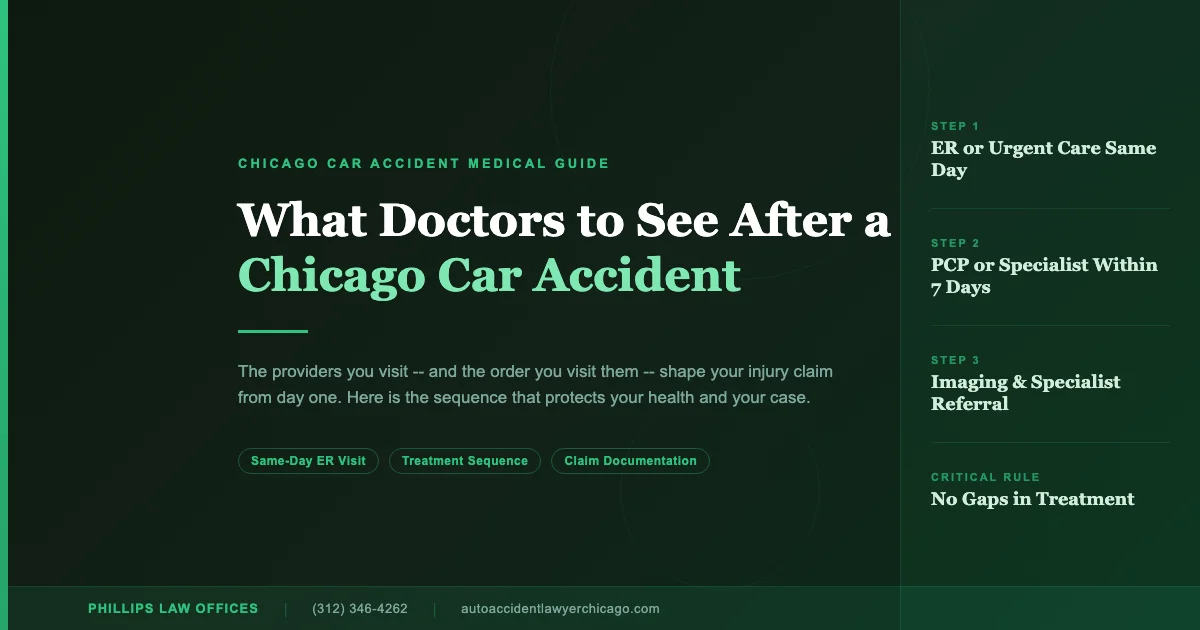
Short answer: See the ER or an urgent care the same day as your crash — even if you feel okay. Follow up with your primary care doctor or a specialist within five to seven days. Gaps in treatment are one of the first things insurance adjusters look for, and a delay of even ten days can reduce your settlement value more than the medical visit itself would have cost.
After handling Chicago car accident cases for more than two decades, I can tell you that the single most common mistake injured people make is not the crash itself — it is what they do in the 72 hours after. They feel sore but functional. They tell themselves to wait and see. Two weeks later they start treating, and the insurer’s first response is: “If you were really hurt, why did you wait?” That gap is now part of your file forever. The sequence of medical care you receive is not just about your health — it is evidence. How you build it determines how much your case is worth.
Why the Same-Day Visit Is Non-Negotiable
Illinois insurers are trained to look for gaps between a crash and first medical contact. Under the state’s comparative fault framework at 735 ILCS 5/2-1116, insurers will argue that a claimant who delayed treatment either was not seriously hurt or failed to mitigate their damages. Both arguments reduce your recovery.
A same-day ER or urgent care visit accomplishes several things at once:
- It creates a contemporaneous record linking the crash to your injuries
- It rules out serious conditions (internal bleeding, cervical fractures, traumatic brain injury) that may not cause obvious symptoms immediately
- It begins the chain of documentation that your attorney will use to build your case
- It removes the insurer’s most potent early argument against your claim
Adrenaline is real. Many crash victims feel surprisingly okay at the scene and for hours afterward. Whiplash, concussion symptoms, disc injuries, and soft tissue damage frequently do not present fully until 24 to 48 hours after impact. A same-day visit captures you at your earliest post-crash state, before inflammation and delayed-onset symptoms begin.
The Treatment Sequence That Supports Your Claim
Not every doctor visit is equal in the eyes of an insurance adjuster or a jury. The sequence matters almost as much as the treatment itself. A claim that follows a logical, medically defensible progression carries far more weight than one where a claimant skipped directly from the crash to a chiropractor without any diagnostic imaging or primary care evaluation.
| Provider | Timing | Purpose in Your Claim |
|---|---|---|
| Emergency Room or Urgent Care | Same day as crash | Documents mechanism of injury; rules out emergencies; anchors the timeline |
| Primary Care Physician | Within 5 to 7 days | Continuing care record; referrals to specialists; ongoing symptom documentation |
| Orthopedist or Neurologist | Within 2 to 3 weeks, as directed | Diagnostic imaging (MRI, CT); confirms structural injuries that support damages |
| Physical Therapist or Chiropractor | After diagnostic workup | Functional recovery; treatment records show ongoing impact of injuries |
| Pain Management Specialist | If conservative care fails | Documents chronic or escalating pain; supports higher damage valuation |
The key principle is continuity. Each appointment should reference the prior one and connect back to the crash. Gaps in appointment records — even a month-long gap while waiting on a referral — will be flagged by the defense. Your attorney can help address this with written explanations, but it is far better not to create the gap at all.
Which Specialists Matter and When to See Them
Orthopedic surgeon. If you have neck or back pain, shoulder injuries, or extremity fractures, an orthopedic evaluation is typically the first specialist referral. They order MRIs and CTs that can confirm disc herniations, rotator cuff tears, and other structural damage that soft tissue claims are built on. Without imaging, an insurer can argue your pain is subjective and unsupported.
Neurologist. Head trauma, loss of consciousness, persistent headaches, cognitive changes, or tingling and numbness in the extremities all warrant a neurological evaluation. Traumatic brain injuries and nerve damage are among the most undervalued injuries in car accident claims — and among the most consequential to your life. A neurologist’s documented findings are difficult for an insurer to minimize.
Pain management specialist. If you are still in significant pain after several months of conservative treatment, a pain management referral signals to the insurer and any jury that your injuries are not minor and may be permanent or long-term. This specialist can also evaluate the need for injections, nerve blocks, or surgical consultation, each of which substantially affects your damages calculation.
Mental health provider. Post-traumatic stress, anxiety about driving, and depression following a serious crash are real and compensable under Illinois law. A psychiatric or psychological evaluation creates the documentation needed to claim these non-economic damages. Many clients overlook this entirely, leaving recoverable damages on the table.
Chiropractic and Physical Therapy — What Insurers Say
Chiropractic care is one of the most common treatments for soft tissue injuries from car crashes. Illinois insurers are familiar with it and have formed views about it. Here is what you need to know.
Chiropractors provide legitimate, well-documented treatment for whiplash and spinal soft tissue injuries. Their records are admissible evidence and their bills are compensable medical specials. However, insurers and defense attorneys will try to minimize chiropractic-only claims by arguing that the lack of diagnostic imaging means the injuries were not structural and were therefore minor.
The solution is not to avoid chiropractic care — it is to combine it with medical doctor evaluation and imaging. A claim that includes ER records, an MRI ordered by an orthopedist showing a disc herniation, and then a course of chiropractic and physical therapy to treat that confirmed injury is a strong claim. Chiropractic records alone, without any medical doctor involvement or imaging, are an easier target for the defense.
Physical therapy operates somewhat differently. PT is typically prescribed by a physician and follows a structured plan of care. Insurers generally view PT records as strong evidence of both injury and recovery effort. The key is that the therapy must be consistent with the documented injury — a patient who treats twice a week for four months for a “minor strain” will face questions about medical necessity.
A 10-day gap between the crash and your first medical appointment will cost you more in settlement value than that appointment would have cost you in time and copay. Insurers document these gaps immediately and use them in every negotiation. The gap is never explainable enough — it is always better not to have one.
Independent Medical Exams — The Defense’s Doctor
At some point in a contested injury claim, the insurance company will request that you attend an Independent Medical Exam, commonly called an IME. Despite the name, there is nothing independent about it. The examining physician is hired and paid by the defense, and their report almost always finds one of three things: your injuries are minor, your injuries preexisted the crash, or your injuries have resolved and you need no further treatment.
You should never attend an IME without first consulting your attorney. You are generally required to cooperate with a reasonable IME request under Illinois law, but the scope of what is reasonable, the timing, the location, and the conditions under which it occurs are all negotiable with legal representation. Your attorney can often have a representative present or obtain the physician’s prior opinions in similar cases.
Your own treating physicians’ records carry far more weight than an IME report when there is a long, consistent treatment record that predates the defense exam. This is another reason why building a complete treatment record from day one is critical — it is the best counter to a one-day IME designed to minimize your claim. For a deeper look at how IMEs work in Illinois, see our guide on Independent Medical Exams in Illinois Auto Cases.
Frequently Asked Questions
Do I have to go to the ER if I feel fine?
You do not legally have to, but skipping the ER is one of the most costly decisions crash victims make. Adrenaline masks pain in the immediate aftermath of a crash, and many serious injuries — whiplash, disc herniations, concussions — take 24 to 72 hours to become symptomatic. If you feel “okay” but later develop pain and have no same-day medical record, the insurer will argue your injuries came from something else, or that they are minor because you didn’t seek immediate care. Going to the ER the same day creates the record your claim depends on.
Can I see a chiropractor instead of a medical doctor?
You can, but you should not do it exclusively if you want to maximize your claim. Chiropractic care is compensable and legitimate, but claims that involve only chiropractic records and no medical doctor evaluation or diagnostic imaging are routinely minimized by insurers. The stronger approach is to start with the ER or your primary care physician, get a referral for imaging, and then pursue chiropractic or physical therapy as part of a medically supervised treatment plan.
What happens at an independent medical exam?
An IME is an examination requested by the insurance company and performed by a doctor of their choosing. The exam typically lasts 15 to 30 minutes. The physician will ask about your symptoms, review your prior records, and conduct a brief physical examination. They will then submit a written report to the insurer. These reports almost always minimize the claimant’s injuries or attribute them to preexisting conditions. Do not attend an IME without speaking to your attorney first.
What if I cannot afford treatment?
Affordability is a genuine concern, but it is not a barrier to care in most Illinois car accident cases. Medical providers who treat crash victims routinely work on medical liens — they provide treatment now and are repaid from your settlement proceeds at the end of the case. Your attorney can help arrange lien-based care with qualified physicians, specialists, and imaging centers. Illinois law also gives lienholding providers specific rights under the Health Care Services Lien Act (770 ILCS 23/). You can also use your own health insurance for treatment costs. For more on how this works, see our guide on Medical Liens in Chicago Auto Accident Cases.
Will the at-fault driver’s insurance pay my medical bills as I go?
Generally, no. The at-fault driver’s liability insurer does not pay your medical bills on an ongoing basis during your treatment. They pay once, at the end of the claim, as part of a lump-sum settlement or jury verdict. Illinois is a tort state, not a no-fault state, which means you are responsible for managing your care costs during the case. Options include your own health insurance, medical liens, and — if you have it — your own MedPay coverage. This is one more reason to have an attorney manage the process so nothing falls through the cracks.
Authoritative Sources
- 215 ILCS 5/ — Illinois Insurance Code
- 735 ILCS 5/2-1116 — Comparative Fault and Duty to Mitigate
- 770 ILCS 23/ — Health Care Services Lien Act
Related Illinois Injury Guides
- Chicago Car Accident Settlement Timeline — What to Expect and When
- Medical Liens in Chicago Auto Accident Cases
- Independent Medical Exams in Illinois Auto Accident Claims
- How to Document a Car Accident Claim in Illinois
If you were injured in a Chicago car accident, the doctors you see and the sequence in which you see them will shape your claim from the first day to the last. At Phillips Law Offices, we have guided Chicago accident victims through this process for decades. Call us at (312) 346-4262 for a free consultation. There is no fee unless you recover.
For an overview of how Illinois car accident claims work and how the firm handles them, see our Chicago car accident lawyer page.
Related guides on injuries and medical treatment
- Start here: Whiplash & Soft Tissue Injuries: Proving ‘Invisible’ Car Accident Damages
- Who Pays for My Medical Bills After a Car Accident in Illinois?
- Medical Liens After a Chicago Auto Accident
- Independent Medical Exams (IME) in Illinois Auto Claims
- The Insurance Company’s Doctor: Defense Medical Exams in Illinois Car Accident Lawsuits
Talk to a Chicago car accident lawyer. Phillips Law Offices offers a free case review, and there is no fee unless we recover for you. Call (312) 346-4262 or request a free case review.
This article is general information about Illinois law, not legal advice, and reading it does not create an attorney-client relationship. Illinois law changes; confirm anything you intend to rely on with a licensed Illinois attorney.