
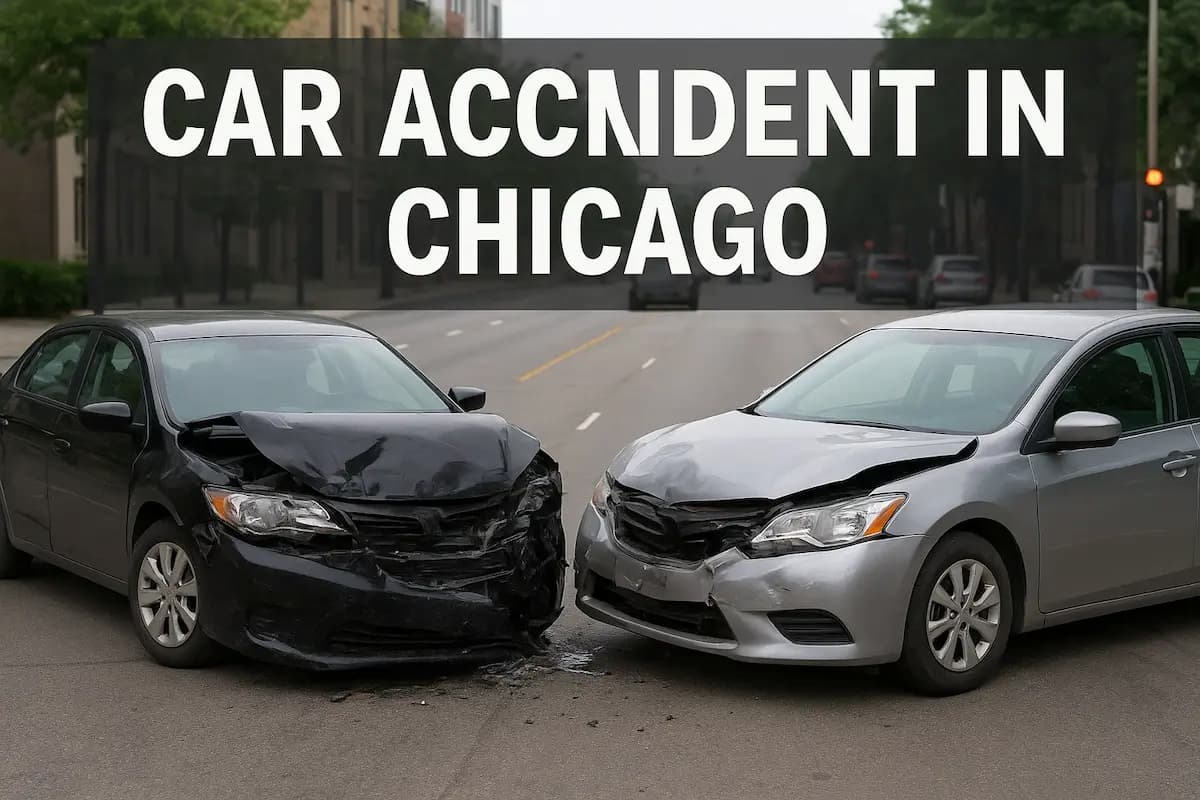
If you’ve just been involved in a car accident in Chicago, Illinois, your next steps are absolutely critical, not only for your safety but also for protecting your legal rights. The moments right after a collision are often filled with confusion, shock, and adrenaline, making it easy to overlook important details that can significantly affect your recovery and compensation.
Whether the crash happened on the Kennedy Expressway, a busy downtown intersection, or a quiet neighborhood street, what you do in the minutes and hours following the incident can shape the outcome of your entire case. As a Chicago personal injury lawyer with over 30 years of experience handling serious car accident cases throughout Cook County and across Illinois, I’ve seen firsthand how quick, informed action can make all the difference.
Step-by-Step Guide After a Car Accident in Chicago
Here’s what you should do immediately after a crash in Chicago or anywhere in Illinois:
Check for injuries and call 911. Your health and safety come first. Request medical assistance even for minor injuries, adrenaline can mask symptoms.
Move to a safe location. If possible, move vehicles out of traffic to prevent further danger, but only if it’s safe to do so.
Report the accident to the police. Illinois law (625 ILCS 5/11-408) requires that accidents involving injury, death, or property damage over $1,500 be reported. Always get an official police report number. Learn more about how to obtain Illinois police crash reports.
Exchange information. Collect names, phone numbers, driver’s license numbers, insurance details, and vehicle plate numbers from all involved parties.
Document the scene. Take photos and videos of vehicle damage, injuries, skid marks, traffic signals, and weather conditions. See our full guide on what evidence you need for an Illinois car accident claim.
Gather witness information. Get names and contact details of anyone who saw the crash, their testimony may be valuable later.
Seek medical attention. Visit a doctor immediately, even if you feel fine. Some injuries, like whiplash or soft tissue injuries, appear hours or days later.
Notify your insurance company. Provide factual details, but do not admit fault or speculate. Be careful about common insurance company tactics designed to minimize your payout.
Contact a Chicago personal injury lawyer. Before signing anything or speaking to other insurers, talk to an experienced attorney at Phillips Law Offices to protect your rights.
Special Situations That Change the Playbook
The steps above cover a standard two-car crash. A meaningful share of Chicago accidents don’t fit that pattern, and each variation adds a wrinkle worth knowing about before it catches you off guard.
Rideshare accidents. If you were a passenger in, or were hit by, an Uber or Lyft vehicle, coverage depends on what the driver’s app status was at the moment of the crash – offline, waiting for a ride request, or actively transporting a passenger. Illinois requires rideshare companies to carry contingent liability coverage that can reach $1 million once a driver is en route to or transporting a passenger. Document the driver’s app screen if you can, and note whether a trip was active.
Hit by a CTA bus or city vehicle. This is a fundamentally different claim. Under the Illinois Local Governmental and Governmental Employees Tort Immunity Act, claims against a public entity like the Chicago Transit Authority or the City of Chicago are generally subject to a one-year notice and filing window, not the standard two years that applies to a private at-fault driver. Miss that shorter window and the claim can be barred entirely, regardless of how strong the underlying case is.
Commercial trucks and delivery vehicles. A crash involving a semi-truck, delivery van, or company vehicle usually means more than one potentially liable party – the driver and the employer, and sometimes a leasing or logistics company as well. These cases often involve federal motor carrier regulations on top of Illinois law, and evidence like driver logs or a vehicle’s black box data can disappear quickly if no one preserves it.
Multi-vehicle expressway pileups. Crashes on the Kennedy, Dan Ryan, or Eisenhower expressways during rush hour or bad weather often involve four or more vehicles, which turns fault-finding into a genuinely complicated exercise. Police reports in these cases sometimes only capture partial information at the scene, which makes independent documentation – your own photos, dashcam footage, witness contacts – more valuable, not less. If your car has a dashcam, save the footage to a separate device the same day; many units overwrite older recordings automatically within a matter of hours.
Understanding Illinois Law: Your Rights After a Car Accident
Car accident claims in Illinois are governed by state laws designed to determine fault, damages, and time limits for filing a lawsuit. Here are key points every driver should know:
Illinois Is an “At-Fault” State
Under Illinois law, the driver or party found to be at fault for causing the accident is legally responsible for covering the damages that result. This concept is known as the “fault” or “tort” system, meaning the person who caused the crash, whether through negligence, recklessness, or a traffic violation, must compensate the victims for their losses. Learn more about how fault is determined in a Chicago car accident.
For example, if another driver rear-ends your vehicle on Lake Shore Drive because they were texting, Illinois law gives you the right to hold that driver (and their insurer) financially accountable for your hospital bills, vehicle repairs, and time missed from work. In more serious cases involving catastrophic injuries or fatalities, victims and families may also pursue non-economic damages.
Comparative Negligence Rule
Illinois follows a “modified comparative negligence” rule, outlined in 735 ILCS 5/2-1116. This law recognizes that in many crashes, more than one person may share some level of responsibility. Read our detailed guide on how Illinois comparative fault affects your claim.
For example, if you were 20% at fault and the other driver was 80% at fault, and your total damages were $100,000, you would still be eligible to receive $80,000 (after a 20% reduction).
Statute of Limitations
Under 735 ILCS 5/13-202, you generally have two years from the date of the accident to file a personal injury lawsuit. For details, see our guide on Illinois car accident lawsuit deadlines.
Reporting and Documentation Requirements
All drivers involved in a traffic collision that results in injury, death, or property damage exceeding $1,500 are legally required to report the crash. If a police officer responds to the scene, they typically complete the Illinois Traffic Crash Report on your behalf. However, if no officer is present, you must file the report within 10 days.
An Illustrative Example (Hypothetical, Not an Actual Case)
Picture a driver stopped at a red light on Ashland Avenue, rear-ended by a delivery van running late on its route. The impact is hard enough to total her bumper, but she waves off the ambulance – she feels shaken, not hurt. She exchanges insurance information, snaps a few photos, and drives herself home.
Three days later the neck pain hasn’t gone away. It’s worse in the morning. She sees a doctor, gets diagnosed with a cervical strain, and starts physical therapy. When she files a claim, the delivery company’s insurer seizes on the gap: no ambulance, no ER visit the day of the crash, three days before any doctor saw her. That gap doesn’t kill the claim, but it hands the adjuster a ready-made argument that the injury was something else entirely, unrelated to the crash. The lesson isn’t that she did anything wrong – adrenaline genuinely does mask pain. It’s that same-day medical documentation, even a brief urgent care visit, closes the exact gap an insurer is trained to look for.
Common Mistakes to Avoid After a Car Accident
In my years representing injured Chicagoans, I’ve seen well-meaning people unintentionally hurt their own cases:
- Don’t leave the scene: Leaving without exchanging information or waiting for police can lead to serious legal consequences. If the other driver flees, see our guide on hit and run victim rights in Illinois.
- Don’t admit fault: Even a simple apology can be used against you later. Let the evidence and investigation determine fault.
- Don’t skip medical treatment: Insurance adjusters often question injury claims if you delay seeing a doctor.
- Don’t talk to the other driver’s insurance adjuster: Their goal is to minimize payouts. Direct all communication through your attorney.
- Don’t post about the accident on social media: Insurance companies monitor posts and may use them to discredit your claim. Read our guide on social media mistakes that hurt accident claims.
Getting Your Vehicle Repaired or Replaced
Property damage gets less attention than injury claims, but it’s rarely simple. The at-fault driver’s insurer will typically send an adjuster to inspect the vehicle or ask for repair estimates from a shop of your choosing. You are not required to use the insurer’s preferred repair shop in Illinois.
If repair costs approach or exceed the car’s actual cash value, the insurer will likely declare it a total loss and offer a payout based on comparable vehicle sales in your area rather than paying for the repair. That valuation is negotiable – insurers routinely start low, and documentation of your vehicle’s actual condition, mileage, and any recent maintenance can move the number. Illinois also recognizes diminished value claims in some circumstances, meaning a repaired vehicle that’s now worth less on resale than an equivalent one with no accident history can, in limited situations, support an additional claim on top of the repair cost itself.
When to Contact a Chicago Personal Injury Lawyer
If you’ve been injured, dealing with medical bills, lost wages, and insurance companies can be overwhelming. Understanding who pays for medical bills after a car accident is critical to your recovery.
You should contact Phillips Law Offices if:
- The accident caused significant injuries or fatalities.
- The other driver was uninsured or underinsured, or fled the scene.
- You’re unsure who was at fault.
- The insurance company is delaying or denying your claim.
At Phillips Law Offices, we have over three decades of experience representing car accident victims across Cook County and throughout Illinois. Contact us for a free consultation today. Call us at (312) 346-4262.
Frequently Asked Questions (FAQs)
1. Should I always file a police report after a car accident in Chicago?
Yes. Under Illinois law, you must report any crash involving injury, death, or property damage over $1,500. A police report serves as key evidence in your claim.
2. How long does it take to settle a car accident claim in Illinois?
It depends on the case. Minor claims may resolve in a few months, while serious injury cases can take a year or more. See our guide on Illinois car accident settlement factors.
3. Can I recover compensation if I wasn’t wearing a seatbelt?
Yes, but your damages might be reduced. Learn more about how Illinois seat belt law affects your claim.
4. What damages can I recover after a car accident?
You may be entitled to medical expenses, lost wages, pain and suffering, property damage, and in some cases, punitive damages. Read our full breakdown of damages you can recover after a Chicago car accident.
5. How much does it cost to hire a Chicago personal injury lawyer?
At Phillips Law Offices, we work on a contingency fee basis, meaning you owe nothing unless we win your case.
6. What if I was hit by a CTA bus or a City of Chicago vehicle?
Treat it as urgent. Claims against public entities like the CTA or the City generally fall under a one-year notice and filing deadline, not the standard two years. Waiting to see how you feel before consulting an attorney is a real risk here in a way it usually isn’t with a private driver.
7. What if I don’t have health insurance?
You can still get treatment and still pursue a claim. Some providers will treat on a lien basis, meaning payment comes out of the eventual settlement, and Illinois’s med-pay or MedPay coverage, if you carry it, can cover initial bills regardless of fault. Don’t skip treatment over cost concerns before talking to an attorney about your options.
8. What if I was a passenger, not the driver?
Passengers generally have a more straightforward path to compensation, since fault questions between the drivers don’t reduce a passenger’s own claim the way comparative negligence can for a driver. You may have a claim against one or both drivers depending on how fault is allocated.
9. Do I have to use the other driver’s insurance-recommended repair shop?
No. You can choose your own shop in Illinois. An insurer can recommend one, and it may be more convenient for scheduling, but you’re not obligated to use it, and choosing an independent shop doesn’t affect your right to compensation.
Take the Right Steps: Protect Your Future
A car accident can turn your world upside down in seconds. By staying calm, documenting everything, and seeking legal guidance, you give yourself the best possible chance to recover both physically and financially.
At Phillips Law Offices, we understand what’s at stake. For more than three decades, we’ve been helping car accident victims throughout Chicago and across Illinois rebuild their lives after serious injuries.
A Realistic Timeline for What Comes Next
Knowing the individual steps helps in the moment. Knowing roughly how the weeks after unfold helps you plan.
The first 24 to 48 hours are about medical care and preservation: get evaluated even if the ER visit feels unnecessary, request a copy of the police report number, and back up any photos or video somewhere other than just your phone. This is also when insurance companies move fastest – the at-fault driver’s insurer may call within a day or two asking for a recorded statement. You’re not required to give one before speaking with an attorney.
In the first week, follow-up medical care matters more than it seems like it should. If your primary care doctor refers you to physical therapy or a specialist, go, and keep every appointment on the calendar even if symptoms improve. Gaps in treatment are one of the most common reasons insurers devalue an otherwise solid claim.
Over the following month, your case starts taking shape around a clearer medical picture. This is typically when a personal injury attorney, if you’ve retained one, begins compiling records, calculating lost wages, and opening formal communication with the insurer rather than leaving you to field calls directly. For a crash involving a public entity like the CTA, this is also the window in which formal notice needs to go out well before the one-year mark, not close to it.
Authoritative Sources
Related Chicago Accident Guides
- Chicago Car Accident FAQ: Your Questions Answered
- Rear-End Collision Claims in Illinois: Proving Fault & Damages
- Winter Driving Accidents in Chicago: Ice, Snow & Liability Issues
- Intersection Accidents in Chicago: Red Light, Stop Sign & Right-of-Way Claims
- 2025 Illinois Personal Injury Law Changes
For an overview of how Illinois car accident claims work and how the firm handles them, see our Chicago car accident lawyer page.
Every guide in our series on what to do after a crash
- Chicago Car Accident FAQ: Your Questions Answered
- Police Crash Reports in Illinois: How to Get Them + What Matters
- Post-Crash Social Media Mistakes: What Can Hurt a Chicago Car Accident Claim (and What to Do Instead)
- Should I Give a Recorded Statement to the Insurance Adjuster?
- Should I Talk to the Other Driver’s Insurance Company After an Accident?
Talk to a Chicago car accident lawyer. Phillips Law Offices offers a free case review, and there is no fee unless we recover for you. Call (312) 346-4262 or request a free case review.
This article is general information about Illinois law, not legal advice, and reading it does not create an attorney-client relationship. Illinois law changes; confirm anything you intend to rely on with a licensed Illinois attorney.