
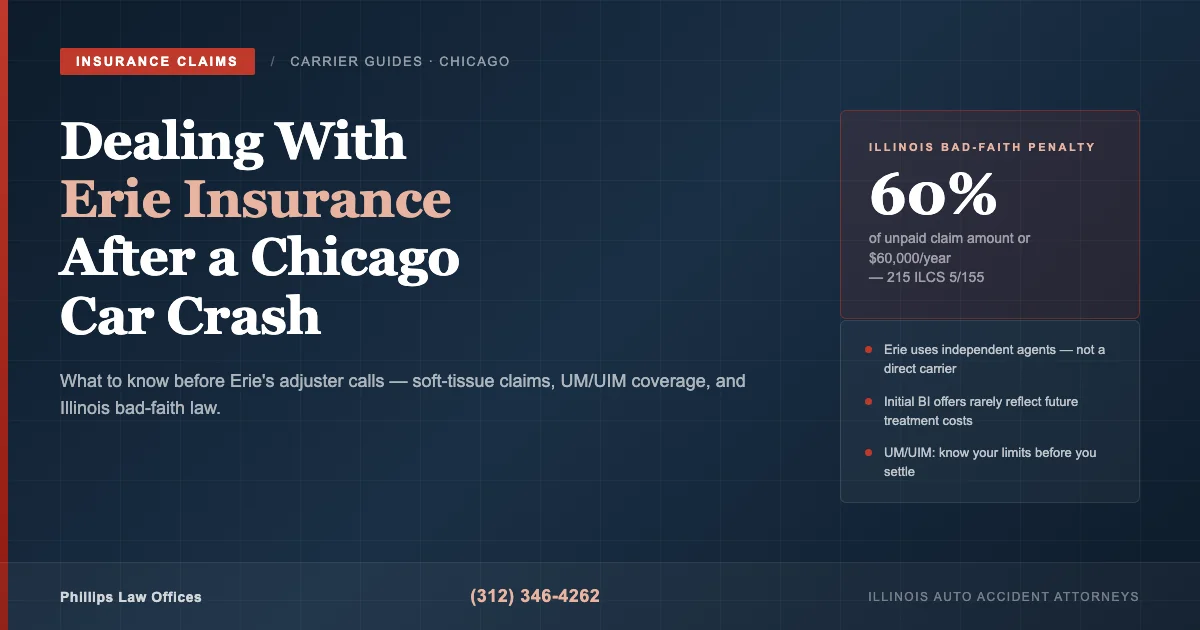
Short answer: Erie Insurance handles Illinois auto claims through independent agents rather than a direct-sales model, which changes how claims are managed and how adjusters are incentivized. On property damage, Erie moves quickly and routes repairs through its preferred shop network. On bodily injury, especially soft-tissue injuries, Erie’s initial settlement offers routinely fall short of full value. If Erie is unreasonably delaying or denying your covered claim, Illinois bad-faith law at 215 ILCS 5/155 allows you to pursue attorney fees and penalties. An experienced attorney can force a realistic valuation before you sign anything.
In my experience handling Illinois car accident cases, Erie Insurance claimants often come in after accepting a property damage check, believing the claim is over, only to discover that the bodily injury portion is still open and the adjuster is already pushing a fast settlement offer. Erie’s independent-agent model means the adjuster you speak with is not necessarily a direct Erie employee, which affects accountability. Understanding how the company operates from the first call forward gives you a meaningful advantage.
How Erie Insurance Operates in Illinois
Erie Insurance is a regional carrier headquartered in Erie, Pennsylvania. Unlike Allstate, State Farm, or GEICO, Erie does not sell policies directly to consumers in most markets. In Illinois, coverage is distributed through a network of independent insurance agencies. This structure has real consequences for claimants:
- Your policy agent is not Erie’s employee. The agent who sold you the policy works independently. Complaints and escalations go to Erie’s regional claims office, not the agent’s desk.
- Adjuster accountability differs from direct carriers. Because independent agents refer customers to Erie and depend on Erie for their book of business, there is sometimes less friction in early claim stages, but the bodily injury adjustment is handled by Erie’s internal claims staff who answer to Erie’s loss ratios, not the local agent.
- Erie covers about 12 states and Washington D.C. It is a major carrier in the Midwest and Mid-Atlantic but does not have the nationwide infrastructure of the largest carriers. Illinois policyholders and claimants deal with Erie’s regional adjusting staff.
None of this makes Erie worse or better than other carriers as a matter of policy quality. What it means is that the claims experience differs from what you might expect from a carrier whose agent is directly responsible for your claim outcome.
Property Damage: Erie’s Preferred Shop Network
Erie maintains relationships with preferred body shops through a program that allows faster estimates and direct billing. On the surface, this benefits claimants by speeding up the repair process. There are trade-offs worth knowing:
- You are not required to use a preferred shop. Illinois law does not compel you to use an insurer’s network shop. If you have a long-standing relationship with an independent body shop or the dealership where you bought your vehicle, you can take your car there. Erie may request its own estimate and pay based on the lower figure, which is why getting your own estimate from a trusted shop matters.
- Parts quality can be an issue. Preferred shop agreements sometimes allow or encourage the use of aftermarket or reconditioned parts rather than OEM (original equipment manufacturer) parts. If your vehicle is newer or has a remaining manufacturer warranty, using non-OEM parts can affect both quality and warranty coverage. Specify OEM parts in writing if this matters to your situation.
- Total loss valuation. Erie uses third-party valuation software (commonly CCC ONE or similar) to determine actual cash value on total losses. These systems sometimes produce valuations that understate market value for your specific vehicle in the Chicago market. You have the right to dispute the valuation with comparables from local listings.
Bodily Injury Claims: Where Erie Often Falls Short
Erie’s adjusters are trained to resolve bodily injury claims quickly. Speed is not the problem. The problem is that fast settlement on a soft-tissue injury almost always means settlement before the full scope of injury is known.
In Illinois rear-end crashes and intersection collisions, the most common injuries are cervical and lumbar sprains, disc herniations, and nerve impingement, conditions that may not reach maximum medical improvement for months or longer. Erie’s initial settlement offer often arrives before diagnostic imaging is complete or before physical therapy has concluded. If you accept that offer and sign the release, you cannot reopen the claim even if an MRI later reveals a disc herniation that requires injection or surgery.
Specific patterns worth knowing:
- Erie calculates pain and suffering using a multiplier applied to medical specials. If your medical bills are low because you delayed treatment or your injury resolved quickly, their multiplier produces a low number regardless of the real impact on your life.
- Lost wages require documentation Erie will scrutinize. Self-employed claimants face particular challenges because Erie adjusters request tax returns, business records, and evidence of specific missed work or contracts. W-2 employees should gather pay stubs and employer letters early.
- Future medical expenses are frequently excluded from early offers. If your treating physician recommends additional physical therapy, pain management, or possible surgery, an offer that does not account for those projected costs is incomplete.
Illinois Bad-Faith Law and What It Means for Erie Claims
Illinois Insurance Code Section 155, codified at 215 ILCS 5/155, gives policyholders a private right of action when an insurer unreasonably delays or denies a covered claim. The statute allows a court to award:
- Attorney fees
- A penalty capped at the lesser of 60 percent of the amount the court finds you are entitled to recover, $60,000, or the amount by which your recovery exceeds any pre-suit offer
- Other costs
Section 155 applies to your own Erie policy, not to a third-party claim against another driver’s Erie policy. However, it is a meaningful lever when Erie is handling your own first-party claim (collision, UM/UIM, or medical payments coverage) and stalling without reasonable grounds. Illinois courts have applied Section 155 in cases where insurers used pretextual investigations to delay legitimate claims, demanded documentation they knew was unavailable, or made lowball offers knowing coverage clearly applied.
If you believe Erie is acting in bad faith on your own policy claim, document every contact, every request for documents, every deadline given and missed. Those records become the foundation of a Section 155 claim.
UM/UIM Coverage: When Your Erie Policy Is Your Primary Recovery
Erie offers competitive uninsured and underinsured motorist (UM/UIM) coverage. Illinois requires insurers to offer UM/UIM at the same limits as liability, though policyholders may reject higher UM/UIM limits in writing (215 ILCS 5/143a-2).
If the at-fault driver in your crash carries minimum Illinois liability limits ($25,000 per person) but your injuries and lost wages exceed that amount, your own Erie UIM policy pays the gap up to your UIM limit. This is often the most important coverage in serious injury cases involving underinsured drivers.
Key considerations for UM/UIM claims with Erie:
- You must typically exhaust the at-fault driver’s liability limits before Erie’s UIM coverage applies, or obtain Erie’s consent to settle with the at-fault carrier without prejudicing Erie’s subrogation rights.
- Erie will investigate your UIM claim independently, reviewing your medical records, wages, and liability facts. Their interest is in minimizing their UIM payout, not in agreeing with your demand.
- Arbitration clauses are common in Erie UM/UIM policies. Illinois law provides certain protections around arbitration in insurance contracts, but the process differs meaningfully from civil litigation.
| Erie Claim Stage | What to Watch For | Recommended Action |
|---|---|---|
| First adjuster contact (within 24-72 hours) | Request for recorded statement, quick property damage inspection scheduled | Decline recorded statement until you have counsel; accept property inspection |
| Property damage estimate | Preferred shop referral, possible aftermarket parts, low total-loss valuation | Get independent estimate; specify OEM parts; dispute ACV with market comparables |
| Early bodily injury contact (within 1-2 weeks) | Settlement offer before treatment is complete, release presented with check | Do not sign release; inform adjuster treatment is ongoing; consult an attorney |
| Medical records request | Broad authorization covering records beyond this accident | Provide only records related to this injury; have attorney review the authorization |
| Demand evaluation (after treatment ends) | Adjuster counters with figure below your demand, cites injury severity as low | Document all basis for your demand; be prepared to negotiate or litigate |
| UM/UIM stage (if at-fault driver underinsured) | Erie investigating independently, possible arbitration demand | Notify Erie of intent to settle with at-fault carrier; get Erie’s written consent |
Not every Erie claim requires a lawyer. If you have a minor fender-bender, no injuries, and property damage that is being handled fairly, handling it yourself is reasonable. Attorney involvement makes a concrete difference when:
- Your injuries required emergency care, imaging, or specialist treatment
- You missed work or anticipate missing future work
- Erie has presented a settlement offer before your treatment is complete
- Erie is requesting a recorded statement (you have no obligation to give one to the opposing carrier)
- You have a UM/UIM claim on your own Erie policy
- Erie has denied coverage or is delaying without reasonable explanation
“The signed release is the end of your claim. Once you accept a settlement check and sign Erie’s release form, the claim is closed permanently. In cases where the full injury picture is still developing, signing early is the single most costly mistake I see clients make. The right time to settle is after treatment is complete, after all bills and wage loss records are gathered, and after an attorney has evaluated whether the offer reflects actual case value.”
Attorneys handling Illinois personal injury cases work on contingency, meaning no fees unless there is a recovery. Initial consultations are free. There is no financial risk in getting an evaluation before deciding whether to settle.
To speak with an attorney about an Erie Insurance claim, call Phillips Law Offices at (312) 346-4262. We handle car accident claims throughout Chicago and the surrounding Illinois counties.
Frequently Asked Questions About Erie Insurance Claims in Illinois
Do I have to give Erie Insurance a recorded statement?
If you are a third-party claimant (injured by someone else who has Erie insurance), you have no legal obligation to give Erie a recorded statement. Erie will likely request one and may imply that cooperation is required to process your claim. It is not. If you have your own Erie policy, your policy contains a cooperation clause that may require you to cooperate with your own carrier’s investigation, but even then you have the right to have an attorney present and to understand exactly what is being recorded before you speak.
How long does Erie have to respond to a claim in Illinois?
Illinois law (215 ILCS 5/154.6) requires insurers to acknowledge a claim within a reasonable time and to accept or deny coverage within a reasonable period after receiving proof of loss. In practice, Illinois regulators and courts have found that delays of more than 30-45 days without reasonable justification can support a finding of unreasonable delay. Erie is generally responsive in the early stages but may slow down on bodily injury claims when the value is contested.
Can I negotiate with Erie on a total loss valuation?
Yes. Erie’s total loss valuation is a starting point, not a final number. You can dispute it by providing comparables: listings for vehicles of the same make, model, year, mileage, and condition sold in the Chicago area. Services like Kelley Blue Book, Edmunds, and local dealer listings all support a counter-valuation. If negotiations fail, Illinois provides a dispute resolution process and you retain the right to pursue litigation over the difference.
What is Erie’s reputation on soft-tissue claims compared to other carriers?
Erie is similar to most regional carriers in that it applies conservative valuation formulas to soft-tissue injuries. Erie adjusters are often quicker to reach out and make an early offer than some larger national carriers, but that speed comes at the price of completeness. Their initial offers on whiplash or lumbar strain cases tend to be based on a low multiplier of medical specials and frequently do not account for future treatment. This pattern is consistent across the Illinois claims market, not unique to Erie, but it is particularly pronounced when treatment is still ongoing at the time of the offer.
Does hiring an attorney hurt my relationship with Erie or slow my claim?
No. Illinois law protects your right to have legal representation at any stage of a claim. Once you retain an attorney, all communication from Erie routes through the attorney’s office, which removes pressure on you to respond quickly or make statements without advice. In practice, represented claimants receive more thorough evaluations and higher settlements than unrepresented ones on comparable injuries, because attorneys know how to document and present the full scope of damages.
Authoritative Sources
- 215 ILCS 5/ Illinois Insurance Code (ILGA full text)
- 215 ILCS 5/155 Unreasonable Delay or Denial (ILGA full text)
- 215 ILCS 5/143a-2 Uninsured and Underinsured Motorist Coverage (ILGA full text)
- 215 ILCS 5/154.6 Unfair Claims Settlement Practices (ILGA full text)
- Illinois Department of Insurance (IDOI)
Related Illinois Injury Guides
- Dealing With Allstate After a Chicago Car Accident
- Dealing With State Farm After a Chicago Car Accident
- Dealing With GEICO After a Chicago Car Accident
- Dealing With Progressive Insurance in Chicago
- Dealing With USAA After a Chicago Car Crash
- Dealing With Liberty Mutual After a Chicago Car Accident
- Dealing With Farmers Insurance After a Chicago Car Accident
- Dealing With AAA Insurance After a Chicago Car Accident
Related guides on dealing with the insurance company
- Start here: Dealing with Insurance Companies After a Chicago Car Accident: Tactics to Watch
- Dealing With Safeco Insurance After a Chicago Car Crash
- Dealing With Farmers Insurance After a Chicago Car Crash
- Dealing With Geico After a Chicago Crash
- Dealing With Kemper Auto Insurance After a Chicago Car Crash
- Dealing With Liberty Mutual After a Chicago Car Crash
Talk to a Chicago car accident lawyer. Phillips Law Offices offers a free case review, and there is no fee unless we recover for you. Call (312) 346-4262 or request a free case review.
This article is general information about Illinois law, not legal advice, and reading it does not create an attorney-client relationship. Illinois law changes; confirm anything you intend to rely on with a licensed Illinois attorney.