
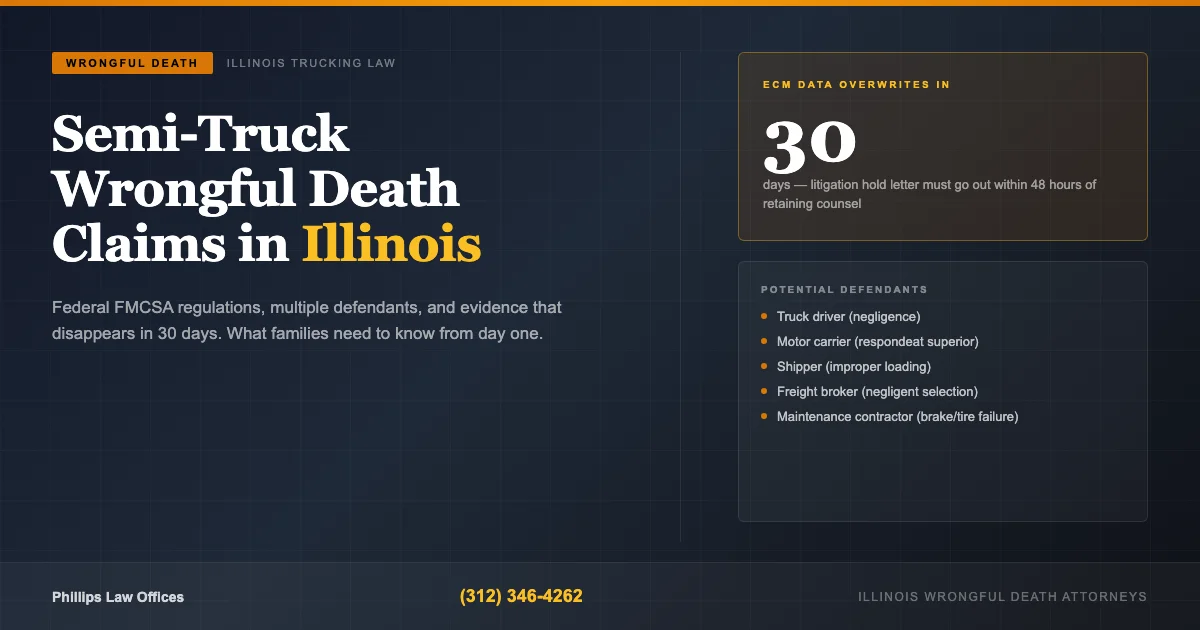
Short answer: A semi-truck wrongful death case in Illinois involves the Illinois Wrongful Death Act (740 ILCS 180/), federal FMCSA trucking regulations, and often four or more potential defendants, including the driver, the motor carrier, the shipper, and the maintenance contractor. Evidence from the truck’s black box and electronic logging device can be overwritten within 30 days. The personal representative of the estate brings the claim, and surviving family members can recover pecuniary losses including financial support, household services, and loss of companionship. Acting within the first 48 hours to preserve data is not optional; it is the difference between a complete case and one built on incomplete facts.
In my experience handling Illinois truck accident cases, wrongful death claims involving semi-trucks are among the most factually complex cases that come through our office. The stakes are the highest they can be, the evidence is time-sensitive in ways that do not apply to ordinary car accidents, and the insurance coverage stacked behind a commercial motor carrier is substantial enough that carriers have strong financial incentives to minimize or dispute liability from the moment of the crash. Families who have just lost someone need to understand what the law allows them to pursue and why the first hours and days of the case matter so much.
The Illinois Wrongful Death Act: Who Can Sue and What Can Be Recovered
Illinois wrongful death claims are governed by the Illinois Wrongful Death Act, 740 ILCS 180/. The statute creates a cause of action that did not exist at common law. Key elements:
- Who brings the claim: The personal representative of the decedent’s estate files the wrongful death action. This is the executor or administrator named in the will or appointed by the probate court. The personal representative acts on behalf of the surviving spouse and next of kin, who are the actual beneficiaries of any recovery.
- Beneficiaries: The surviving spouse, children, parents, and siblings are the next of kin who share in the wrongful death recovery. Illinois courts apportion the recovery among beneficiaries based on the pecuniary loss each has suffered.
- Recoverable damages: The Wrongful Death Act limits recovery to pecuniary loss, which includes financial support the decedent would have provided, the monetary value of household services, and the loss of society and companionship. Illinois courts have interpreted society and companionship broadly to include the full range of the relationship between the decedent and surviving family members.
- Pain and suffering of the decedent: The Wrongful Death Act does not cover the decedent’s pre-death pain and suffering. That claim is a survival action brought under the Survival Act, 755 ILCS 5/27-6, and belongs to the estate. If the decedent survived the crash for any period before death, the survival action may include conscious pain and suffering, medical expenses, and lost earnings from the time of injury to death. Both the wrongful death claim and the survival action are typically pursued together.
- Statute of limitations: Illinois wrongful death claims must be filed within two years of the date of death (740 ILCS 180/2). Missing this deadline permanently extinguishes the claim.
Who Can Be Held Liable: Multiple Defendants in a Truck Crash Death
A semi-truck wrongful death case almost never involves just one defendant. Federal and state law, combined with how the trucking industry structures its business relationships, creates multiple paths to liability:
The Driver: The truck driver is liable for negligence in operation, including speeding, following too closely, distracted driving, fatigue (if hours of service were violated), failure to yield, or unsafe lane changes. Driver negligence is the starting point, but rarely the ending point.
The Motor Carrier: The trucking company is liable under respondeat superior if the driver is a company employee operating within the scope of employment. If the driver is an independent contractor, the carrier may still be liable under a theory of negligent entrustment (failing to investigate the driver’s qualifications), negligent hiring, or negligent supervision. Federal regulations impose non-delegable duties on motor carriers for vehicles operated under their authority regardless of the driver’s employment classification. This is a critical distinction: carriers cannot escape liability by misclassifying drivers as independent contractors when the carrier controls the work.
The Shipper or Cargo Owner: If the cargo was improperly loaded, overloaded, or improperly secured, and that condition contributed to the accident (a shifting load that caused a rollover, for example, or an overweight truck with compromised braking), the party responsible for loading the trailer may share liability. Federal weight regulations under 49 CFR Part 393 set maximum allowable weights; an overweight load that contributed to brake failure creates liability for the shipper.
The Freight Broker: Under the theory recognized in cases like Sperl Trucking Inc. v. Underwriters at Lloyd’s, freight brokers who negligently select motor carriers (for example, by selecting a carrier with a history of safety violations or an out-of-service record) can be held liable for negligent carrier selection. FMCSA’s SAFER system provides publicly available carrier safety data; a broker who failed to check it before booking a carrier with a poor safety record has a difficult position to defend.
The Maintenance Contractor: If the truck was inspected or maintained by a third-party maintenance company and a mechanical failure caused by that company’s negligent work contributed to the crash (brake failure, tire blowout, steering defect), that company is a defendant. Federal inspection and maintenance standards at 49 CFR Part 396 define the duty of care for vehicle inspection and maintenance.
| Defendant | Theory of Liability | Key Evidence |
|---|---|---|
| Truck Driver | Negligence in operation (speeding, fatigue, distraction, HOS violation) | ELD data, logbooks, cell phone records, toxicology, police report |
| Motor Carrier (employer) | Respondeat superior (employee driver); negligent hiring/supervision/entrustment (contractor driver) | Driver qualification file, hiring records, training records, FMCSA safety rating, prior violations |
| Shipper/Cargo Owner | Negligent loading, improper securing, overweight cargo | Bills of lading, weight tickets, cargo inspection records, loading records |
| Freight Broker | Negligent carrier selection | Broker’s carrier vetting records, SAFER system data at time of booking, contract between broker and carrier |
| Maintenance Contractor | Negligent inspection or repair; failure to identify defect | Maintenance logs, inspection records, parts records, DVIR (driver vehicle inspection report) |
Federal Motor Carrier Safety Administration regulations are incorporated into Illinois negligence law as the standard of care for commercial trucking operations. Violations of FMCSA regulations are evidence of negligence per se in Illinois courts. The regulations most frequently at issue in wrongful death cases:
49 CFR Part 395: Hours of Service. Federal regulations strictly limit how many hours a commercial driver may operate per day and per week without rest. A driver who operated beyond these limits and caused a fatigue-related crash has violated a federal safety regulation designed to prevent exactly that outcome. Electronic logging devices (ELDs) have been federally mandated since December 2017 for most commercial motor vehicles, replacing paper logbooks that were far easier to falsify. ELD data creates a contemporaneous record of driving time, duty status, and location.
49 CFR Part 391: Driver Qualifications. This regulation sets minimum qualifications for commercial drivers: valid CDL, medical certificate issued by a certified medical examiner, drug and alcohol testing (pre-employment, random, post-accident, reasonable suspicion), and review of prior driving record. A carrier that put an unqualified driver behind the wheel, or failed to conduct required drug testing, has violated this regulation.
49 CFR Part 396: Vehicle Inspection, Repair, and Maintenance. Carriers are required to systematically inspect, repair, and maintain all vehicles under their control. Drivers must complete a driver vehicle inspection report (DVIR) after each day’s work, noting any defects. Known defects must be repaired before the vehicle is returned to service. A brake system defect that was noted in a DVIR and not repaired before the fatal crash is direct evidence of regulatory violation.
49 CFR Part 393: Parts and Accessories Necessary for Safe Operation. This regulation covers brakes, lighting, tires, coupling devices, cargo securement, and other equipment. A tire in violation of tread depth minimums, or brakes out of adjustment, at the time of the crash is a regulatory violation that supports both negligence per se and a direct liability claim against the carrier.
The 48-Hour Evidence Window: Why the Litigation Hold Letter Cannot Wait
“The first call I make after being retained in a semi-truck wrongful death case is not to the insurance company. It is to the motor carrier’s registered agent, by overnight mail and email, with a litigation hold letter demanding preservation of every piece of evidence the carrier controls: the truck’s ECM data, the ELD records, the driver’s qualification file, maintenance logs, inspection records, dispatch records, and communications. Commercial truck ECM (event data recorder) systems typically overwrite data on a 30-day loop. By the time a family has buried their loved one and retained an attorney 45 days after the crash, the ECM data capturing pre-crash speed, braking, throttle position, and engine load may already be gone. The litigation hold letter creates a legal duty to preserve. If the carrier destroys evidence after receiving the letter, the family’s attorney moves for a spoliation instruction, which tells the jury it may presume the destroyed evidence was unfavorable to the carrier.”
The ECM (event data recorder) and ELD are the truck’s equivalent of an airplane’s flight data recorder. ECM data captures the seconds before impact: vehicle speed, brake application, throttle position, engine RPM, and cruise control status. This data can prove or disprove a driver’s account of the crash. ELD data provides hours of service compliance over the preceding 180 days. Together, these two data sources are often the most powerful evidence in a truck crash case.
Beyond the electronic data, physical evidence also needs to be preserved: the truck itself (for inspection by an accident reconstruction expert), tire remnants, cargo load records, and the scene itself. In some cases, hiring an accident reconstruction firm within the first week to document the scene before evidence is cleaned up or weather conditions change is necessary.
Expert Witnesses Required in a Semi-Truck Wrongful Death Case
Wrongful death cases involving commercial trucks require specialized expert testimony to translate the technical evidence into findings a jury can evaluate:
- Accident reconstruction expert: Analyzes physical evidence (skid marks, vehicle damage, gouge marks, debris field), ECM data, and crash dynamics to determine pre-impact speed, point of impact, and the mechanics of the collision. Testifies about how the crash occurred and what the driver could and should have done differently.
- FMCSA compliance expert (trucking industry expert): A former trucking safety director or commercial vehicle safety specialist who reviews the carrier’s practices against federal regulations and testifies about which regulations were violated and what industry-standard practices require. This witness connects the federal regulatory framework to the specific failures in your case.
- Life care planner (in survival action component): If the decedent survived for a period requiring medical care, a life care planner quantifies future medical needs and costs that were foreclosed by the death.
- Economist: Calculates the present value of the decedent’s lost future earnings and financial contributions to the family over the decedent’s projected working life, reduced to present value. Also calculates the value of household services the decedent would have provided.
If you have lost a family member in a semi-truck crash in Illinois, call Phillips Law Offices at (312) 346-4262. We handle wrongful death cases throughout Chicago and the surrounding counties and can send a litigation hold letter on your behalf within hours of being retained.
Frequently Asked Questions About Semi-Truck Wrongful Death Claims in Illinois
Who can file a wrongful death lawsuit after a fatal truck accident in Illinois?
Under 740 ILCS 180/2, the personal representative of the decedent’s estate files the wrongful death action. If the decedent left a will, the executor named in the will typically serves as personal representative after the will is admitted to probate. If there is no will, the probate court appoints an administrator, often the surviving spouse or an adult child. The personal representative brings the action on behalf of all surviving next of kin who are beneficiaries, including the spouse, children, and parents. An attorney can assist with the appointment of a personal representative if that step has not already occurred.
How long does the family have to file a wrongful death lawsuit in Illinois?
The Illinois Wrongful Death Act (740 ILCS 180/2) sets a two-year statute of limitations running from the date of death. In most cases, this means you have two years from the day your family member died, not from the date of the crash (though in a fatal crash, those dates are often the same). Missing this deadline is permanent; courts do not extend it in ordinary circumstances. The survival action has its own limitations period, which also warrants review with an attorney as soon as possible given the complexity of truck crash cases.
How much is a semi-truck wrongful death case worth in Illinois?
There is no standard value because every case turns on the specific facts of the decedent’s age, income, relationships, and life expectancy, combined with the strength of the liability case against the defendants. Illinois law caps non-economic damages in medical malpractice cases but not in personal injury or wrongful death cases arising from truck crashes. Verdicts and settlements in fatal Illinois truck cases have ranged from hundreds of thousands of dollars to tens of millions depending on the earning capacity of the decedent, the number of dependents, the clarity of liability, and the degree of corporate misconduct involved. A realistic valuation requires a full case evaluation, not a general estimate.
Can the trucking company be held responsible even if the driver was an independent contractor?
Often yes. Federal regulations impose non-delegable duties on motor carriers for vehicles operated under their operating authority, regardless of how the driver is classified. Additionally, if the carrier failed to verify the driver’s qualifications, failed to conduct required drug testing, or exercised sufficient control over the driver’s work, courts may find the carrier directly liable even without an employer-employee relationship. The motor carrier’s insurance policy also typically covers drivers operating under the carrier’s authority, regardless of employment classification, under federal financial responsibility rules (49 CFR Part 387).
What if the truck driver was also killed in the crash?
The driver’s death does not eliminate liability. The motor carrier, the driver’s estate, and other responsible parties (shipper, maintenance contractor, freight broker) remain as defendants. The carrier’s commercial auto liability policy, which federal regulations require to carry minimum limits of $750,000 for most general freight operations and $1,000,000 or more for hazardous materials, is the primary source of recovery regardless of whether the driver survived. The carrier’s insurer defends the claim and pays any judgment or settlement within policy limits.
Authoritative Sources
- 740 ILCS 180/ Illinois Wrongful Death Act (ILGA full text)
- 755 ILCS 5/27-6 Illinois Survival Act (ILGA full text)
- 49 CFR Part 395: Hours of Service of Drivers (eCFR)
- 49 CFR Part 391: Qualifications of Drivers (eCFR)
- 49 CFR Part 396: Inspection, Repair, and Maintenance (eCFR)
- 49 CFR Part 393: Parts and Accessories Necessary for Safe Operation (eCFR)
- FMCSA Safety Measurement System (SMS/SAFER)
- 49 CFR Part 387: Minimum Levels of Financial Responsibility (eCFR)
Related Illinois Injury Guides
- Delivery Truck Accidents in Chicago: Liability and What to Do
- Tow Truck and Wrecker Crashes in Chicago
- How Much Is My Car Accident Case Worth in Illinois?
- When to Hire a Lawyer After a Chicago Car Accident
Crashes with commercial vehicles run on different rules and a faster evidence clock. See our Chicago truck accident lawyer page.
Every guide in our series on wrongful death claims
- Illinois Wrongful Death Claims After a Car Accident
- Spinal Cord Injury and Paralysis Claims in Illinois
Talk to a Chicago wrongful death lawyer. Phillips Law Offices offers a free case review, and there is no fee unless we recover for you. Call (312) 346-4262 or request a free case review.
This article is general information about Illinois law, not legal advice, and reading it does not create an attorney-client relationship. Illinois law changes; confirm anything you intend to rely on with a licensed Illinois attorney.