
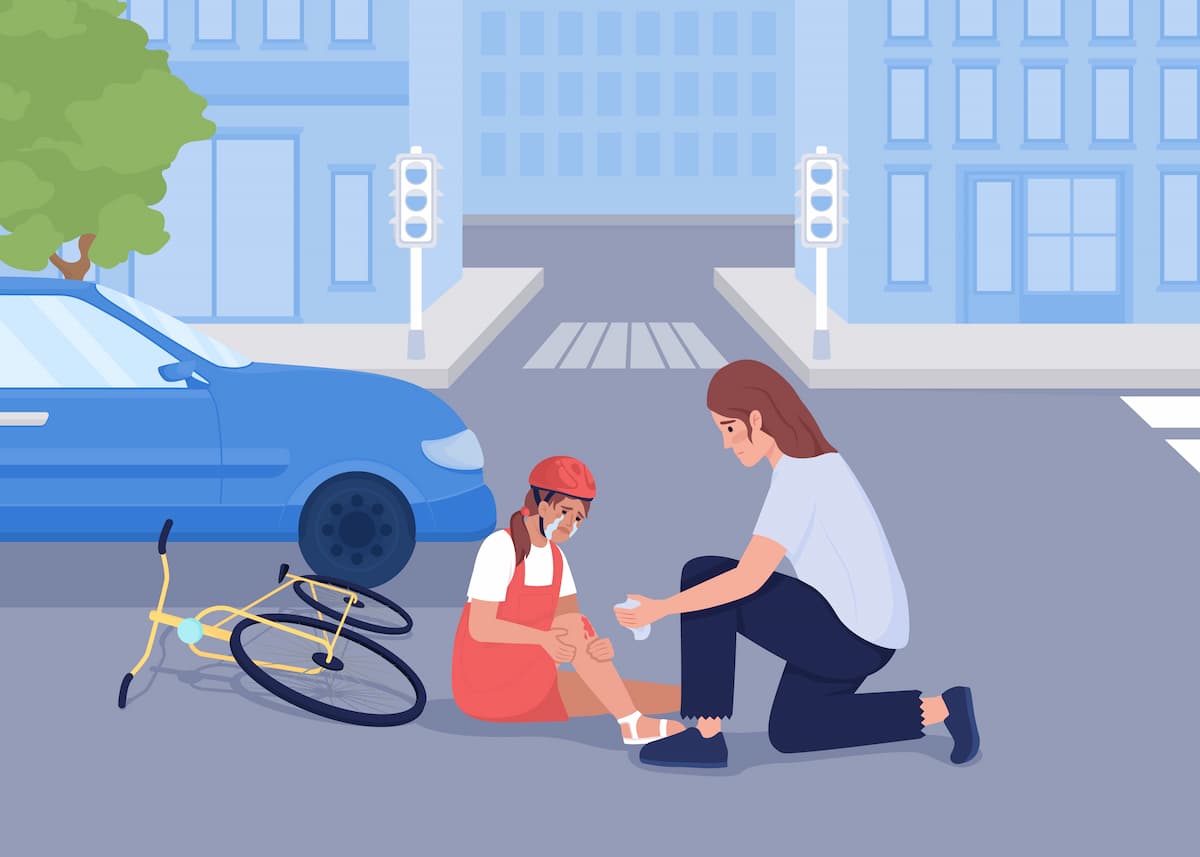
Pedestrians involved in Chicago traffic collisions rarely walk away unscathed. Without a frame of steel and a seatbelt absorbing the impact, even a low-speed crash can produce broken bones, traumatic brain injury, or spinal cord damage. According to the National Highway Traffic Safety Administration, 76 percent of pedestrian fatalities nationwide happen after dark, and nearly three-quarters occur away from intersections – a pattern that lines up with what Chicago police reports show on busy corridors like Pulaski Road, Cicero Avenue, and Western Avenue after sunset. Sorting out who caused the crash matters immensely, because in Illinois the fault determination directly controls how much money an injured pedestrian can recover.
At Phillips Law Offices, we have represented pedestrians, cyclists, and drivers across Illinois for more than 30 years. Most callers ask some version of the same question after a crash: was this my fault, the driver’s fault, or somewhere in between? The honest answer is usually “it depends,” and getting that answer right is the difference between a fair settlement and a case that gets undervalued.
Understanding Fault in Pedestrian Accidents
Illinois traffic law assigns responsibilities to both drivers and pedestrians, and a fault investigation weighs all of it together – speed, right-of-way, road conditions, signal timing, and the conduct of everyone involved. Fault is almost never assigned by a single fact. An insurance adjuster or, eventually, a jury looks at the whole sequence of events: where the pedestrian was standing when the light changed, whether the driver had an unobstructed view, and what a reasonably careful person would have done in the same circumstances.
Responsibility is frequently split rather than assigned entirely to one side. A driver who rolls through a stop sign without checking for foot traffic can be primarily at fault even if the pedestrian was jaywalking a few feet from the marked crosswalk. Illinois uses a modified comparative negligence system, which is covered in detail below, so a pedestrian who bears some responsibility is not automatically shut out of compensation – but the percentage assigned to them reduces what they can collect.
Key Factors That Affect Fault
- Right-of-way violations: Drivers must yield to pedestrians in marked and unmarked crosswalks under specific conditions. Failing to do so is one of the clearest paths to driver liability.
- Pedestrian behavior: Crossing outside a crosswalk, ignoring a “Don’t Walk” signal, or stepping off a curb without checking traffic can shift some fault onto the pedestrian.
- Speed and aggressive driving: A driver traveling above the posted limit, or one who accelerates through a yellow light near a crosswalk, has less time to react and is more likely to be found at fault.
- Impairment: Alcohol, drugs, or even severe fatigue can increase liability for either party, and toxicology results or field sobriety reports often become central pieces of evidence.
- Environmental conditions: Poor street lighting, faded crosswalk paint, construction detours, or heavy rain can shift how fault is analyzed, particularly when a municipality had notice of the hazard and failed to fix it.
Illinois Pedestrian Right-of-Way Law in Plain Terms
Illinois law (625 ILCS 5/11-1002) requires drivers to stop and yield to a pedestrian crossing within a crosswalk when the pedestrian is on the driver’s half of the roadway, or close enough to the other half to be in danger. When a car ahead has already stopped for someone in a crosswalk, the vehicles behind it are legally barred from passing and continuing through – a rule that exists specifically because so many pedestrian crashes happen when a second driver doesn’t realize why traffic ahead has stopped. Illinois law also carries heightened right-of-way protections for pedestrians in marked school zones, reflecting how much less forgiving these crashes are for children.
None of this means a pedestrian has unlimited right-of-way. The same body of law prohibits a pedestrian from suddenly leaving a curb or safe position and walking into the path of a vehicle that is close enough to make a stop impossible. “Jaywalking” is not automatically illegal in Illinois – crossing mid-block is permitted in many circumstances – but it does factor into how a jury or adjuster allocates fault if it contributed to the collision. The practical effect is that neither “the driver hit me” nor “I was in the street” ends the analysis by itself; both facts get weighed against the full picture.
Who Can Be Held Liable?
More than one party is frequently responsible for a Chicago pedestrian crash, and identifying every liable party is often what separates a modest settlement from full compensation.
1. Drivers
Most pedestrian crashes trace back to driver negligence – running a red light, failing to yield at a crosswalk, speeding through a residential block, or looking at a phone instead of the road. Traffic camera footage, event data recorder downloads, witness statements, and the responding officer’s citation (if one was issued) are usually the strongest evidence of driver fault.
2. Pedestrians
Pedestrians can bear partial responsibility if they crossed mid-block against signals, stepped into the roadway without checking for traffic, or wore dark clothing on an unlit street at night. Illinois’s comparative negligence rule means a partially at-fault pedestrian can still recover damages, just reduced by their assigned percentage.
3. Property Owners and Municipalities
Broken sidewalks, obstructed crosswalks, missing signage, or a burned-out streetlight the city knew about and never repaired can shift liability onto a property owner or a government body. Claims against the City of Chicago, the CTA, or another municipal entity move on a different and much shorter clock than claims against a private driver – Illinois’s Local Governmental and Governmental Employees Tort Immunity Act generally requires filing suit within one year of the incident, not the standard two years that applies to most personal injury claims. Missing that window can permanently bar an otherwise valid claim, which is why identifying a possible government defendant early matters.
4. Vehicle Manufacturers
If a mechanical defect – brake failure, a headlight or taillight malfunction, or a steering system fault – caused or worsened the crash, the vehicle’s manufacturer can face a separate product liability claim that runs alongside the personal injury case against the driver. These cases are less common than straightforward driver-negligence claims, but they matter when a driver’s insurance limits alone won’t cover the full extent of a pedestrian’s injuries.
Illinois’s Comparative Negligence Rule: The 51% Bar
Illinois follows a modified comparative negligence system codified at 735 ILCS 5/2-1116, sometimes called the “51% bar rule.” A pedestrian can recover compensation as long as their own share of fault is 50 percent or less. If a jury or adjuster finds the pedestrian more than 50 percent responsible for the crash, recovery is barred entirely. For everyone at or under that line, the total award is reduced by their percentage of fault – a pedestrian found 20 percent responsible for a $100,000 claim recovers $80,000, not the full amount.
This is exactly why insurance companies push hard to assign pedestrians even a small percentage of fault after a crash. Every point they can attribute to the pedestrian directly lowers the payout, and getting a pedestrian close to the 50 percent line can eliminate the claim altogether. An early recorded statement, given without legal advice, is one of the most common ways claimants unintentionally hand the adjuster language to support a higher fault percentage.
Steps to Take After a Chicago Pedestrian Accident
What happens in the hours and days after a crash often determines how a fault dispute gets resolved months later.
- Get medical care immediately. Adrenaline masks pain, and some injuries – concussions, internal bleeding, soft-tissue damage – don’t show obvious symptoms right away. A same-day medical record is also one of the strongest pieces of evidence tying your injuries to the crash rather than some later, unrelated event.
- Call the police and get the report number. A Chicago Police Department crash report documents the date, time, location, involved parties, and often includes the officer’s observations about fault indicators like skid marks or signal timing. Ask for the report number before you leave the scene if you’re able.
- Photograph everything. Vehicle position, skid marks, the crosswalk or signal, weather and lighting conditions, and your own visible injuries all matter. Photos taken minutes after a crash carry more weight than a description written from memory weeks later.
- Get witness contact information. Bystanders often leave the scene once emergency responders arrive. A name and phone number jotted down in the first few minutes can be the difference between a corroborated account and a case that turns into your word against the driver’s.
- Say as little as possible about fault. Avoid apologizing, speculating about what happened, or giving a recorded statement to the driver’s insurance company before speaking with a lawyer. Adjusters are trained to extract phrases that sound like an admission, even when none was intended.
How a Chicago Personal Injury Lawyer Can Help
An experienced Illinois pedestrian accident attorney typically handles the parts of a claim that are hardest to get right without legal training: pulling traffic camera footage before it’s overwritten, identifying every potentially liable party (including a municipality, if the one-year notice window applies), negotiating directly with insurance adjusters instead of leaving that conversation to the injured person, and preparing the case for litigation if a fair settlement doesn’t materialize. At Phillips Law Offices, that work starts with a case review at no cost to the client.
Common Causes of Chicago Pedestrian Accidents
Distracted driving – texting, GPS use, eating behind the wheel – remains one of the most frequent contributing factors in Chicago pedestrian crashes, alongside failure to yield at crosswalks and speeding through residential and high-foot-traffic areas. Darkness compounds all of it: NHTSA data shows the large majority of pedestrian deaths nationwide occur at night, when a driver’s reaction window shrinks and a pedestrian in dark clothing may not be visible until it’s too late to stop. Winter conditions add another layer specific to Chicago – snowbanks that force pedestrians into the street, ice that lengthens stopping distances, and reduced visibility during early sunsets. Downtown intersections with heavy turning traffic present a different pattern: a driver focused on merging into a turn lane can miss a pedestrian who already has the walk signal, which is why left-turn and right-turn-on-red collisions show up so often in the crash reports our office reviews.
A Realistic Example
The following is a hypothetical scenario used for illustration only, not an account of an actual case or a guaranteed outcome.
Imagine a pedestrian crossing mid-block on a Chicago side street, about forty feet from the nearest marked crosswalk, when a driver traveling ten miles over the posted limit fails to stop in time. The pedestrian suffers a fractured tibia and a concussion. The driver’s insurer initially argues the pedestrian was 60 percent at fault for crossing outside the crosswalk, which would bar recovery entirely under the 51% rule. An investigation turns up a nearby business’s security camera showing the driver was speeding and looking down at a phone in the seconds before impact. That footage, combined with the responding officer’s citation for distracted driving, shifts the fault allocation to roughly 25 percent pedestrian and 75 percent driver – enough to preserve the claim and recover a meaningful percentage of the pedestrian’s damages rather than nothing at all. The scenario illustrates why the first days of evidence-gathering carry so much weight: without that camera footage, the case could have gone the other way entirely.
Not every case has a convenient security camera nearby. When the physical evidence is thin or contested – conflicting witness accounts, no footage, or a dispute over vehicle speed – an accident reconstruction expert can analyze skid marks, vehicle damage patterns, and roadway geometry to build an independent opinion on how the crash unfolded. That kind of analysis costs money and is not necessary for most claims, but it can be worth the expense when a large settlement hinges on a fault percentage that’s genuinely in dispute.
Recovering Compensation
Pedestrian accident victims may be entitled to recover for:
- Medical expenses, including future treatment and rehabilitation
- Lost wages and diminished future earning capacity
- Pain and suffering
- Property damage, such as a damaged phone, bicycle, or mobility device
- Wrongful death damages, in cases where the crash proved fatal
Illinois law allows a claimant to pursue damages from every party whose negligence contributed to the crash, not just the driver who made physical contact. When a defective traffic signal, an unmarked construction hazard, and a distracted driver all played a role, a well-documented claim can pursue all three.
When the At-Fault Driver Has No Insurance
Illinois requires drivers to carry liability coverage, but plenty of Chicago collisions still involve a driver who is uninsured, underinsured, or flees the scene entirely. In those situations, a pedestrian’s own auto policy – specifically the uninsured or underinsured motorist coverage most Illinois drivers carry, sometimes without realizing it – can become the primary source of recovery. Pedestrians without their own auto policy may still have options through a household member’s coverage. This is a separate claims process from a standard liability claim and comes with its own deadlines, which is worth reviewing early rather than after a claim has already stalled. Filing an uninsured motorist claim also means dealing with your own insurer, which is not always the cooperative process people expect – your carrier has a financial interest in minimizing the payout just like the at-fault driver’s insurer would, even though you’ve been paying premiums to that same company for years.
Contact Phillips Law Offices Today
If you or someone you love has been hurt in a pedestrian accident in Chicago or anywhere in Illinois, the evidence that decides fault starts disappearing fast – camera footage gets overwritten, skid marks fade, and witnesses move on. Preserving what exists now protects your claim later.
Phillips Law Offices has represented pedestrian accident victims across Illinois for more than 30 years. Call (312) 346-4262 for a free consultation, and our team will walk through what happened, identify every party who may share responsibility, and handle the insurance conversations so you don’t have to navigate them alone.
Final Thought
Pedestrian accidents happen in an instant, but sorting out who pays for the damage takes a careful look at Illinois traffic law, the physical evidence, and the comparative negligence rules that determine how much of a claim survives. Whether the driver, a distracted pedestrian, or a negligent property owner shares responsibility, understanding the 51% bar rule and knowing what to document in the first hours after a crash changes the outcome. If you’ve been injured, don’t wait to get the facts preserved and your questions answered.
Authoritative Sources
Related Chicago Accident Guides
- Are There Special Laws Protecting Pedestrians in Illinois?
- Car Fires After Collisions in Chicago: Evidence Preservation, Product-Liability Flags, and Immediate Steps
- Car-vs-Pedestrian Crosswalk Claims in Chicago (Non-Fatal): Rights, Evidence, and Next Steps
- What Damages Can I Recover After a Chicago Car Accident?
- What If the Other Driver Was Uninsured or Underinsured in Chicago?
- What Should I Do After a Car Accident in Chicago? | Phillips Law Offices Guide
FAQs
How is fault determined in pedestrian crashes?
Fault is based on right-of-way rules, traffic signals, driver conduct, pedestrian conduct, and the physical evidence gathered at the scene.
Can a pedestrian still recover if partly at fault?
Yes, as long as the pedestrian’s share of fault is 50 percent or less under Illinois’s comparative negligence rule. Their recovery is reduced by their percentage of fault.
What should pedestrians document after a crash?
Medical treatment records, scene photos, witness names and numbers, the police report number, and any communications with insurance adjusters.
Is jaywalking automatically the pedestrian’s fault?
No. Crossing mid-block is not automatically illegal in Illinois, and it does not by itself excuse a driver who was speeding, distracted, or otherwise failed to exercise reasonable care.
How long do I have to file a claim if the City of Chicago is involved?
Claims against a government entity in Illinois generally must be filed within one year, far shorter than the two-year deadline that applies to most private driver claims, so identifying a possible government defendant early is important.
Illinois law gives pedestrians the right of way in a crosswalk. See our Chicago pedestrian accident lawyer page.
Every guide in our series on pedestrian crashes in Chicago
- CTA Bus and Train Accident Claims in Chicago
- Are There Special Laws Protecting Pedestrians in Illinois?
- Car-vs-Pedestrian Crosswalk Claims in Chicago (Non-Fatal): Rights, Evidence, and Next Steps
Talk to a Chicago pedestrian accident lawyer. Phillips Law Offices offers a free case review, and there is no fee unless we recover for you. Call (312) 346-4262 or request a free case review.
This article is general information about Illinois law, not legal advice, and reading it does not create an attorney-client relationship. Illinois law changes; confirm anything you intend to rely on with a licensed Illinois attorney.