
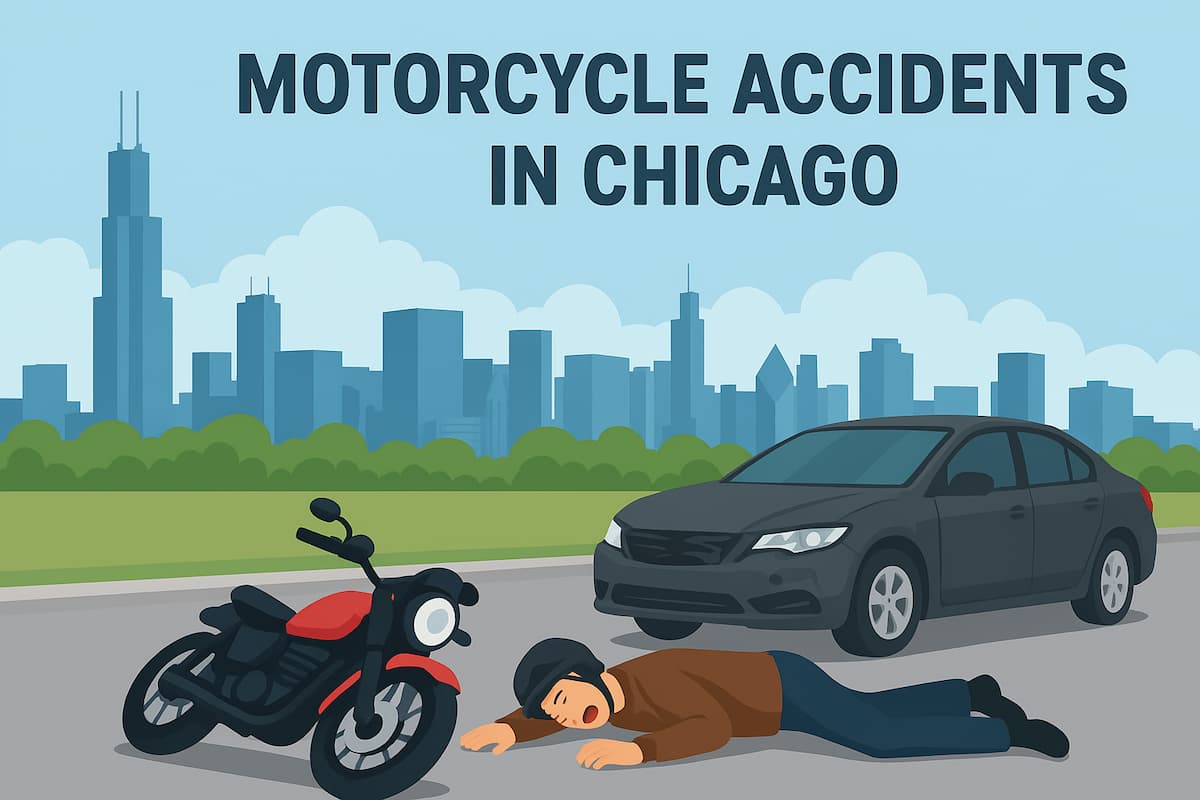
A motorcycle rider has nothing between them and the pavement except riding gear. When a car or truck misjudges a motorcycle’s speed or simply doesn’t see it, the resulting crash tends toward broken bones, spinal injuries, and traumatic brain injury rather than the bumps and bruises a similar low-speed collision might leave on two car occupants. Nationally, motorcyclists are killed in traffic crashes at a rate roughly 24 times higher than passenger car occupants per mile traveled, and in 2024 motorcyclist deaths accounted for about 16 percent of all traffic fatalities – a wildly disproportionate share given how few miles motorcycles actually cover compared to cars.
As a Chicago personal injury lawyer with more than 30 years handling motorcycle crash cases, I’ve seen how much the specific cause of a crash shapes the claim that follows. A left-turn collision, a lane-change sideswipe, and a pothole that throws a rider off the bike all point toward different defendants and different evidence, which is why identifying exactly what went wrong matters as much as documenting the injuries themselves.
Common Causes of Motorcycle Accidents
- Distracted drivers. Texting, phone calls, and infotainment screens keep drivers from noticing motorcycles, which present a much smaller visual profile than a car or truck. A driver scanning for headlight width rather than shape can miss a motorcycle entirely, even in daylight.
- Speeding. Higher speed shrinks the reaction window for both riders and drivers and increases crash severity dramatically. A collision survivable at 25 mph can be fatal at 45.
- Failure to yield, especially left turns. A driver turning left across oncoming traffic who misjudges a motorcycle’s speed and distance – assuming it’s farther away than it is because it’s smaller than a car – is one of the single most common causes of serious motorcycle crashes at intersections nationwide, and Chicago’s dense intersection grid produces plenty of opportunities for exactly this mistake.
- Impaired driving. Alcohol or drug impairment in either the motorist or the rider slows reaction time and reduces coordination, and toxicology results often become central evidence in disputed-fault cases.
- Unsafe lane changes. A driver who checks mirrors but not the blind spot directly beside them can merge straight into a motorcycle, producing a side-impact collision that frequently throws the rider from the bike.
- Poor road conditions. Potholes, loose gravel, steel plates over construction cuts, and faded lane markings all affect a motorcycle far more than a four-wheeled vehicle, since a bike relies entirely on two narrow contact patches for stability.
Illinois’s Helmet Law, and Why It Doesn’t Decide Fault
Illinois is one of a small number of states with no universal helmet requirement for adult riders. That surprises a lot of people, and it leads to a common misconception: that a rider who wasn’t wearing a helmet is automatically partly to blame for a crash. That’s not how Illinois law works. Whether a helmet was worn goes to the extent of head injuries, not to who caused the collision in the first place – a driver who ran a red light and hit a helmetless rider is still fully liable for causing the crash, even if the lack of a helmet affected how severe the resulting injury turned out to be. Insurance adjusters sometimes lean on this misconception anyway, hoping an unrepresented claimant won’t know the difference between causation and injury severity.
Typical Injuries in Chicago Motorcycle Crashes
The injury patterns in motorcycle crashes differ from car-versus-car collisions in ways that matter for a claim’s value. Road rash from sliding across pavement can require skin grafts in severe cases. “Biker’s arm” – nerve damage from instinctively bracing during a fall – can cause lasting weakness even after fractures heal. Lower-extremity injuries are common because a rider’s legs have no door or frame protecting them, and traumatic brain injury risk is elevated even with a helmet, since a helmet reduces but doesn’t eliminate the risk of serious head trauma. Documenting the full scope of these injuries, including ones that aren’t obvious in an emergency room the same day, is part of why ongoing treatment records matter as much as the initial crash report.
Understanding Illinois Law
Illinois applies a modified comparative negligence rule (735 ILCS 5/2-1116) to motorcycle crashes the same as any other personal injury claim. A rider who shares some responsibility for a crash isn’t automatically barred from recovering compensation – their award is simply reduced by whatever percentage of fault gets assigned to them, and recovery is barred entirely only if that percentage exceeds 50 percent. A rider found 20 percent at fault for a $200,000 claim recovers $160,000, not the full amount, which is exactly why insurance companies push hard to inflate a rider’s share of the blame after any crash involving a motorcycle.
The math matters in practice, not just in theory. Take a rider with $50,000 in documented medical bills, lost wages, and pain and suffering. If an insurer successfully argues the rider was 15 percent at fault for not signaling a lane change soon enough, the payout drops to $42,500. Push that argument to 45 percent, right at the edge of the bar, and the payout falls to $27,500 – less than the medical bills alone might total in a serious crash. Every percentage point an adjuster can attach to the rider is worth real money to the insurance company, which is the single biggest reason recorded statements and casual admissions at the scene do so much damage to a claim’s value.
One detail specific to motorcycles matters here: Illinois does not permit lane splitting or lane filtering – riding between lanes of stopped or slow-moving traffic – unlike a handful of other states. A rider who was lane splitting at the time of a crash may face an uphill argument on fault regardless of what the other driver did, which makes it worth discussing candidly with an attorney rather than leaving it for the insurance company to discover and use against the claim later.
How Long You Have to File a Claim
Illinois generally gives injury victims two years from the date of the crash to file a lawsuit (735 ILCS 5/13-202). That deadline runs regardless of how the settlement negotiations are going, and letting it pass generally ends the case even if liability was never seriously in dispute. A shorter one-year window applies if a government entity – a municipality responsible for a poorly maintained road, for example – is a potential defendant, under the Local Governmental and Governmental Employees Tort Immunity Act. Identifying a possible government defendant, such as when a pothole or debris from a city project caused the crash, is worth doing early precisely because that clock runs so much faster.
A Realistic Example
The following is a hypothetical scenario used for illustration only, not an account of an actual case or a guaranteed outcome.
Imagine a rider traveling straight through a green light on a four-lane Chicago arterial when an oncoming driver turns left, misjudging the motorcycle’s speed, and the two collide. The rider suffers a broken femur and a concussion. The driver tells the responding officer the motorcycle “came out of nowhere,” and the insurer’s first offer assumes significant shared fault on the rider’s part for supposedly speeding. Traffic camera footage from a nearby intersection shows the motorcycle traveling at or near the posted limit, and an accident reconstruction analysis of the debris field confirms the speed estimate. With that evidence in hand, the fault allocation shifts almost entirely onto the turning driver, and the settlement discussion moves from a shared-fault framework to one reflecting close to full driver liability. The scenario illustrates how quickly an insurer will default to blaming the rider absent hard evidence proving otherwise.
Common Mistakes to Avoid
Motorcycle crash claims get weakened by predictable, avoidable mistakes in the hours and days afterward.
- Admitting fault, even informally. A reflexive “I’m sorry” at the scene can be repeated back later as an admission. Stick to the facts and let the evidence do the talking.
- Skipping medical care. An injury that seems minor at the scene can turn out to be a fracture or internal injury that doesn’t show symptoms right away, and a delayed exam gives the insurer room to argue something else caused the injury later.
- Letting evidence disappear. Photograph the bike, the other vehicle, skid marks, the intersection or roadway, and your injuries before the scene gets cleared. Once traffic reopens, most of that evidence is gone for good.
- Giving a recorded statement before talking to a lawyer. Adjusters are trained to ask questions that produce answers they can characterize as fault-shifting, even from a cooperative, honest rider.
At Phillips Law Offices, we take over those insurance conversations for our clients so a stray comment made while still processing the crash doesn’t end up used against the claim.
It also helps to think about the timeline realistically. Property damage and initial medical bills usually get resolved fastest, sometimes within weeks. A claim involving ongoing treatment, physical therapy, or a question about whether a surgery will be needed down the road typically takes longer to value accurately, because settling too early risks accepting a number that doesn’t account for costs that haven’t materialized yet. Rushing a serious injury claim to a quick settlement is one of the more common regrets riders describe after the fact, once a second surgery or an extended course of physical therapy turns out to cost more than the case settled for.
When to Contact a Chicago Personal Injury Lawyer
Early legal guidance matters most in exactly the cases where insurers move fastest to minimize a payout: serious injuries, disputed fault, or a driver with minimal insurance coverage. Even a crash that looks straightforward at first can carry hidden long-term costs – a concussion that affects work performance for months, or a knee injury that needs surgery a year later – that a quick early settlement won’t cover. Our team manages the insurance communications, gathers and preserves evidence, and takes the case to litigation if a fair settlement doesn’t materialize through negotiation.
What If the At-Fault Driver Is Uninsured
Illinois requires liability insurance, but plenty of drivers carry the state minimum or none at all, and a serious motorcycle injury can easily exceed even a properly insured driver’s policy limits. A rider’s own uninsured and underinsured motorist coverage, if purchased, can fill that gap – a separate claim against your own insurer that comes with its own procedural rules and deadlines, worth discussing with an attorney rather than assuming the case ends when the driver’s coverage runs out.
Motorcycle Insurance Basics in Illinois
Illinois requires the same minimum liability coverage for motorcycles as for cars, but many riders carry only that state minimum, which can be exhausted quickly in a serious crash. Riders who own a separate motorcycle policy should check whether it includes uninsured and underinsured motorist coverage specifically for the bike, since a personal auto policy’s UM/UIM coverage doesn’t always automatically extend to a motorcycle depending on how the policy is written. Reviewing your own coverage before a crash happens, not after, is one of the more overlooked ways to avoid a coverage gap when you need it most.
Compensation You May Recover
A motorcycle accident claim in Illinois can pursue several categories of damages, depending on the injury and its long-term effects:
- Emergency treatment, surgery, and ongoing rehabilitation
- Lost wages during recovery and reduced future earning capacity for career-limiting injuries
- Pain and suffering, including the psychological impact of a traumatic crash
- Repair or replacement of the motorcycle, helmet, and riding gear
- Wrongful death damages when a crash proves fatal, pursued by the estate and surviving family members
Proving the future-facing categories – ongoing care, reduced earning capacity – typically takes more than a stack of medical bills. A treating physician’s opinion on long-term prognosis, and sometimes a vocational expert’s assessment of how the injury affects your ability to work, carries real weight in getting an insurer to move off a lowball number.
Evidence That Strengthens a Motorcycle Claim
Beyond the basics of photos and a police report, a few less obvious pieces of evidence often make the difference in a disputed-fault motorcycle case. Traffic and security camera footage from nearby businesses is frequently the single most persuasive piece of evidence, since it removes the “he said, she said” problem entirely, but it’s usually overwritten within days or weeks, which is why requesting it quickly matters. Event data from the other vehicle, when available, can establish speed and braking at the moment of impact. And in cases where fault is genuinely contested, an accident reconstruction expert can analyze the debris field, gouge marks in the pavement, and final resting positions of the vehicle and motorcycle to build an independent account of how the crash actually unfolded.
Frequently Asked Questions
1. What should I do immediately after a motorcycle accident in Chicago?
Seek medical attention, call the police, gather evidence, and contact a Chicago personal injury lawyer before speaking with insurance companies.
2. Who can be held liable for a motorcycle accident?
Liability can fall on other drivers, property owners, municipalities, or even vehicle manufacturers, depending on the circumstances.
3. How long do I have to file a claim in Illinois?
Generally two years from the date of the accident, though a one-year deadline applies if a government entity is a potential defendant.
4. Do I still have a case if I was partially at fault?
Yes, as long as your share of fault is 50 percent or less. Illinois’s comparative negligence rule reduces your compensation by your percentage of fault rather than eliminating the claim.
5. Can I handle the insurance claim myself?
It’s possible, but insurers routinely offer less to unrepresented claimants, so most riders benefit from a consultation before accepting any settlement offer.
Final Thought
Distracted driving, speeding, failure to yield at left turns, impairment, unsafe lane changes, and poor road conditions cause most Chicago motorcycle crashes, and each of those causes points toward different evidence and, sometimes, a different defendant. Documenting the scene thoroughly, getting checked medically without delay, and avoiding early statements to an insurance adjuster protect a claim that’s often worth more than the first number offered.
Contact Phillips Law Offices Today
If you were hurt in a motorcycle accident in Chicago or anywhere in Illinois, call (312) 346-4262 for a free consultation. We bring more than 30 years of experience to motorcycle crash claims and handle the insurance company communications so you can focus on recovery.
Authoritative Sources
Related Chicago Accident Guides
- Who is at Fault in a Chicago Pedestrian Accident?
- What Damages Can I Recover After a Chicago Car Accident?
- What If the Other Driver Was Uninsured or Underinsured in Chicago?
- What Should I Do if I’m Hit by a Car While Riding My Bike in Illinois?
- Car Fires After Collisions in Chicago: Evidence Preservation, Product-Liability Flags, and Immediate Steps
- Car-vs-Pedestrian Crosswalk Claims in Chicago (Non-Fatal): Rights, Evidence, and Next Steps
- Motorcycle Lane-Filtering and Lane-Splitting Crashes in Illinois
FAQs
What are common causes of motorcycle crashes in Chicago?
Left-turn conflicts, visibility issues, speeding, and distracted driving are common contributors.
Do helmet or gear issues decide fault automatically?
No. Fault is based on overall crash evidence and traffic-law analysis, not gear alone.
What evidence is most helpful in motorcycle injury claims?
Crash reports, scene photos, bike damage, witness statements, and consistent medical documentation.
Is lane splitting legal for motorcycles in Illinois?
No. Illinois does not permit lane splitting or lane filtering, and riding that way at the time of a crash can affect a fault determination.
Riders face fault arguments that drivers do not. See our Chicago motorcycle accident lawyer page.
Every guide in our series on motorcycle crashes in Illinois
- Illinois Motorcycle Helmet Law and Injury Claims
- Motorcycle Lane-Filtering and Lane-Splitting Crashes in Illinois
Talk to a Chicago motorcycle accident lawyer. Phillips Law Offices offers a free case review, and there is no fee unless we recover for you. Call (312) 346-4262 or request a free case review.
This article is general information about Illinois law, not legal advice, and reading it does not create an attorney-client relationship. Illinois law changes; confirm anything you intend to rely on with a licensed Illinois attorney.