
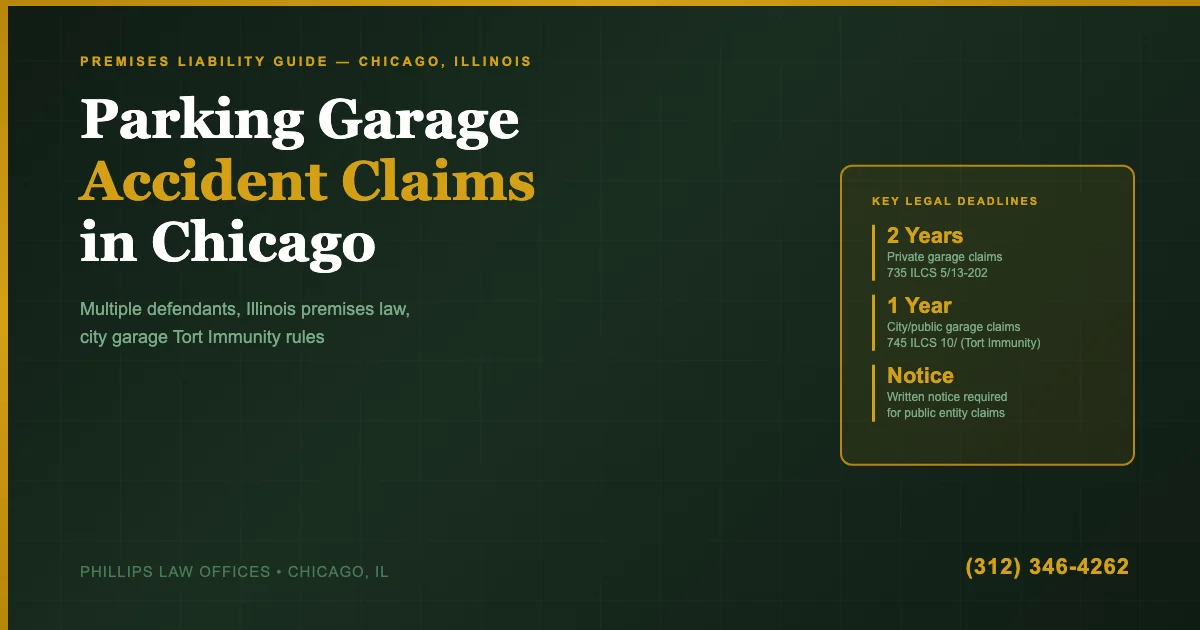
Short answer: Parking garage accidents in Chicago can involve multiple responsible parties: the garage operator, property owner, maintenance contractor, and in some cases the City of Chicago or a public authority. Injured victims may have claims under Illinois premises liability law, negligent security doctrine, or the Illinois Tort Immunity Act depending on who owns and operates the structure. The rules differ significantly between private garages and city-operated or Chicago Park District facilities, including a much shorter statute of limitations.
In my experience handling Illinois injury cases, parking garage accidents are among the most legally complex because they typically involve more than one defendant and more than one legal theory. A pedestrian struck by a backing vehicle faces both a negligent driver and potentially a garage that failed to install adequate traffic controls or warning systems. A person who slips on oil, water, or ice in a garage stairwell faces a premises liability claim against the operator, owner, or maintenance contractor. These cases require identifying every responsible party early, because delays can result in missed notice deadlines, spoliated evidence, and lost surveillance footage. This guide walks through the most common parking garage injury scenarios in Chicago, the applicable Illinois law, and what steps to take immediately after an accident.
Common Types of Parking Garage Accidents in Chicago
Parking garages create a specific combination of hazards: moving vehicles in tight spaces, pedestrian foot traffic, poor lighting, wet or oily surfaces, and in some areas, a history of criminal activity. The most common injury scenarios include:
- Pedestrian struck by vehicle: A driver backs out of a space or navigates a ramp without adequate visibility or warning signals. The driver may be liable for negligence, but if the garage lacked proper traffic controls, signage, or mirrors at blind corners, the garage operator may share liability.
- Slip and fall on oil, water, or ice: Fluid leaks from vehicles, rainwater tracked in from ramps, and ice accumulation on exposed levels create slip hazards. Under the Illinois Premises Liability Act (740 ILCS 130/), paying customers are invitees and are owed the highest duty of care: the operator must inspect and maintain the premises or warn of known hazards.
- Assault and negligent security: Parking garages are frequent sites of robbery and assault, particularly in poorly lit or unattended structures. If prior criminal incidents occurred in or near the garage and the operator failed to respond with adequate security measures, lighting, or camera systems, a negligent security claim may be viable.
- Carbon monoxide exposure: In enclosed or partially enclosed garages, ventilation failures can allow exhaust to accumulate. Prolonged exposure to carbon monoxide can cause serious neurological injury. The operator and any maintenance contractor responsible for the ventilation system may be liable.
- Structural failure: Collapsed ramps, failing cable barriers, crumbling concrete, and broken stairwell railings can cause catastrophic injuries. Liability may extend to the property owner, the original structural engineer, and any contractor who performed maintenance or repair.
Who Can Be Held Liable in a Chicago Parking Garage Accident
Multiple parties may bear legal responsibility for a parking garage injury, and identifying all of them is essential to maximizing recovery. The potential defendants in most Chicago parking garage cases include:
- The garage operator: The company or individual that manages day-to-day operations, including staffing, inspection, maintenance scheduling, and security protocols, is typically the primary defendant in a premises liability claim.
- The property owner: Even if the owner leases the garage to an operator, the owner may retain liability for structural conditions, major maintenance, and capital improvements. Lease agreements and property records will clarify the division of responsibility.
- Maintenance contractors: If a third party was hired to handle cleaning, lighting, HVAC systems, or structural repairs, that contractor may be directly liable for negligent work or failure to identify hazards.
- The negligent driver: In pedestrian-struck or vehicle collision cases, the at-fault driver’s personal auto insurance is typically the primary source of recovery. The garage’s liability does not diminish the driver’s responsibility.
- The City of Chicago or a public authority: If the garage is operated by the Chicago Park District, CTA, the City of Chicago, or another public entity, a separate legal framework applies, detailed in the next section.
Illinois Premises Liability Act and the Invitee Standard
Illinois premises liability law is codified at 740 ILCS 130/. The statute establishes that the duty owed to a person on someone else’s property depends on that person’s status: trespasser, licensee, or invitee. A paying customer in a commercial parking garage is an invitee, which carries the highest duty of care.
Under the invitee standard, the garage operator must: (1) use reasonable care to maintain the premises in a reasonably safe condition, (2) inspect the premises to discover dangerous conditions, and (3) either repair the condition or provide adequate warning to visitors. This is an ongoing duty, not a one-time obligation. If a garage operator fails to inspect stairwells, ignores reported hazards, or leaves ice or fluid spills unaddressed for an unreasonable period, they have breached their duty to invitees.
For slip and fall claims involving ice or snow specifically, Illinois courts require that the property owner or operator have actual or constructive notice of the condition. Constructive notice means the condition existed long enough that a reasonable inspection would have discovered it. If ice forms on an exposed ramp level overnight and no inspection occurs before the garage opens to customers, constructive notice is a viable argument.
Paying customers in a commercial parking garage are invitees under 740 ILCS 130/. That status carries the highest duty of care under Illinois law. When a garage operator fails to inspect, fails to warn, and fails to maintain safe conditions, that failure is not just negligence in the abstract, it is a legal breach that can form the basis of a personal injury claim.
City-Operated Garages: Tort Immunity Act and Special Rules
If the parking garage is owned or operated by a governmental entity, including the City of Chicago, the Chicago Park District, or the Chicago Transit Authority, the Illinois Tort Immunity Act applies. This changes the claim process in two critical ways.
First, the statute of limitations is shorter. Under 745 ILCS 10/, personal injury claims against local public entities must be filed within one year of the injury, compared to the standard two-year period for private defendants under 735 ILCS 5/13-202. Missing the one-year deadline almost always bars your claim permanently.
Second, the deadline is the filing deadline itself — Illinois repealed the Tort Immunity Act’s pre-suit notice provision in 1986. Specific notice requirements vary by entity. For Chicago Park District claims, for example, the lawsuit must be filed within one year of the injury under 745 ILCS 10/8-101. Failure to provide proper notice is often a complete bar to recovery. If you are injured in a city-owned or district-operated garage, preserving your right to sue requires acting well before the one-year mark.
The Tort Immunity Act also grants certain immunities to public entities for discretionary acts, such as decisions about where to place security personnel, that private defendants would not have. This does not mean a public garage cannot be held liable, but the legal analysis is more involved and requires an attorney experienced with Illinois public liability law.
Parking Garage Injury Scenarios and Potentially Liable Parties
| Injury Scenario | Potentially Liable Parties | Key Legal Theory |
|---|---|---|
| Pedestrian struck by reversing vehicle | At-fault driver, garage operator (if poor traffic controls) | Driver negligence + premises liability |
| Slip on oil or fluid leak | Garage operator, maintenance contractor | Premises liability (invitee duty), negligent maintenance |
| Fall on ice (exposed ramp/roof level) | Garage operator, property owner | Premises liability, actual or constructive notice of ice |
| Assault or robbery in garage | Garage operator, property owner, security contractor | Negligent security (foreseeability of crime) |
| Carbon monoxide poisoning | Garage operator, HVAC maintenance contractor | Premises liability, negligent maintenance |
| Structural collapse or railing failure | Property owner, operator, structural contractor, engineer | Premises liability, construction negligence |
| Accident in city-operated garage | City of Chicago, Chicago Park District, CTA | Illinois Tort Immunity Act (745 ILCS 10/8-101), 1-year deadline to file suit |
Negligent Security Claims in Chicago Parking Structures
A parking garage operator’s duty to maintain safe premises extends to protecting customers from foreseeable criminal acts. Negligent security claims in Illinois are analyzed under a foreseeability standard: was the criminal act foreseeable given the history of criminal activity in or near the garage, and did the operator take reasonable steps to address that risk?
Evidence relevant to a negligent security claim includes: police reports of prior incidents at the same address, city crime statistics for the area, the operator’s own incident logs, the presence or absence of surveillance cameras, whether camera footage was actually monitored in real time, lighting levels (measured against applicable codes), whether an attendant was on duty, and whether the operator had received complaints about security issues before the incident.
Illinois courts have recognized that parking structures, particularly those in high-traffic urban areas or neighborhoods with documented crime patterns, create a heightened duty to implement reasonable security measures. An operator who knew or should have known about prior criminal incidents in the facility and did nothing is in a difficult legal position.
What to Do Immediately After a Parking Garage Accident in Chicago
The steps you take in the hours and days after a parking garage injury can significantly affect your ability to recover compensation. Here is what to do:
- Call 911 and get medical attention: Document the injury immediately. A police report establishes the time, location, and initial circumstances of the incident.
- Photograph the scene: Capture the hazard that caused the injury, the area lighting, any visible warning signs (or the absence of them), and the surrounding conditions. Do this before any cleanup occurs.
- Request surveillance footage in writing: Parking garages retain surveillance video for varying periods, sometimes as little as 24 to 72 hours. Send a written preservation demand to the garage operator and property owner immediately. Once footage is overwritten, it is gone.
- Get witness information: Names and contact information for anyone who saw the accident or was nearby. Attendants, valets, and other customers can be important witnesses.
- Report the incident to the garage operator: Ask for a copy of any incident report they complete. This creates a record that they were put on notice.
- Consult an attorney before giving statements: Garage operators and their insurers may contact you quickly. Do not give a recorded statement or sign any releases before speaking with a lawyer.
Frequently Asked Questions About Parking Garage Accidents in Illinois
Can I sue a Chicago parking garage if I was assaulted in it?
Yes, if the assault was foreseeable and the garage operator failed to take reasonable security precautions. Illinois negligent security law holds property owners and operators responsible when they knew or should have known about criminal activity in the area and failed to implement reasonable measures, such as adequate lighting, working cameras, or attendant coverage. Prior crime reports for the location are critical evidence in these cases.
How long do I have to file a claim after a parking garage accident in Chicago?
For private garage operators, the standard two-year statute of limitations applies under 735 ILCS 5/13-202. If the garage is operated by the City of Chicago, the Chicago Park District, or another public entity, you must act within one year under the Illinois Tort Immunity Act (745 ILCS 10/), and there is no separate pre-suit notice step — filing the suit within that year is the requirement. Do not rely on the longer deadline without first confirming who owns and operates the garage.
What if the driver who hit me in the garage left the scene?
If the at-fault driver fled without providing insurance information, you have two potential sources of recovery: your own uninsured motorist (UM) coverage, if you carry it, and a potential premises liability claim against the garage if poor traffic controls or visibility contributed to the collision. The garage’s surveillance footage is essential in hit-and-run scenarios both to identify the driver and to document conditions at the time of the accident.
Is the parking garage responsible if I slipped on ice on an open-air level?
It depends on notice. Under Illinois premises liability law, the garage operator must have actual or constructive notice of the ice condition. If ice formed overnight and the garage opened without any inspection or de-icing of exposed levels, constructive notice is a reasonable argument. Weather records, the operator’s own maintenance logs, and any prior complaints about ice on the level are all relevant evidence.
Does Illinois comparative fault affect my parking garage injury claim?
Yes. Illinois follows a modified comparative fault system under 735 ILCS 5/2-1116. If you are found to be more than 50 percent at fault for your own injury, you cannot recover. If you are 50 percent or less at fault, your recovery is reduced proportionally. Insurance adjusters and defense attorneys routinely argue that injured parties contributed to their own accidents in parking garage cases. Having an attorney document the scene conditions and counter these arguments early is important.
Authoritative Sources
- 740 ILCS 130/, Illinois Premises Liability Act
- 745 ILCS 10/, Illinois Tort Immunity Act (public entity liability)
- 735 ILCS 5/13-202, Illinois Code of Civil Procedure, Personal Injury Statute of Limitations
- 735 ILCS 5/2-1116, Illinois Modified Comparative Fault
- 215 ILCS 5/143a, Uninsured Motorist Coverage (for hit-and-run scenarios)
Related Illinois Injury Guides
- How Much Is a Car Accident Case Worth in Chicago?
- How Long Does a Car Accident Settlement Take in Illinois?
- When to Hire a Lawyer After a Chicago Car Accident
- Chicago Slip and Fall Accident Lawyer (Accident Injury Lawyer Chicago)
If you were injured in a Chicago parking garage, call Phillips Law Offices at (312) 346-4262 for a free consultation. We handle premises liability, negligent security, and vehicle accident claims in parking structures throughout the Chicago area.
Related guides on collision types and fault
- Start here: Intersection Accidents in Chicago: Red Light, Stop Sign & Right-of-Way Claims
- Most Dangerous Intersections in Chicago for Car Accidents
- Winter Driving Accidents in Chicago: Ice, Snow & Liability Issues
- Car Fires After Collisions in Chicago: Evidence Preservation, Product-Liability Flags, and Immediate Steps
- Airbag Injuries and Airbag Non-Deployment Claims in Illinois
Talk to a Chicago car accident lawyer. Phillips Law Offices offers a free case review, and there is no fee unless we recover for you. Call (312) 346-4262 or request a free case review.
This article is general information about Illinois law, not legal advice, and reading it does not create an attorney-client relationship. Illinois law changes; confirm anything you intend to rely on with a licensed Illinois attorney.