
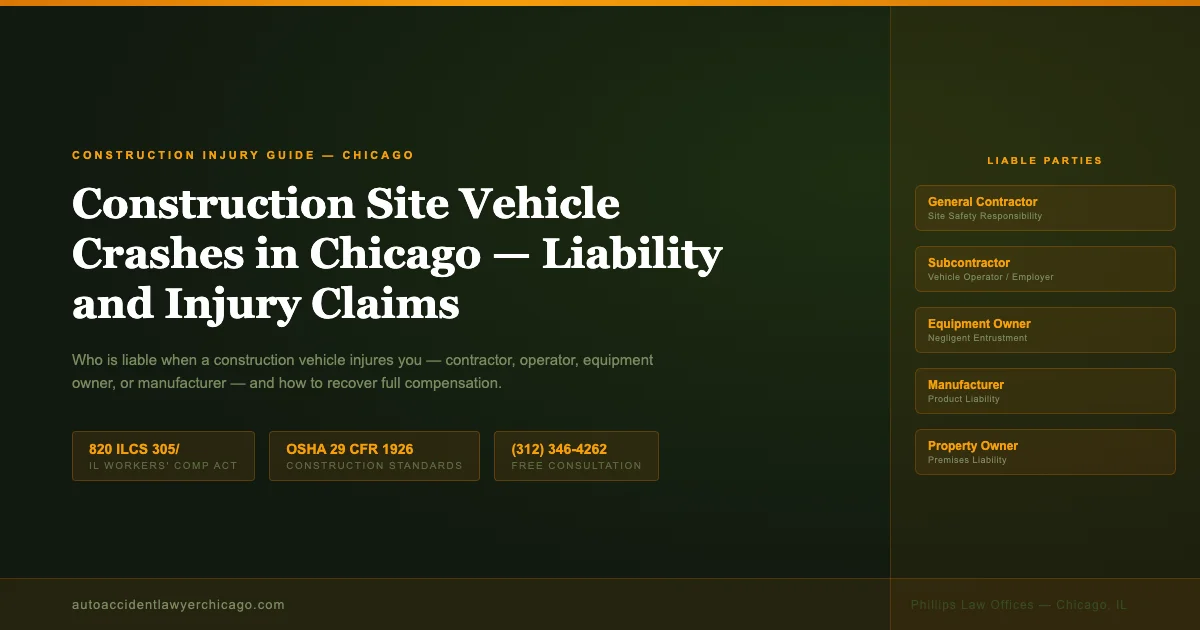
Short answer: Construction site vehicle crashes in Chicago can involve multiple responsible parties, the general contractor, a subcontractor, the equipment owner, the vehicle operator, or the property owner. If you were injured by a construction vehicle on a public road or a worksite, you may have claims against more than one defendant and may be entitled to compensation beyond what workers’ compensation alone provides. Illinois law allows injured construction workers and bystanders to pursue third-party personal injury claims in addition to, or instead of, workers’ comp benefits. Getting an attorney involved early is critical because evidence disappears fast on active job sites.
Multi-Party Liability in Chicago Construction Vehicle Cases
At Phillips Law Offices, I handle construction site vehicle crash cases throughout Chicago and Cook County. These cases are among the most legally complex injury matters I work on, not because the facts are obscure, but because the web of contracts, insurance policies, and overlapping liability rules requires careful navigation from day one. A dump truck that backs into a worker may be owned by a subcontractor, operated by a temp agency employee, insured through a commercial fleet policy, and working under a general contractor’s site safety plan, all simultaneously. Every one of those layers is a potential source of compensation, and every one of those parties will have lawyers protecting their interests the moment an injury is reported. You need someone protecting yours.
Types of Construction Vehicle Accidents in Chicago
Construction vehicle crashes in the Chicago area fall into several distinct categories, each with its own liability dynamics:
- Dump trucks and cement mixers on public roads. Heavy vehicles entering and exiting job sites pose risks to passing drivers and cyclists. If a construction truck failed to yield, lacked proper signage, or was overloaded, the trucking company and the general contractor responsible for site traffic management may both be liable.
- Forklifts and warehouse vehicles inside worksites. Forklift accidents are among the most common construction site injuries in Illinois. OSHA’s powered industrial truck standards at 29 CFR 1926.602 govern forklift operation on construction sites. Violations of those standards establish negligence.
- Cranes and aerial lifts. Crane swing strikes, boom collapses, and aerial lift tip-overs cause catastrophic injuries. Equipment maintenance records, load certifications, and operator training documentation are critical evidence in these cases.
- Excavators and bulldozers near pedestrians. Heavy earthmoving equipment operates in areas that may be inadequately cordoned from bystanders or from workers in adjacent areas. Poor site organization and inadequate spotting procedures are common contributing factors.
- Delivery and supply vehicles on active job sites. Vendors delivering lumber, rebar, or equipment often enter sites without formal safety orientation. When a delivery driver’s vehicle injures a worker, the delivery company may carry independent commercial auto liability.
- Roadway construction vehicle strikes. Workers in Illinois highway construction zones are protected by enhanced penalties under Illinois Vehicle Code provisions, but crashes still happen. Both the contracting company and the striking driver may be liable.
Who Is Liable, Multiple Possible Defendants
Illinois law allows injured parties to pursue every defendant whose negligence contributed to the crash. Here is how liability typically breaks down in construction vehicle cases:
| Defendant Type | Basis for Liability | Common Evidence |
|---|---|---|
| General Contractor | Overall site safety responsibility, OSHA compliance, subcontractor supervision | Site safety plan, OSHA citations, daily logs |
| Subcontractor | Direct operator of vehicle, employer of negligent driver, equipment maintenance | Employment records, maintenance logs, training certificates |
| Equipment Owner (Rental Company) | Negligent entrustment if rented to unqualified operator; defective equipment if not maintained | Rental agreements, inspection records, service history |
| Equipment Manufacturer | Product liability if defective design or manufacturing caused or contributed to the crash | Recall records, engineering specifications, incident reports |
| Property Owner | Premises liability for unsafe site conditions, failure to require contractor compliance with safety standards | Site lease agreements, property owner safety requirements, prior incident history |
| Staffing Agency | Vicariously liable if the negligent operator was placed by the agency | Staffing contracts, operator qualifications on file with agency |
Illinois construction workers often assume that workers’ compensation is their only option after a job site vehicle crash. That is rarely true. If any party other than your direct employer caused or contributed to your injury, a subcontractor, an equipment owner, a neighboring contractor, you can file a third-party personal injury lawsuit on top of your workers’ comp claim. Dual recovery is not just possible; in serious injury cases it is often the only way to get full compensation for what you have actually lost.
Illinois Workers’ Compensation vs. Third-Party Claims
If you were injured as a construction worker, you may have two separate legal remedies running simultaneously:
- Workers’ compensation (820 ILCS 305/). Your employer’s workers’ comp covers medical bills and two-thirds of your average weekly wage while you are off work, regardless of fault. Workers’ comp does not cover pain and suffering. You cannot sue your direct employer for negligence, workers’ comp is the exclusive remedy against them.
- Third-party personal injury lawsuit. If a party other than your direct employer caused your injury, a subcontractor’s driver, an equipment manufacturer, the site owner, you can file a civil lawsuit seeking full compensation including pain and suffering, full lost wages, and future earning capacity. Workers’ comp has a lien on any third-party recovery, but even after satisfying that lien, injured workers typically net significantly more through a combined recovery than through workers’ comp alone.
If you were a bystander or a driver on a public road struck by a construction vehicle, workers’ compensation does not apply to you at all. Your remedy is a direct personal injury claim against the vehicle operator, the construction company, and any other responsible party.
OSHA and Illinois Safety Regulations That Establish Negligence
Violations of OSHA standards and Illinois safety regulations are powerful evidence of negligence in construction vehicle crash cases. Key applicable standards include:
- OSHA 29 CFR 1926.600-602, Motor vehicles and mechanized equipment on construction sites, including requirements for backup alarms, rollover protection, and operator competency.
- OSHA 29 CFR 1926.20, General safety and health provisions, requiring contractors to initiate and maintain programs to prevent accidents.
- OSHA 29 CFR 1926.21, Safety training and education requirements, operators must be trained and competent.
- 820 ILCS 225/ (Illinois Health and Safety Act), Illinois-specific workplace safety requirements that overlap with and supplement OSHA standards.
- Illinois Vehicle Code, Standard traffic laws apply to construction vehicles on public roads and site roads that connect to public streets.
An OSHA citation issued after your crash is not required for a successful civil claim, but it is highly persuasive evidence. Obtaining OSHA inspection records, incident reports, and the employer’s own internal accident investigation is a priority in the first weeks after a serious construction vehicle injury.
Evidence to Preserve After a Construction Vehicle Crash
Evidence on construction sites disappears quickly. Vehicles are repaired or returned to rental companies. Job site configurations change daily. Witnesses move to other projects. If you or someone you know has been injured in a construction vehicle crash in Chicago, these are the most time-sensitive evidence items to preserve:
- Photographs of the scene. Document the vehicle, the area of the crash, any barriers or lack thereof, warning signs, and your injuries before anything is moved or changed.
- Incident reports. Request a copy of any on-site incident report completed by the general contractor or subcontractor. Under Illinois law, you are entitled to a copy of any report that concerns your injury.
- OSHA inspection records. If OSHA responded to the incident or inspected the site in the months before your crash, those records are public and can be requested through OSHA’s online portal.
- Vehicle maintenance and inspection logs. Equipment involved in crashes must be preserved. A legal hold letter sent to all parties puts them on notice not to destroy records. Your attorney can send this immediately after being retained.
- Witness information. Fellow workers, delivery drivers, and bystanders may move on quickly. Get names and phone numbers before they leave the site.
- Black box and telematics data. Many commercial construction vehicles have event data recorders or GPS tracking. This data may be overwritten within days unless a preservation demand is sent immediately.
- Your medical records and work records. Document every treatment, every missed shift, and every out-of-pocket expense from the day of the crash forward.
Frequently Asked Questions
Can I sue if I was a construction worker injured on the job?
Yes, under specific circumstances. Workers’ compensation bars you from suing your direct employer, but it does not prevent you from filing a personal injury lawsuit against any other party who contributed to your injury. In construction vehicle cases, those parties often include subcontractors, equipment owners, rental companies, and site owners. If a co-worker employed by a different company injured you, that company may be a viable defendant. An attorney can map every party’s role on the project against the site’s contract structure to identify who is actually your employer versus who is a third party you can sue.
What if the construction vehicle had no markings or license plates?
Unmarked construction vehicles are common on enclosed job sites, and the absence of markings does not eliminate liability. Your attorney will subpoena the general contractor’s equipment inventory, subcontractor contracts, and daily sign-in logs to identify which company owned and operated the vehicle at the time of the crash. Site surveillance cameras, nearby business cameras, and witness accounts can also establish the vehicle’s identity. The general contractor who controlled the job site retains responsibility for ensuring all equipment on the site is properly operated and maintained, regardless of ownership.
Who pays if an uninsured subcontractor’s vehicle hit me?
Illinois law requires contractors to carry adequate insurance for their operations, and general contractors often require proof of insurance from every subcontractor as a condition of their contract. If a subcontractor violated that requirement, the general contractor may be directly liable for failing to enforce it. Additionally, the property owner and the project’s umbrella or excess liability policies may provide coverage even when the direct subcontractor is underinsured. If you were in your own vehicle at the time, your own uninsured or underinsured motorist coverage may also apply. These cases require a thorough insurance coverage analysis as an early step.
How long do I have to file a claim in Illinois?
For personal injury lawsuits against private parties in Illinois, the statute of limitations is two years from the date of the injury under 735 ILCS 5/13-202. For claims against a government entity, such as a crash involving a city contractor on a public road project, the deadline may be shorter and may require a formal notice of claim before filing suit. Workers’ compensation claims have separate deadlines under 820 ILCS 305/. In every construction vehicle case, two years sounds like a long time but evidence collection, expert retention, and pre-litigation negotiation take months. Starting early is always advantageous.
What is the Illinois Structural Work Act and does it still apply?
The Illinois Structural Work Act, which historically imposed strict liability on property owners and general contractors for scaffold and elevation-related injuries, was repealed effective January 1, 1996. It no longer applies to new claims. Some attorneys still encounter references to it in older case law, and historically it was a significant tool for injured construction workers, but current Illinois construction site injury claims rely on general negligence principles, the Illinois Health and Safety Act (820 ILCS 225/), OSHA violations, and the workers’ compensation system. If you have heard about the Structural Work Act in connection with your claim, the applicable legal framework today is different.
Authoritative Sources
- 820 ILCS 305/, Illinois Workers’ Compensation Act, governing benefits for injured employees and the exclusive remedy rule
- 820 ILCS 225/, Illinois Health and Safety Act, establishing Illinois-specific workplace safety requirements for employers and contractors
- OSHA 29 CFR 1926, Federal OSHA construction industry standards, including subpart O (motor vehicles), subpart N (cranes and derricks), and subpart G (safety training)
- 735 ILCS 5/13-202, Illinois personal injury statute of limitations (two years from date of injury)
Related Illinois Injury Guides
- Food Delivery Driver Accident Claims in Chicago
- Amazon, FedEx, and UPS Delivery Truck Crashes in Chicago
- Medical Liens After a Chicago Auto Accident
- Broken Bones and Fractures, Illinois Injury Claims
If you or someone you know was injured by a construction vehicle in Chicago, call Phillips Law Offices at (312) 346-4262 for a free consultation. We handle construction vehicle crash cases on a contingency fee basis, no fee unless we recover for you.
Crashes with commercial vehicles run on different rules and a faster evidence clock. See our Chicago truck accident lawyer page.
Related guides on truck and commercial vehicle crashes
- Start here: Commercial and Delivery Vehicle Crashes in Chicago: Company vs. Driver Coverage, Data, and Claim Steps
- Amazon, FedEx, UPS Delivery Truck Crashes in Chicago
- Tow Truck and Wrecker Crashes in Chicago
- Chicago Work Zone Accidents: Illinois Construction Zone Speed Limits, Fines, and Claims
Talk to a Chicago truck accident lawyer. Phillips Law Offices offers a free case review, and there is no fee unless we recover for you. Call (312) 346-4262 or request a free case review.
This article is general information about Illinois law, not legal advice, and reading it does not create an attorney-client relationship. Illinois law changes; confirm anything you intend to rely on with a licensed Illinois attorney.