
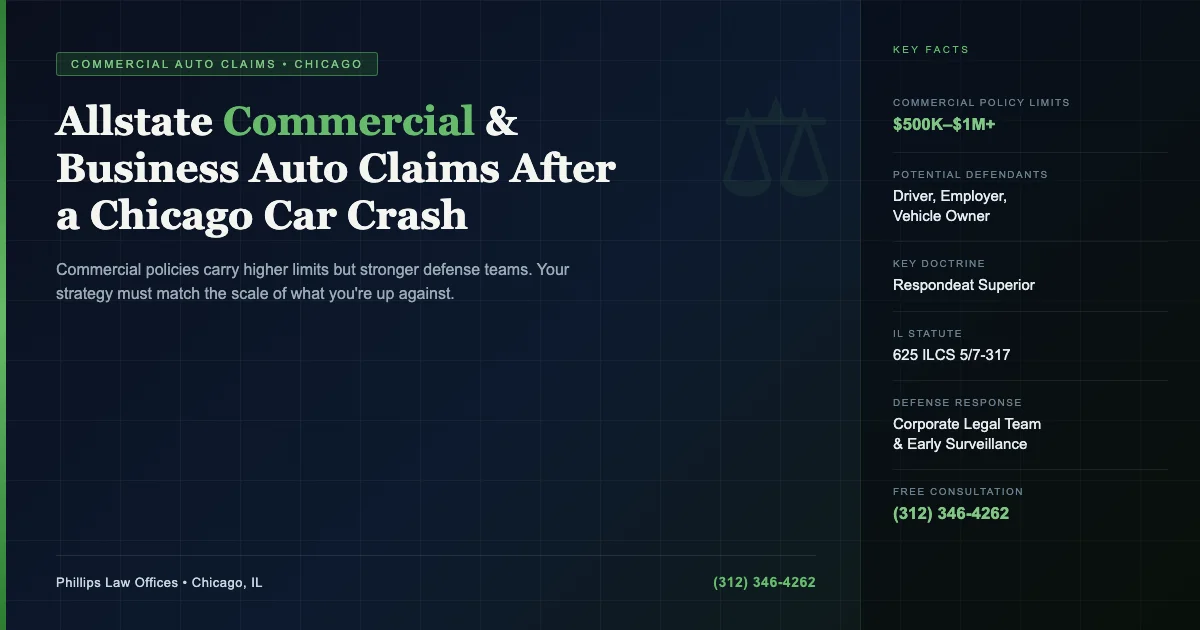
Short answer: Commercial and business auto policies issued by Allstate carry higher liability limits than personal auto policies, but they also come with more aggressive corporate defense teams, multiple potential defendants (the driver, the employer, and often the vehicle owner), and claims processes designed to protect business assets rather than compensate injured people. If you were hit by an Allstate-insured commercial vehicle in Chicago, the rules are different, and so is the strategy you need.
I want to be upfront about something. When I talk to clients who have been hit by a commercial vehicle, delivery van, or company car, there is often genuine surprise when they discover that the claim works nothing like a typical car accident case. The driver may be insured under a business policy they know little about. The employer may be a named insured. And Allstate’s commercial claims unit will often respond faster and more aggressively than the personal auto claims side ever would. That is not paranoia. That is how commercial claims work, and understanding it gives you a real advantage.
Commercial Auto vs. Personal Auto: Key Differences
Most people assume that all auto insurance works the same way. You file a claim, the adjuster evaluates it, and you receive a settlement. Commercial auto policies share some of that surface structure, but the underlying economics and legal dynamics are sharply different.
| Factor | Personal Auto Claim | Commercial Auto Claim |
|---|---|---|
| Typical policy limits | $25,000–$100,000 per person | $500,000–$1,000,000+ (often CSL) |
| Potential defendants | At-fault driver | Driver, employer, vehicle owner, lessor |
| Defense resources | Standard adjuster and counsel | Corporate legal team, retained defense firms |
| Time to resolve | Weeks to months | Often 12–24+ months for contested cases |
Commercial policies are purchased by businesses to protect their financial interests in the event an employee causes a crash while operating a company vehicle. When Allstate underwrites a commercial policy, the business owner is the named insured. That means the business, not just the driver, is the policyholder, and Allstate’s obligation runs to that business first.
Who Is Liable: Driver, Employer, and Vehicle Owner
One of the most important differences in commercial crash cases is that liability can extend well beyond the person behind the wheel. Under Illinois law, there are three distinct theories that may apply depending on the facts of your case.
First, the driver remains personally liable for their own negligence, just as in any accident. If the driver ran a red light or was distracted, that is direct negligence. Second, the employer may be liable under respondeat superior, which imposes liability on a business for the negligent acts of its employees committed within the scope of their employment. Third, the vehicle owner may be independently liable under Illinois’s owner liability statute, 625 ILCS 5/7-317, which creates liability when a vehicle is operated with the owner’s permission.
In a typical commercial vehicle case, all three theories apply simultaneously. That means you may be pursuing claims against the driver individually, the business entity, and potentially a vehicle leasing company, all within a single lawsuit.
Allstate’s Commercial Claims Process
Allstate handles commercial claims through a separate business insurance division that operates differently from the personal auto claims side. When a commercial claim is reported, a dedicated commercial claims adjuster is assigned. That adjuster is trained to evaluate claims with business liability exposure in mind, not to make the process easy for injured parties.
Expect Allstate’s commercial team to request a recorded statement early. They may also investigate the driver’s employment status, whether the driver was acting within the scope of their job at the time of the crash, and whether any maintenance issues with the vehicle contributed to the accident. These are not procedural formalities. They are information-gathering steps designed to build a defense.
Before you give any recorded statement to Allstate’s commercial claims unit, speak with an attorney. The information you provide will be used to frame the defense narrative, and commercial cases often involve early investigation by surveillance or accident reconstruction professionals.
Attorney insight: Commercial claims are not just bigger personal auto claims. They involve corporate defense teams with institutional knowledge of how to minimize exposure on high-limit policies. Surveillance often begins within days of the accident. Your social media, daily routine, and medical appointments may all be monitored. A different strategy is required from day one, and that starts with not volunteering information before you understand the full scope of who is on the other side.
Higher Policy Limits and What That Means for Your Claim
The existence of higher policy limits is genuinely good news if your injuries are serious. Commercial auto policies often carry combined single limits of $500,000, $1,000,000, or even higher for large fleets. If a driver with a standard Illinois minimum policy hit you, your recovery might be limited by that $25,000 per-person floor even in catastrophic cases. Commercial policies remove that ceiling in most serious injury scenarios.
But higher limits also mean higher stakes for the insurer and the business. A $1,000,000 claim gets very different treatment than a $25,000 claim. Allstate’s commercial side will invest significantly more in defense, investigation, and delay when the potential payout is substantial. This is why commercial cases frequently take longer to resolve and why the litigation phase matters more.
Medical documentation, treatment continuity, expert witnesses, and detailed damages calculations all become more important when the policy limits create room for a full recovery. A skilled Illinois injury attorney can help you build the kind of case that holds up against a corporate defense team with significant resources.
Respondeat Superior and Negligent Entrustment in Illinois
Respondeat superior is a Latin phrase that means “let the master answer.” Under this common law doctrine, an employer is vicariously liable for the torts of an employee committed within the scope of employment. In Illinois, courts have consistently applied this doctrine to commercial vehicle accidents where the driver was performing job duties at the time of the crash.
The key questions are: Was the driver an employee (not an independent contractor)? Was the driver acting within the scope of their employment at the time? If the driver was making a delivery, transporting equipment, or performing any task assigned by the employer, respondeat superior almost certainly applies.
Negligent entrustment is a separate but related theory. Under this doctrine, the vehicle owner can be independently liable if they entrusted a vehicle to a driver they knew, or should have known, was unfit to drive. This might apply if the driver had a history of violations, a suspended license, or prior accidents that the employer knew about but ignored. Negligent entrustment claims require evidence of the employer’s actual or constructive knowledge of the driver’s unfitness.
Both theories are authorized under Illinois law and can be pleaded simultaneously. The Illinois Insurance Code at 215 ILCS 5/ governs how commercial insurers like Allstate must respond to claims, and 625 ILCS 5/7-317 creates the statutory basis for owner liability in vehicle accident cases.
Frequently Asked Questions
What is the difference between an Allstate personal and commercial auto policy?
A personal auto policy covers an individual’s private use of a vehicle. A commercial auto policy is purchased by a business to cover vehicles used in business operations. Commercial policies typically carry significantly higher liability limits, list the business as the named insured, and are subject to different underwriting and claims handling procedures. When a crash involves a commercial vehicle, the insurer’s obligations, the available coverage, and the potential defendants are all different from a standard personal auto claim.
Can I sue both the driver and the employer after a commercial vehicle crash?
Yes. Illinois law permits claims against the driver individually for their own negligence and against the employer under respondeat superior if the driver was acting within the scope of their employment at the time of the crash. You can name both as defendants in a lawsuit and pursue recovery from both. The vehicle owner may also be named as a defendant under Illinois’s owner liability statute. An attorney can help you identify all responsible parties before filing.
What is respondeat superior?
Respondeat superior is a common law legal doctrine that holds employers vicariously liable for the negligent acts of their employees committed within the scope of employment. In a commercial vehicle accident context, if the driver was performing job duties at the time of the crash, the employer can be held liable for the driver’s negligence even if the employer did nothing wrong independently. This doctrine is well established under Illinois law and regularly applied in commercial vehicle injury cases.
Do commercial auto policies have higher limits than personal auto policies?
Generally, yes. Illinois law requires minimum personal auto liability coverage of $25,000 per person and $50,000 per accident. Commercial auto policies often carry combined single limits of $500,000 to $1,000,000 or more, particularly for fleets, delivery operations, and larger businesses. The higher limits can make a significant difference in serious injury cases where medical expenses, lost wages, and other damages exceed what a personal auto policy would cover.
How long do commercial auto claims take to settle?
Commercial claims typically take longer to resolve than personal auto claims. Cases involving significant injuries and high policy limits may take 12 to 24 months or more, particularly if litigation is required. The insurer and employer have financial incentives to delay and minimize, and corporate defense teams are often experienced at extending the process. Completing your medical treatment before settling, understanding the full scope of your damages, and having experienced legal representation all affect how efficiently a case moves toward resolution.
Authoritative Sources
- 215 ILCS 5/, Illinois Insurance Code (governing insurer obligations and commercial auto coverage requirements)
- 625 ILCS 5/7-317, Illinois Vehicle Code (owner liability for permissive use of a vehicle)
- Respondeat superior doctrine, Illinois common law as applied in commercial vehicle negligence cases
Related Illinois Injury Guides
- Dealing With Allstate After a Chicago Car Crash
- Dealing With Nationwide Insurance in Chicago
- Should You Give a Recorded Statement to an Insurance Adjuster in Illinois?
- Should You Accept the First Settlement Offer After an Illinois Accident?
If you were injured by an Allstate-insured commercial or business vehicle in Chicago, the Phillips Law Offices team can evaluate your claim, identify all responsible parties, and build a strategy designed for the commercial claims environment. Call us at (312) 346-4262 for a free consultation.
Related guides on dealing with the insurance company
- Start here: Dealing with Insurance Companies After a Chicago Car Accident: Tactics to Watch
- Dealing With American Family Insurance After a Chicago Car Crash
- Dealing With Country Financial After a Chicago Car Crash
- Dealing With Erie Insurance After a Chicago Car Crash
- Dealing With Farmers Insurance After a Chicago Car Crash
Talk to a Chicago car accident lawyer. Phillips Law Offices offers a free case review, and there is no fee unless we recover for you. Call (312) 346-4262 or request a free case review.
This article is general information about Illinois law, not legal advice, and reading it does not create an attorney-client relationship. Illinois law changes; confirm anything you intend to rely on with a licensed Illinois attorney.