
Short answer: If Travelers Insurance is involved in your Chicago car accident claim, you can expect a structured claims process that moves at their pace, not yours. Travelers adjusters are trained to minimize payouts through recorded statements, quick lowball offers, and delay tactics. Under Illinois law, you have the right to independent legal counsel, written claim explanations, and timely settlement of a valid claim. If Travelers is dragging its feet or offering less than your medical bills, lost wages, and pain and suffering are worth, it is time to talk to a Chicago car accident attorney before you sign anything.
My Experience Handling Travelers Insurance Claims in Chicago
At Phillips Law Offices, I have represented injured Chicago drivers and passengers going up against Travelers Insurance for years. Travelers is one of the largest auto insurers in the country, and its size means it has a well-funded claims department, experienced adjusters, and a predictable playbook for keeping settlements low. In my experience, Travelers tends to move faster than some competitors in the early stages of a claim, which can feel like good news until you realize the speed is designed to get you to accept a low offer before you fully understand the extent of your injuries. I have seen clients come to me after accepting a Travelers settlement that did not even cover their future physical therapy costs. This guide will walk you through what to expect, what Travelers will not volunteer to tell you, and how Illinois law protects you.
Travelers’ Claims Process in Illinois
Travelers operates a relatively efficient claims intake system. After a Chicago car accident, you or the other driver will report the crash, and Travelers will assign an adjuster, usually within one business day. That adjuster’s job is to evaluate liability and damages, but keep in mind their performance is measured against how much they save the company, not how fairly they treat claimants.
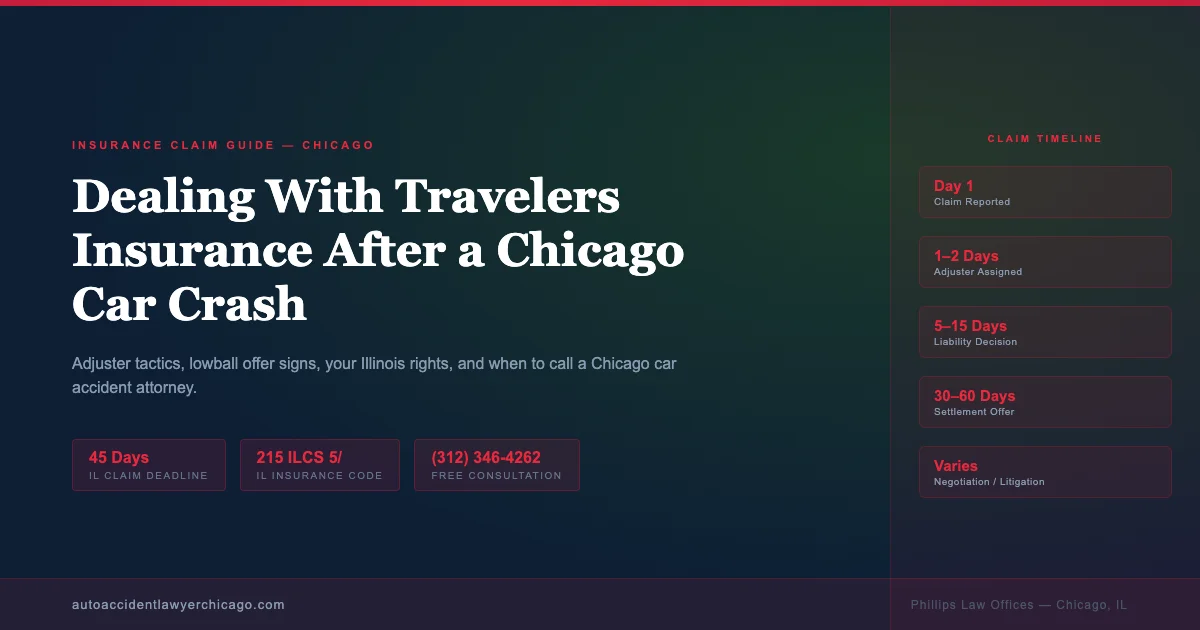
Here is a general timeline of how a Travelers auto claim unfolds in Illinois:
| Stage | Typical Timeframe | What to Watch For |
|---|---|---|
| Claim Reported | Day 1 | Get a claim number immediately |
| Adjuster Assigned | 1-2 business days | They may request a recorded statement right away |
| Liability Determination | 5-15 days | Travelers may try to share fault with you to reduce payout |
| Medical Records Requested | 2-4 weeks after treatment | They will request full medical history, not just crash-related records |
| Initial Settlement Offer | 30-60 days after injury stabilizes | First offers are almost always below fair value |
| Negotiation Period | Weeks to months | This is where an attorney adds the most value |
| Settlement or Litigation | Varies widely | Filing suit often moves things significantly faster |
Common Travelers Adjuster Tactics
Travelers adjusters are professional negotiators. Most accident victims are not. That imbalance is intentional. Here are the tactics I see most often in Chicago-area Travelers claims:
- The early recorded statement request. Adjusters will call within days of the crash and ask to record your account of events. Anything you say can be used to minimize your claim. You are not required to give a recorded statement to the other driver’s insurer.
- Suggesting your injuries are pre-existing. Travelers will request your full medical history looking for prior back, neck, or joint issues. Even if you had a prior condition, Illinois law still entitles you to compensation if the crash aggravated it.
- Lowball offers framed as reasonable. An adjuster might present a settlement as “what our analysis shows is fair” while leaving out future medical costs, lost earning capacity, and pain and suffering.
- Encouraging you not to hire an attorney. Adjusters sometimes tell claimants that hiring a lawyer “slows things down” or “takes money out of your pocket.” Research consistently shows represented claimants recover more even after attorney fees.
- Delays when you push back. If you decline an early offer, expect communication gaps, requests for redundant documentation, and general delay tactics designed to pressure you into settling.
What Travelers Pays (and Doesn’t)
Travelers will typically cover economic damages that are clearly documented: medical bills, property damage, and lost wages with appropriate verification. Where claims get disputed is on non-economic damages, future medical needs, and any gray-area liability situations.
Travelers generally does not volunteer compensation for:
- Future medical treatment and therapy costs beyond what they consider “necessary”
- Loss of enjoyment of life and emotional distress
- Pain and suffering beyond a multiple of your medical bills
- Lost earning capacity if you cannot document every specific shift or project you missed
- Out-of-pocket costs like rideshare to medical appointments, home care, or prescription copays
In my experience, Travelers is one of the insurers most likely to make a fast initial offer, specifically because they know injured people are dealing with medical bills and income loss. Speed is a strategy, not a courtesy. The right move is to wait until you reach maximum medical improvement before accepting anything, no matter how reasonable the first number sounds.
Your Rights Under Illinois Law
Illinois gives accident victims meaningful legal protections when dealing with insurers like Travelers. Under the Illinois Insurance Code (215 ILCS 5/), insurers must:
- Acknowledge a claim within 15 days of receiving notice
- Accept or deny a claim within 45 days of receiving proof of loss
- Not engage in unfair settlement practices, including making unreasonably low offers
- Provide a written explanation if a claim is denied or a settlement is offered below the claimed amount
Illinois also operates under a modified comparative fault rule. If Travelers argues you were partially at fault for the crash, your compensation is reduced by your percentage of fault, but you can still recover as long as you were not more than 50 percent at fault. This is important because Travelers adjusters often try to assign you 20 or 30 percent of fault as a negotiating tactic.
The Illinois Department of Insurance (IDOI) regulates Travelers and all insurers doing business in the state. You can file a complaint with IDOI at doi.illinois.gov if you believe Travelers is acting in bad faith or violating your rights under the Illinois Insurance Code.
When to Hire an Attorney for a Travelers Claim
You should strongly consider hiring a Chicago car accident attorney if any of the following apply to your situation:
- Your injuries required emergency care, hospitalization, surgery, or ongoing treatment
- You missed work or expect to miss future work due to your injuries
- Travelers is disputing liability or claiming you share fault
- Travelers denied your claim or is not responding in a timely way
- You received a settlement offer that does not cover all your medical bills
- You are unsure what your claim is actually worth
- Travelers requested a recorded statement before you had legal advice
At Phillips Law Offices, we handle Travelers Insurance claims on a contingency fee basis, meaning you pay nothing unless we recover compensation for you. Call us at (312) 346-4262 for a free consultation.
Frequently Asked Questions
Do I have to give Travelers Insurance a recorded statement?
If Travelers is the other driver’s insurer, you have no legal obligation to give them a recorded statement. If Travelers is your own insurer, your policy may require you to cooperate, but you should consult an attorney about the scope of that obligation before agreeing to any recording. Recorded statements are routinely used to find inconsistencies that reduce or deny claims.
How long does Travelers have to settle a claim in Illinois?
Under 215 ILCS 5/ (the Illinois Insurance Code), Travelers must acknowledge a claim within 15 days and accept or deny it within 45 days of receiving proof of loss. If they fail to meet these deadlines or engage in unreasonable delay tactics, you can file a complaint with the Illinois Department of Insurance or pursue a bad faith claim.
What if Travelers says I was partly at fault for the accident?
Illinois follows a modified comparative fault rule under 735 ILCS 5/2-1116. If Travelers claims you were 20 percent at fault, your recovery is reduced by 20 percent. You can still recover as long as your fault does not exceed 50 percent. An attorney can challenge Travelers’ fault allocation with accident reconstruction evidence, police reports, and witness statements.
Can Travelers access my full medical history?
Travelers will ask you to sign a broad medical authorization form that gives them access to records well beyond your crash-related treatment. You are not required to sign a blanket authorization. An attorney can help you provide records relevant to your claim while protecting your privacy and preventing Travelers from mining unrelated history to minimize your settlement.
Is it worth hiring an attorney for a Travelers claim?
For minor fender-benders with no injuries, you may handle the claim yourself. For any injury claim, the answer is almost always yes. Studies show that represented claimants receive significantly higher net settlements even after attorney fees. Travelers’ adjusters have handled thousands of claims; most injured people are navigating this for the first time. That experience gap costs claimants real money.
Authoritative Sources
- 215 ILCS 5/, Illinois Insurance Code (ilga.gov)
- Illinois Department of Insurance, Auto Insurance Consumer Guide
- 735 ILCS 5/2-1116, Illinois Comparative Fault Statute
Related Illinois Injury Guides
- Dealing With State Farm After a Chicago Car Crash
- Dealing With Allstate After a Chicago Car Crash
- Should You Give a Recorded Statement to an Insurance Adjuster in Illinois?
- Should You Accept the First Settlement Offer? Illinois Injury Guide
If Travelers Insurance is handling your Chicago car accident claim, do not go through the process alone. Call Phillips Law Offices at (312) 346-4262 for a free, no-obligation consultation with a Chicago car accident attorney who knows how Travelers operates.
Related guides on dealing with the insurance company
- Start here: Dealing with Insurance Companies After a Chicago Car Accident: Tactics to Watch
- Dealing With Safeco Insurance After a Chicago Car Crash
- Dealing With USAA After a Chicago Car Crash
- What If Both Drivers Have the Same Insurance Company?
- Should I Use My Own Collision Coverage or File Against the Other Driver?
- Illinois Car Insurance Pricing: What Factors Are Legal, What Is Limited, and How It Can Affect Your Claim (Chicago)
Talk to a Chicago car accident lawyer. Phillips Law Offices offers a free case review, and there is no fee unless we recover for you. Call (312) 346-4262 or request a free case review.
This article is general information about Illinois law, not legal advice, and reading it does not create an attorney-client relationship. Illinois law changes; confirm anything you intend to rely on with a licensed Illinois attorney.