
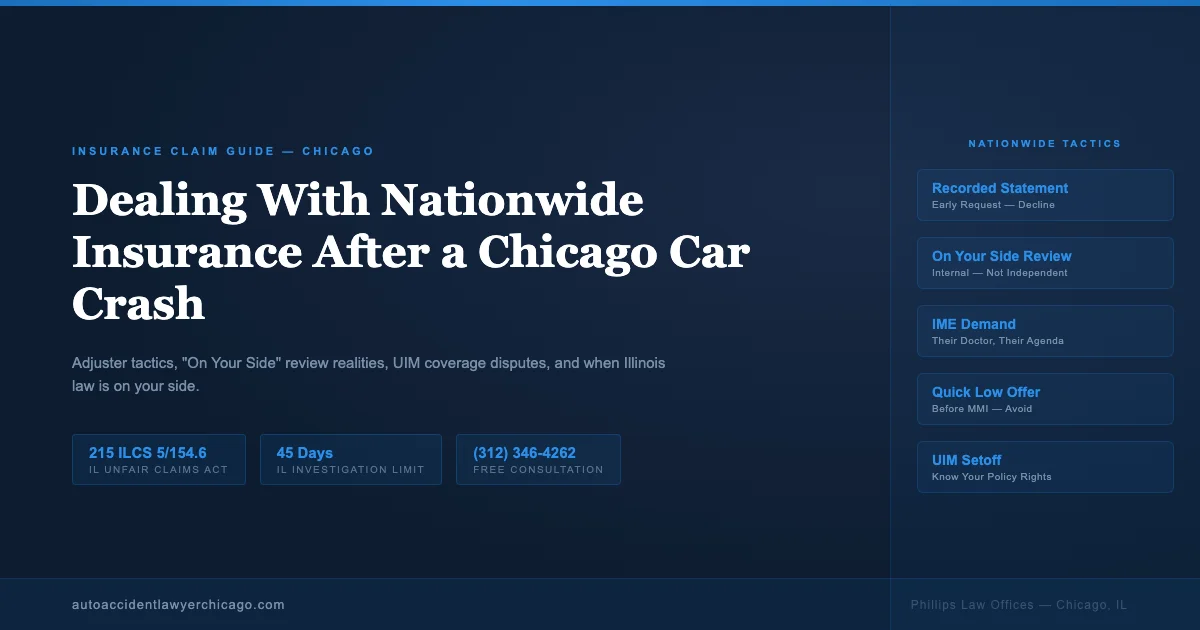
Short answer: If Nationwide Insurance is involved in your Chicago car accident claim, expect a structured claims process driven by their “On Your Side” branding that can mask adjuster tactics designed to limit what you recover. Illinois law gives you the right to a fair, prompt investigation and written explanations for any claim denial or reduction. Nationwide adjusters use recorded statements, independent medical reviews, and quick low offers to protect the company’s bottom line. Before you sign any release or give a statement, talk to a Chicago car accident attorney.
My Experience Handling Nationwide Insurance Claims in Illinois
At Phillips Law Offices, I have represented injured drivers and passengers across Chicago whose claims involved Nationwide Insurance. Nationwide is one of the largest auto insurers in the United States, and its Illinois claims operation follows a predictable playbook: early outreach, recorded statement requests, medical record sweeps, and settlement offers that arrive before you understand the full scope of your injuries. The “On Your Side” promise sounds reassuring, but it refers to Nationwide’s internal review process, not an independent advocate working in your interest. Understanding the gap between that marketing language and reality has helped my clients avoid costly mistakes.
Nationwide’s Claims Process in Illinois
Nationwide assigns adjusters quickly after a crash is reported. Their Illinois claims process generally follows this timeline:
| Stage | Typical Timeframe | What to Watch For |
|---|---|---|
| Claim Reported | Day 1 | Get your claim number in writing immediately |
| Adjuster Assigned | 1-2 business days | Early recorded statement request is common |
| Liability Investigation | 5-15 days | They may dispute fault or assign partial fault to you |
| Medical Records Review | 2-4 weeks post-treatment | Nationwide requests full prior medical history |
| Initial Settlement Offer | 30-60 days after treatment ends | First offers typically undervalue non-economic damages |
| On Your Side Review | At adjuster’s discretion | An internal review that is not independent, see FAQ below |
| Negotiation or Litigation | Weeks to months | Attorney representation significantly shifts leverage |
Under Illinois law, insurers must acknowledge your claim within 10 working days of receiving notice and must complete an investigation within 45 days unless there is good cause for delay. See 215 ILCS 5/154.6 for the specific unfair claim practice prohibitions that govern Nationwide’s conduct in this state.
Common Nationwide Adjuster Tactics
Nationwide adjusters are trained professionals whose performance is measured against claim costs, not claimant satisfaction. Here are the tactics that appear most frequently in Chicago-area Nationwide claims:
- Recorded statement requests within days of the crash. Adjusters call quickly and ask to record your description of the accident. Statements made before you know the extent of your injuries can be used to limit your recovery. You are not legally required to give a recorded statement to another driver’s insurer.
- Pre-existing condition arguments. Nationwide will request your full medical history seeking prior back, neck, shoulder, or joint issues. Even if you had a prior condition, Illinois law entitles you to compensation when a crash aggravates that condition.
- Fault apportionment. Illinois follows a modified comparative fault rule. Nationwide adjusters may argue you were 20 or 30 percent at fault, which reduces their payout proportionally. That assessment is not final and can be challenged.
- Quick low settlement offers. Offers that arrive in the first weeks after a crash rarely account for future medical costs, ongoing pain and suffering, or lost earning capacity. Once you sign a release, you cannot go back.
- Independent Medical Examinations. Nationwide may request an IME by a doctor of their choosing. These examinations are designed to support the insurer’s position, not provide you with a neutral medical opinion.
- Communication delays after pushback. If you reject an initial offer, expect slow responses, additional documentation requests, and general delays designed to wear you down.
Nationwide’s Coverage Products That Affect Your Claim
The coverage types on a Nationwide policy directly affect what compensation is available after a Chicago car crash. Understanding the relevant products helps you know what to demand and where Nationwide may try to limit its exposure:
| Coverage Type | What It Covers | Common Post-Crash Dispute |
|---|---|---|
| Bodily Injury Liability | Injuries to others when Nationwide’s insured is at fault | Disputes over fault percentage and injury causation |
| Property Damage Liability | Vehicle and property damage caused by their insured | Lowball repair estimates, total loss valuations |
| Collision Coverage | Your vehicle damage regardless of fault | Depreciation disputes, aftermarket parts substitution |
| Uninsured Motorist (UM) | Your injuries when the at-fault driver has no insurance | Nationwide disputes the uninsured status or limits payout |
| Underinsured Motorist (UIM) | Your injuries when at-fault driver’s limits are too low | Nationwide’s own UIM limits vs. stacked coverage disputes |
| Medical Payments (MedPay) | Medical bills regardless of fault, up to policy limits | Reimbursement demands after you settle with another insurer |
Nationwide’s “On Your Side” review sounds like an independent check on their adjuster’s work. It is not. It is an internal process Nationwide controls from start to finish. I have never seen an On Your Side review result in a higher offer without an attorney already in the picture pushing back on the original valuation. Treat it as a customer service tool, not an appeals process with any real teeth.
Underinsured Motorist Coverage With Nationwide
One of the most contentious areas in Nationwide claims involves underinsured motorist coverage. If the driver who hit you carries state minimum liability limits, Illinois requires only $25,000 per person, and your medical bills exceed that amount, you may be able to make a UIM claim against your own Nationwide policy.
Nationwide’s UIM process presents specific challenges in Illinois:
- Consent to settle requirement. Before settling with the at-fault driver’s insurer, you typically must get Nationwide’s consent in writing. Settling without it can waive your UIM claim entirely.
- Setoff provisions. Nationwide will reduce its UIM payment by the amount you received from the at-fault driver’s policy. Understanding exactly how setoff is calculated matters significantly for larger claims.
- Independent valuation disputes. Even on your own UIM claim, Nationwide will argue your damages are worth less than you claim. Your own insurer is adverse to you in a UIM case.
- Arbitration clauses. Many Nationwide policies require arbitration for UIM disputes rather than allowing you to file suit directly. Review your policy language before proceeding.
When to Hire an Attorney for a Nationwide Claim
Not every Nationwide claim requires an attorney. If your accident caused only minor property damage, no injuries, and Nationwide is acting in good faith, you may be able to handle the process yourself. But in the following situations, legal representation is strongly advisable:
- You suffered injuries requiring emergency care, hospitalization, surgery, or ongoing treatment
- Nationwide is disputing liability or arguing you share fault for the crash
- Nationwide has made a settlement offer that does not cover all your medical bills
- You are making a UIM claim against your own Nationwide policy
- Nationwide has denied your claim outright or stopped responding
- You missed work or lost income due to your injuries
- You were seriously injured and face long-term or permanent consequences
Research consistently shows that injury claimants represented by attorneys recover significantly more than unrepresented claimants, even after legal fees. An attorney who handles Chicago car accident claims knows how Nationwide values cases and what evidence moves the needle.
Frequently Asked Questions
Does Nationwide use independent adjusters in Illinois?
Nationwide uses a combination of staff adjusters and independent adjusting firms depending on the volume of claims in a given area and the complexity of the claim. Whether the adjuster is a Nationwide employee or an independent contractor, their job is the same: protect Nationwide’s financial exposure. An independent adjuster is not independent from Nationwide’s interests, they are hired and paid by Nationwide to handle claims on its behalf.
How long does Nationwide take to settle a claim in Illinois?
Simple property damage claims can settle within two to four weeks. Injury claims depend heavily on how long your treatment takes. The right approach is to wait until you have reached maximum medical improvement before accepting any settlement, which could be weeks or many months after the crash. Illinois law requires Nationwide to act promptly and in good faith, but there is no hard statutory deadline for settlement once liability is accepted. If Nationwide is stalling unreasonably, your attorney can apply pressure through bad faith claim procedures under 215 ILCS 5/155.
Can Nationwide deny my claim if I was partly at fault?
Illinois uses a modified comparative fault system. If you were less than 51 percent at fault for the crash, you can still recover damages, but your recovery is reduced by your percentage of fault. If Nationwide argues you were 51 percent or more responsible, they can deny the claim entirely. Their fault assessment is not final. An attorney can gather evidence, secure witness statements, obtain accident reconstruction analysis, and challenge Nationwide’s fault determination effectively.
What is Nationwide’s On Your Side Review?
Nationwide markets its “On Your Side” review as a check of your coverage to ensure you have the right protection. After an accident, an adjuster may offer you an On Your Side claim review as part of their process. This is an internal Nationwide evaluation, not an independent appeal. It does not involve a neutral third party and does not give you any right to a different outcome. If you disagree with how Nationwide is handling your claim, the meaningful remedies are a formal complaint to the Illinois Department of Insurance, bad faith litigation under Illinois law, or filing a lawsuit.
Should I give Nationwide a recorded statement?
If Nationwide is the other driver’s insurer, you are not required to give a recorded statement. Politely decline and let your attorney communicate with Nationwide on your behalf. If Nationwide is your own insurer and your policy requires cooperation, you may have a contractual obligation to provide a statement. Even then, you have the right to have an attorney present. Never give a recorded statement, to any insurer, before you fully understand your injuries, have gathered your own evidence, and ideally have spoken with a lawyer.
Authoritative Sources
- 215 ILCS 5/, Illinois Insurance Code, governing insurer conduct and policyholder rights in Illinois
- 215 ILCS 5/154.6, Illinois Unfair Claim Settlement Practices Act, prohibiting delay tactics, misrepresentation, and failure to promptly settle valid claims
- Illinois Department of Insurance, Consumer complaint portal for bad faith and improper claim handling disputes
Related Illinois Injury Guides
- Dealing With Travelers Insurance After a Chicago Car Crash
- Dealing With State Farm After a Chicago Car Crash
- Should You Give a Recorded Statement to an Insurance Adjuster in Illinois?
- Should You Accept the First Settlement Offer From an Insurance Company?
If Nationwide Insurance is involved in your Chicago car accident claim and you are not confident the offer on the table is fair, call Phillips Law Offices at (312) 346-4262 for a free consultation. We handle car accident cases throughout the Chicago area on a contingency fee basis, no fee unless we recover for you.
Related guides on dealing with the insurance company
- Start here: Dealing with Insurance Companies After a Chicago Car Accident: Tactics to Watch
- Dealing With Mercury Insurance After a Chicago Car Crash
- Dealing With Progressive After a Chicago Crash
- Dealing With State Farm After a Chicago Crash
- Dealing With Travelers Insurance After a Chicago Car Crash
- Dealing With USAA After a Chicago Car Crash
Talk to a Chicago car accident lawyer. Phillips Law Offices offers a free case review, and there is no fee unless we recover for you. Call (312) 346-4262 or request a free case review.
This article is general information about Illinois law, not legal advice, and reading it does not create an attorney-client relationship. Illinois law changes; confirm anything you intend to rely on with a licensed Illinois attorney.