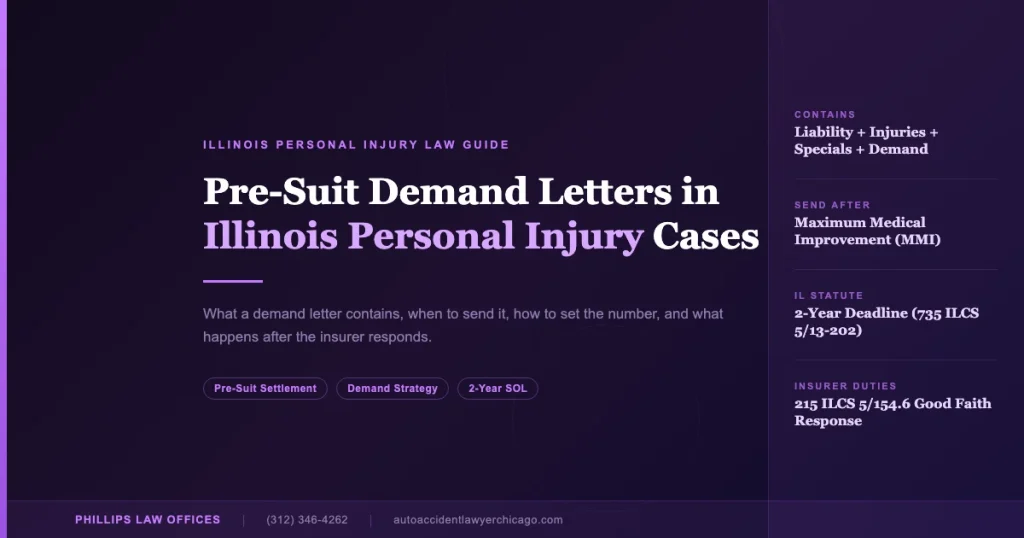
Short answer: A demand letter is a written settlement demand sent to the at-fault party’s insurance company that sets out liability, your injuries, medical bills, lost wages, and a specific dollar amount you are willing to accept to resolve the case. Most Illinois personal injury cases begin here — before any lawsuit is filed — and most settle during or shortly after this phase.
I describe the demand letter to clients as the opening move in a negotiation, not a final offer. It is the first time you put a number on paper and hand it to the insurer. Everything that follows — their response, the counter, the back-and-forth, and ultimately the settlement or the lawsuit — flows from how well that letter is built. A poorly drafted demand letter signals to the adjuster that the claimant does not understand their own case. A well-drafted one signals the opposite: that this claim is documented, legally grounded, and ready to go to court if necessary.
What a Demand Letter Contains
A demand letter in an Illinois personal injury case is a structured document, not a complaint letter. It serves a legal and strategic function, and every section is there for a reason. Missing a section or underbuilding it gives the insurer a reason to lowball or deny.
| Component | What It Does | Supporting Exhibits |
|---|---|---|
| Liability Section | Establishes that the defendant caused the crash and is legally responsible | Police report, witness statements, photos, traffic citations |
| Injury Summary | Describes each injury, how it was diagnosed, and its impact on daily function | ER records, specialist notes, MRI/CT reports |
| Medical Specials | Itemizes every medical bill related to the crash | Itemized billing statements from all providers |
| Lost Wages | Documents income lost due to the injury and recovery | Pay stubs, employer letter, tax records |
| Pain and Suffering | Articulates non-economic harm in human terms | Journal entries, photos, family/friend accounts |
| Future Damages | Projects ongoing care costs and future lost income if injuries are permanent | Physician opinion letters, vocational assessments |
| Total Demand | States the specific dollar amount demanded to settle the claim | Summary calculation referencing all above |
The demand letter is sent with a complete exhibits package. An adjuster reading a bare demand letter with no supporting documentation will offer less and delay more. The documentation is not a courtesy — it is the case.
When to Send the Demand Letter
The timing of a demand letter is one of the most important strategic decisions in any Illinois personal injury case. Send it too early and you leave money on the table. Send it too late and you create problems.
Too early means you have not reached maximum medical improvement (MMI) — the point at which your treating physicians believe your condition has stabilized. If you send a demand before MMI and settle the case, you release all future claims. If your injury turns out to require surgery or has long-term consequences, you have permanently closed your claim at a fraction of its actual value.
Too late means you are cutting into the time needed for negotiation, filing suit if necessary, and still resolving the case before Illinois’s two-year statute of limitations under 735 ILCS 5/13-202. Most experienced Illinois personal injury attorneys send demands at least six to nine months before the limitations deadline to preserve room for negotiations and litigation if needed.
The right time is after MMI, once all medical records and bills have been gathered, all lost wage documentation has been collected, and your attorney has a complete picture of your damages. This is typically several months after your last active treatment, but it varies by case.
Setting the Demand Amount — High vs. Realistic
The demand number is not a ceiling — it is the opening of a negotiation. Setting it well requires understanding what the case is actually worth and what number creates useful leverage without making the insurer dismiss the demand outright as unreasonable.
There are two schools of thought among Illinois plaintiffs’ attorneys. The first is to demand a figure that is significantly above expected settlement value — sometimes two to three times the realistic range — to create maximum room for negotiation. The second is to demand a figure that is high but defensible, grounded in comparable Illinois verdicts and settlements, to signal credibility and move the negotiation forward efficiently.
The right approach depends on the strength of liability, the severity of injuries, the policy limits available, and the specific adjuster and carrier involved. An experienced Illinois personal injury attorney will know which approach fits your case. What you should never do is set the demand at or near what you actually need to recover — that leaves you with nowhere to negotiate.
The demand number is not a ceiling — it opens a negotiation. Set it too low and it becomes a ceiling. You cannot walk the number back up once the insurer has a written figure in their file that is lower than what you need to recover. The demand must give you room to move down while still landing above your minimum acceptable outcome.
What Happens After You Send the Demand
Once the demand letter is sent, the insurance company has a period to respond. Illinois’s Unfair Claims Practices statute at 215 ILCS 5/154.6 requires insurers to acknowledge claims promptly, investigate in good faith, and not delay settlement offers unreasonably. The statute does not specify a hard deadline for responding to a pre-suit demand, but most carriers respond within 30 to 60 days in routine cases.
When the insurer responds, one of four things happens:
- They accept the demand. This is rare at full demand value but occasionally happens when liability is clear, injuries are severe, and the demand is reasonable relative to policy limits.
- They make a counter-offer. This is the most common response. The counter is typically well below the demand and begins the negotiation. Multiple rounds of offers and counter-offers often follow.
- They dispute liability or coverage. The insurer may push back on who was at fault, argue comparative negligence, or raise a coverage issue. These disputes often require additional investigation or — if not resolved — litigation.
- They ignore or delay. Some carriers stall. This is a bad-faith risk under 215 ILCS 5/154.6 and it frequently accelerates the timeline to filing suit.
Your attorney manages this entire phase — maintaining your settlement timeline, evaluating counter-offers, and making the call on when negotiation has run its course and it is time to file. For more on what the overall timeline looks like, see our guide on the Chicago car accident settlement timeline.
Demand Letters vs. Filing Suit
The demand letter is not the same as filing a lawsuit. It is a pre-suit communication. Filing suit means your attorney prepares and files a complaint in the appropriate Illinois circuit court, which triggers the formal litigation process — discovery, depositions, motions, and ultimately trial if no settlement is reached.
Most Illinois personal injury cases settle without ever filing suit. The demand letter and negotiation phase resolves the majority of claims because litigation is expensive and uncertain for both sides. However, the credible threat of litigation is what gives the demand letter its power. An insurer that knows your attorney will file suit if necessary takes the demand more seriously than one dealing with an unrepresented claimant who has never mentioned court.
When negotiations fail or the insurer’s offer is unreasonably low, filing suit is not a failure — it is the next step in the process. Many of the best Illinois personal injury settlements are reached after suit is filed, often during the discovery period or shortly before trial. To understand how the decision to file affects your claim, see our guide on when to hire a lawyer after a Chicago car accident.
Frequently Asked Questions
Can I write my own demand letter?
You can, but it is rarely in your interest. A self-drafted demand letter signals to the insurer that you are unrepresented, which is valuable information for them. Unrepresented claimants typically recover significantly less than represented ones — not because the law is different, but because adjusters know exactly how to exploit inexperience. A letter that does not include the right legal framework, properly calculated damages, and a credible threat of litigation gives the insurer every reason to offer minimum value. If cost is the concern, remember that Illinois personal injury attorneys work on contingency — no recovery, no fee.
How long does the insurance company have to respond?
Illinois’s Unfair Claims Practices Act at 215 ILCS 5/154.6 requires insurers to acknowledge claims promptly and investigate without unreasonable delay, but it does not set a specific hard deadline for responding to a demand letter. In practice, most carriers respond within 30 to 60 days. If an insurer is not responding or is stalling beyond a reasonable period, that delay itself becomes a factor in your case — repeated, documented delays can support a bad-faith argument under 215 ILCS 5/155, which provides for attorney fees and penalties against the insurer.
What if the insurer offers less than my demand?
This is the normal outcome of sending a demand. A counter-offer below your demand is the beginning of negotiations, not the end. Your attorney will evaluate the counter, respond with a revised demand or counter, and continue the process until either an acceptable number is reached or it becomes clear that settlement is not achievable without litigation. Never accept the first offer without your attorney’s assessment of whether it represents fair compensation for your specific injuries and circumstances. For help evaluating whether an offer is reasonable, see our guide on how much your Chicago car accident case may be worth.
Does sending a demand letter start the statute of limitations clock?
No. The statute of limitations clock starts on the date of the accident, not when the demand letter is sent. Under 735 ILCS 5/13-202, you have two years from the date of the crash to file a lawsuit in Illinois. The demand letter and any negotiations that follow do not toll or extend that deadline. If negotiations drag on and the two-year mark approaches without a settlement, your attorney must file suit to preserve your rights, regardless of where discussions stand. This is why timing the demand well before the limitations deadline matters.
What if the insurer ignores the demand letter?
Ignoring a demand letter is a recognized bad-faith practice under Illinois law. Under 215 ILCS 5/154.6, insurers are prohibited from failing to acknowledge claims or failing to respond in a reasonable time. If an insurer does not respond to a demand letter, your attorney’s next step is typically to file suit. The lawsuit creates a legal obligation for the insurer to respond. In cases of egregious delay or bad-faith denial, 215 ILCS 5/155 allows courts to award attorney fees and penalties to the claimant on top of the underlying damages. Check our guide on dealing with insurance adjusters in Illinois for more on how insurers use delay tactics.
Authoritative Sources
- 735 ILCS 5/13-202 — Two-Year Statute of Limitations for Personal Injury
- 215 ILCS 5/154.6 — Unfair Claims Practices (Insurer Response Obligations)
- 215 ILCS 5/155 — Attorney Fees and Penalties for Vexatious Delay
Related Illinois Injury Guides
- Recorded Statements and Insurance Adjusters in Illinois
- How Much Is My Chicago Car Accident Case Worth?
- When to Hire a Lawyer After a Chicago Car Accident
- Should You Accept the First Settlement Offer in Illinois?
If you have a personal injury claim in Illinois and are ready to begin the settlement process, the attorneys at Phillips Law Offices can evaluate your case, build your demand package, and handle negotiations from start to finish. Call us at (312) 346-4262 for a free consultation. There is no fee unless you recover.
Related guides on Chicago crash types
- Start here: Chicago Car Accident FAQ: Your Questions Answered
- E-Scooter and Bicycle Crash Claims in Chicago
- Head-On and Wrong-Way Driver Crashes in Chicago
- Hit and Run Accidents in Illinois: Criminal Penalties & Victim Rights
Questions about your own crash? Request a free case review or call (312) 346-4262.
This article is general information about Illinois law, not legal advice, and reading it does not create an attorney-client relationship. Illinois law changes; confirm anything you intend to rely on with a licensed Illinois attorney.