Illinois Traffic Signal Laws
Under 625 ILCS 5/11-306, Illinois law defines what each traffic signal means and the legal duties of drivers:
Red Light Requirements
Drivers facing a steady red signal must stop before entering the crosswalk or intersection and remain stopped until the light turns green. The only exception is a permitted right turn on red after coming to a complete stop and yielding to pedestrians and cross traffic.
Yellow Light Requirements
A yellow signal warns that the red signal is about to appear. Drivers should stop if they can do so safely. Entering an intersection on yellow is legal, but accelerating to “beat the light” often leads to accidents when the light turns red mid-intersection.
Green Light Requirements
A green light permits vehicles to proceed, but drivers must still yield to vehicles and pedestrians lawfully in the intersection. A green light doesn’t guarantee safe passage—drivers must exercise due care.
Stop Sign Violations
Under 625 ILCS 5/11-904, drivers approaching a stop sign must:
- Come to a complete stop before entering the crosswalk or intersection
- Yield the right-of-way to vehicles and pedestrians in the intersection
- Yield to vehicles approaching on the cross street so closely as to constitute an immediate hazard
“Rolling stops” or “California stops” violate Illinois law. If a driver fails to stop completely and causes an accident, they are presumptively at fault.
Right-of-Way Rules at Intersections
Illinois right-of-way rules determine who proceeds first at intersections:
Four-Way Stops
At intersections with stop signs for all directions:
- The first vehicle to stop has the right-of-way
- If two vehicles stop simultaneously, the vehicle on the right goes first
- Vehicles going straight generally have right-of-way over turning vehicles
Uncontrolled Intersections
At intersections without signals or signs, drivers must yield to vehicles approaching from the right that are close enough to pose an immediate hazard.
Left Turns
Under 625 ILCS 5/11-902, drivers turning left must yield to oncoming traffic. This applies whether you’re at a traffic light (even with a green signal) or an uncontrolled intersection. Left-turn accidents are among the most dangerous intersection crashes.
Common Types of Intersection Accidents
T-Bone (Broadside) Collisions
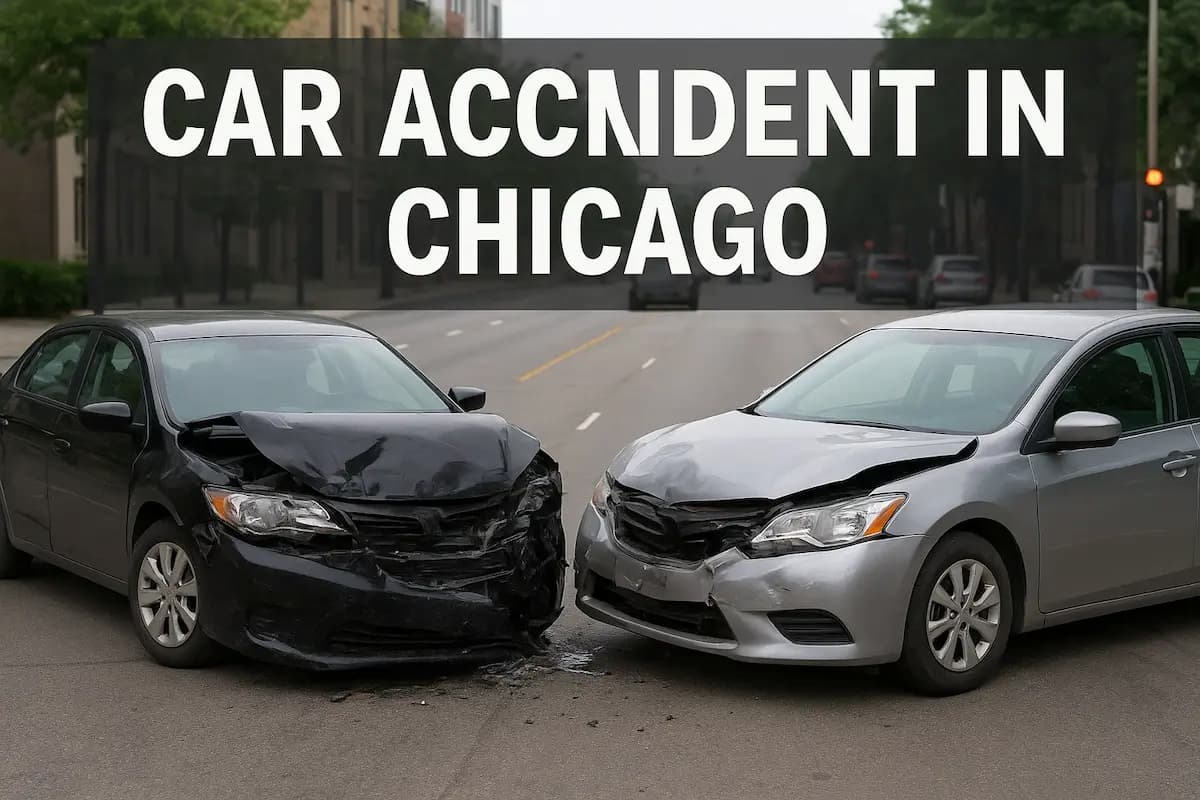
The most dangerous intersection crashes occur when one vehicle strikes the side of another. These “T-bone” accidents often result in severe injuries because vehicle sides offer less protection than front or rear ends. Common causes include:
- Running red lights or stop signs
- Failing to yield on left turns
- Misjudging gaps in cross traffic
- Distracted driving through intersections
Left-Turn Accidents
Left-turning vehicles are frequently involved in intersection crashes. The turning driver usually bears liability for failing to yield, but exceptions exist when:
- The oncoming vehicle was speeding excessively
- The oncoming driver ran a red light
- The turning driver had a protected green arrow
Right Turn on Red Accidents
Drivers making right turns on red must yield to cross traffic and pedestrians. Accidents occur when turning drivers:
- Fail to come to a complete stop
- Look left for traffic while pedestrians approach from the right
- Misjudge the speed of approaching vehicles
Rear-End Collisions at Intersections
When traffic stops for signals, following vehicles sometimes fail to stop in time, rear-ending cars waiting at the light.
Proving Fault in Intersection Accidents
Unlike rear-end collisions, intersection accidents don’t carry automatic presumptions of fault. Evidence is critical:
Red Light Camera Footage
Chicago operates red light cameras at numerous intersections. This footage can definitively prove who had the red light. Your attorney can subpoena this evidence, but it may be deleted after a set period—act quickly.
Traffic Camera Video
Beyond red light enforcement cameras, many intersections have traffic monitoring cameras operated by the Chicago Department of Transportation. This footage may capture accidents.
Witness Testimony
Independent witnesses—other drivers, pedestrians, business employees—provide crucial testimony about light colors and driver behavior. Collect contact information at the scene.
Police Reports
Officers investigate intersection accidents and often issue citations for traffic violations. While not conclusive proof of fault, citations for running red lights or failing to yield strongly support your claim.
Vehicle Damage Patterns
The location and severity of damage can indicate vehicle positions and directions of travel. Accident reconstruction experts can analyze damage to determine who was in the intersection first.
Event Data Recorders (Black Boxes)
Modern vehicles record speed, braking, and other data before crashes. This information can prove whether a driver braked or accelerated approaching an intersection.
Comparative Fault in Intersection Cases
Intersection accidents frequently involve shared fault arguments. Under 735 ILCS 5/2-1116, your compensation is reduced by your percentage of fault.
Example: Driver A runs a red light. Driver B, who had the green, was speeding. A jury might find Driver A 80% at fault and Driver B 20% at fault. Driver B’s $100,000 damages would be reduced to $80,000.
If you’re found 50% or more at fault, you recover nothing under Illinois law.
Chicago’s Most Dangerous Intersections
Certain Chicago intersections see disproportionate numbers of accidents:
- Cicero Avenue & I-55: High-speed traffic merging with local streets
- Western Avenue & various cross streets: One of Chicago’s busiest corridors
- Ashland Avenue intersections: Heavy traffic, complex turning patterns
- Lake Shore Drive & major east-west streets: High speeds, limited visibility
- Six-way intersections throughout the city: Confusing traffic patterns
Injuries from Intersection Accidents
The severity of intersection accident injuries often exceeds other crash types due to impact angles:
- Traumatic brain injuries: Side impacts cause violent head movement
- Spinal cord injuries: T-bone crashes can cause paralysis
- Broken bones: Particularly ribs, pelvis, and limbs on the impact side
- Internal organ damage: Blunt force trauma to abdomen and chest
- Fatal injuries: Intersection crashes have high fatality rates
What to Do After an Intersection Accident
- Stay at the scene and call 911
- Document the traffic signals—note what color the light was when you entered
- Photograph everything: Vehicle positions, damage, traffic signals, signs, road markings
- Get witness information—especially those who saw the light colors
- Look for cameras—note any red light, traffic, or business security cameras nearby
- Seek medical attention—even if injuries seem minor
- Contact an attorney—intersection cases require prompt evidence preservation
Contact Phillips Law Offices
Intersection accident cases often come down to whose account of events the evidence supports. At Phillips Law Offices, we act quickly to preserve critical evidence—camera footage, witness statements, vehicle data—before it disappears.
Our experienced Chicago car accident attorneys have handled countless intersection collision cases. We know how to prove fault, counter comparative negligence arguments, and fight for the compensation you deserve.
If you’ve been injured in an intersection accident in Chicago, call Phillips Law Offices at (312) 598-0917 for a free consultation. Time is critical—evidence doesn’t last forever.
]]>Authoritative Sources
Related Chicago Accident Guides
- What Evidence Do You Need for an Illinois Car Accident Claim?
- Dealing with Insurance Companies After a Chicago Car Accident: Tactics to Watch
- Rear-End Collision Claims in Illinois: Proving Fault & Damages
FAQs
Who is usually at fault in an intersection crash?
Fault depends on right-of-way, signals, lane position, and independent evidence like camera footage or witnesses.
Does a red-light citation guarantee liability?
Not always, but it can strongly influence insurer and legal fault analysis.
What if both drivers share blame at an intersection?
Illinois comparative fault rules may reduce recovery based on each party’s percentage of fault.